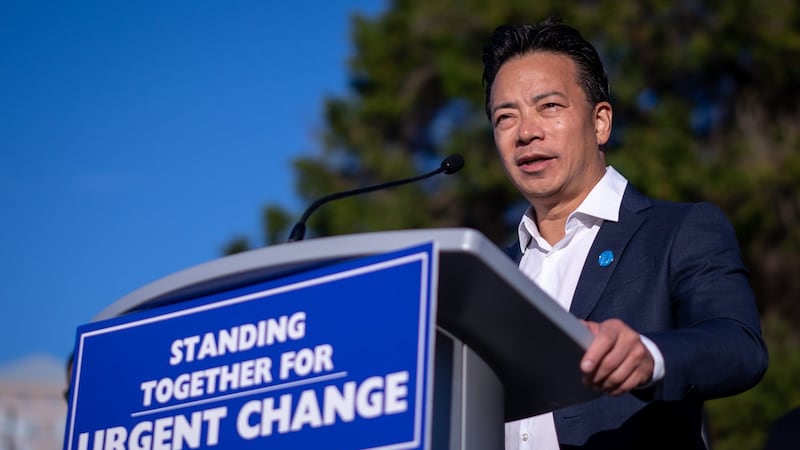
For the second time in a month, Vancouver Mayor Ken Sim has issued a public letter slamming the B.C. government for failing to deliver new involuntary care beds within his city—but is that actually a problem? Sim’s latest letter, which he published on social media Thursday afternoon, demands a minimum of 100 local involuntary care beds to “address the mental health and addiction crisis that continues to drive street disorder in our city.” Addressing Premier David Eby, Sim writes: “Your government has repeatedly announced and placed involuntary care beds in Maple Ridge, Prince George, and Surrey, none of which serve Vancouver.” “This lack of action is increasingly difficult to explain to Vancouver residents, business owners, families, front-line workers and those who come to visit our city,” he adds. 473 beds in local health region Asked about the mayor’s assertion, Vancouver Coastal Health confirmed that city borders are not a roadblock to receiving care—whether voluntary or involuntary. In a statement, the health authority told CTV News all mental health and substance use beds located across its operations are “available for involuntary- and voluntary-care patients living in Vancouver.” That includes the beds at Spiritwood Homes in Maple Ridge, a secure care facility open to involuntary care patients from across the Lower Mainland. Throughout the Vancouver Coastal Health region, which includes dozens of municipalities from Richmond to Pemberton, there are currently 473 beds that can be used for involuntary care, according to officials. CTV News requested an interview with Sim on Friday, but has not received a response. Lack of beds causing ‘street disorder’? In his letter to Eby, the mayor suggests a lack of involuntary care beds within Vancouver is the reason the city continues to experience “street disorder.” “Street disorder in Vancouver can be properly addressed with compassion if your government takes meaningful steps to get people who are a danger to themselves and others into treatment and care,” he writes. Harm reduction and recovery advocate Guy Felicella found the mayor’s demand misguided, noting the vast majority of people struggling with drug addiction and mental health issues would not meet the strict criteria needed to commit someone to involuntary care. “You cannot just pick people up off the street because you don’t want them to be there, or the public doesn’t like looking at them, and then force them into treatment,” Felicella said. The B.C. government’s involuntary care program was always billed as limited in scope, applying only to those suffering a combination of severe brain injuries, drug addiction and mental health issues. Contacted by CTV News on Friday, Deputy Premier Niki Sharma said the province is “committed to expanding the capacity for involuntary care” in every region of the province, but that is only one piece of the government’s approach. “We launched B.C.’s Road to Recovery model of addictions care in Vancouver, which has significantly cut wait times for withdrawal management services,” Sharma said in a statement. “We are making progress on the services and supports we need to build a safe, healthy community where everyone gets the help they need.” It’s unclear how many people living in Vancouver or arrested in Vancouver have been committed to involuntary care since the program was announced two years ago. Vancouver Coastal Health said it could not provide the data Friday by deadline. ‘It’s a slogan’ Felicella, who has worked in the private treatment industry, does not support involuntary care in general, believing that forcing people into recovery doesn’t work. “It fails miserably,” he said. “I don’t believe Vancouver needs 100 involuntary care beds, I believe we need voluntary care beds that people can access.” With an election coming up in a few months, Felicella said he was struck by déjà vu reading the mayor’s letter—after Sim campaigned four years ago on a promise to hire 100 police officers and 100 nurses. Only the policing promise was fully realized. “What’s the 100 for?” Felicella asked. “It’s a slogan, and you know, simple slogans don’t solve complex problems.” Political opponents pounce Sim’s opponents in the mayoral race had thoughts about his letter as well. Green candidate Pete Fry pointed out Sim and his ABC party implemented a freeze on supportive housing facilities within Vancouver last year—something he found incongruent with the mayor’s insistence on getting involuntary care facilities now. “I’m not even sure how he reconciles that level of hypocrisy,” Fry told CTV News. Colleen Hardwick, leader of TEAM for a Livable Vancouver, suggested the mayor is trying to pass the buck for the problems his council has failed to solve. “The timing says it all,” Hardwick said. “Sim and ABC are hustling out there to give the impression that they have been doing their job, but I think if you ask most people, ‘Are things better than they were four years ago?’ The answer will be no.” With files from CTV News Vancouver’s Martin MacMahon