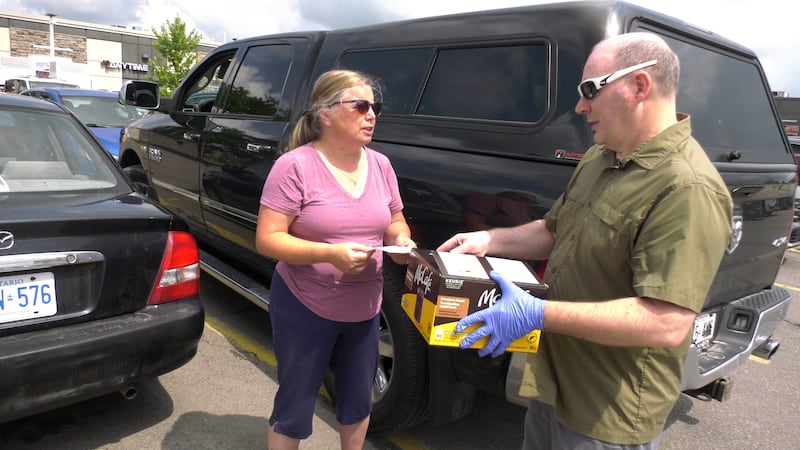
Turtles are arriving at the Ontario Turtle Conservation Centre at a record pace this season, with more than 1,950 already admitted from across the province. “The vast majority of those are turtles that have been hit by cars on the road,” said Glenn Cunnington, executive director of the Ontario Turtle Conservation Centre. “Some of them have had interactions with pets or other wildlife and that but most of the injuries we see are shell fractures from being hit by cars.” The Peterborough facility operates Ontario’s only wildlife hospital dedicated entirely to turtles. Last year, the organization treated around 2,200 turtles. This year, it is on pace to surpass that number well before the season ends. “All eight of the species that we have in Ontario are listed as risk federally, it means that their populations are at risk of going extinct or becoming endangered,” said Cunnington. Cunnington says there may be several reasons for the increase, including more roads, more turtles or simply more people knowing who to call when they find one. He says turtles play an important role in maintaining healthy wetlands by recycling nutrients and supporting ecosystems that help improve water quality. “Turtles help to filter out a lot of extra things that could be detrimental to other wildlife and humans and things like that. Generally, wetlands are a very important part of the natural environment that help to filter all the water and things like that so having healthy wetlands help contribute to healthy and good water quality as well,” he said. Helping injured turtles reach the conservation centre is a province-wide network of more than 1,600 Turtle Taxi volunteers and more than 50 first responders including veterinarians and animal care professionals. “If a turtle gets hit and someone calls our hotline, the first thing we do is we try to get them connected with one of our first responders to provide that immediate care,” Cunnington said. “Once we get a turtle and we’ve gotten it to our primary care folks, the turtle taxi volunteers jump into action, and they relay the turtles across the province.” In 2024, that network of volunteers travelled more than 270,000 kilometres transporting turtles to and from the conservation centre. Volunteers like Connie Schulz and Gavin Cramer who were among those helping relay a snapping turtle that was hit by a vehicle near Monkland to Peterborough on Thursday. “Turtles in general are decreasing in the province just like all our native pollinators and everything else so if I can help out a little bit, at least we can keep the species going,” said Schulz. Although the turtle did not survive overnight, its journey was not over. The turtle was transported from Monkland to Kemptville before being taken to a veterinary clinic in Perth. From there, another volunteer completed the final leg to the Ontario Turtle Conservation Centre in Peterborough. “If it’s a female carrying eggs that could be a dozen turtle lives at stake so we can recover a lot of the eggs even if the turtle itself doesn’t make it,” said Cramer. Turtles are commonly found along roads during the warmer months as they travel between wetlands and search for places to lay their eggs, putting them at greater risk of being hit by vehicles. “If you see a turtle on the road and it hasn’t been hit, we always want to make sure that people are making sure that they’re safe. It’s important to pull over to the side of the road, put your four ways on,” said Cunnington. “After that, if you are going to move the turtle off the road, which is always a good idea, move it in the direction it is already going. If you move them somewhere else, they’re going to try to get back to where they were.” He says municipalities can also help minimize the impacts on turtles by designing crossings and culverts that guide turtles beneath roads, reducing the risk of them being hit by vehicles. If a turtle has been hit, Cunnington recommends placing it in a dry bin or cardboard box, avoid adding water and calling the Turtle Hotline at 705-741-5000 (option 4). While the turtle Schulz and Cramer helped relay couldn’t be saved, its journey may still help the next generation. If eggs are recovered, they could one day hatch and be released back into the wild.