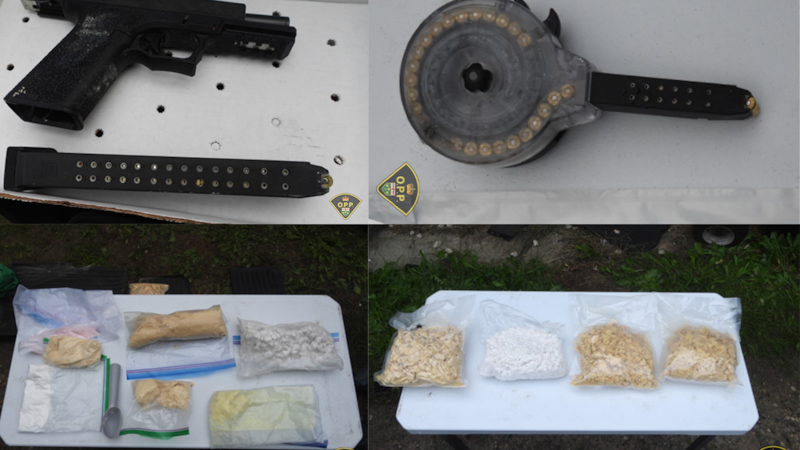
A Superior Court justice has rejected arguments that a guilty verdict against a man charged with drugs and weapons offences in Sudbury should be thrown out because of a flawed search warrant. The case centres on Bidah Preet Singh Bhatia, a Kitchener, Ont., man whom police suspected was involved in the drug trade in Sudbury. Police received a tip from an informant in summer 2021 that someone known as ‘Bandz’ was selling fentanyl and cocaine in Greater Sudbury. Police later came to believe that Bandz was actually Bhatia, and that his accomplice was Shafi Ahmed. Investigators applied for warrants covering five mobile phones and two vehicles. ‘Anticipatory’ warrant Investigators asked for an “anticipatory” general warrant “to enter and preserve any residence an/or vehicle associated with Bidh Bhatia and/or Shafi Ahmed when they attend the City of Greater Sudbury.” Police argued the general warrant was necessary because each time the two men came to the city, they arrived using different vehicles and would stay at different Airbnb rentals or hotels. “The City of Greater Sudbury has over 200 rental properties listed on Airbnb and over 20 hotels, making it very difficult to predict where Bhatia and Ahmed will establish themselves,” according to the decision by Patrick J. Boucher, Chief Justice of the Superior Court of Justice of Ontario. Under the terms of the general warrant, police would be allowed to search vehicles and properties used by the two men when they were in Sudbury, should police reasonably determine they were in the process of selling drugs. The warrant allowed police to secure the scene and preserve evidence until a Controlled Drugs and Substances Act warrant was obtained. The defence argued the general warrant was invalid because it gave police too much leeway in determining “whether reasonable and probable grounds existed that offences were occurring at the location identified in the general warrant.” Previous court rulings have said that it shouldn’t be left up to police to decide whether reasonable grounds existed for the general warrant to be executed. Clerks sometimes tip off suspects However, the justice ruled that there were clear grounds in this case for when the warrant could be executed: when both men arrived in Sudbury and rented a property or hotel room. “These conditions are informed by the ongoing investigation and prior judicial authorizations,” Boucher’s decision said. The defence also argued that there was time for Sudbury police to get a traditional warrant after officers determined Ahmed and Bhatia had checked into a hotel on Feb. 26, 2022. After midnight on Feb. 27, police spotted Ahmed entering the hotel carrying a green reusable shopping bag. A Sudbury police officer testified he didn’t want to check the room number “because in his experience, individuals involved in the drug trade are often tipped off by night clerks when police make inquiries.” “He resolved to wait until the morning when he could contact a trusted hotel employee to obtain the room number,” the decision said. “He contacted this person around 10 a.m. on Feb. 27, 2022, and received the room number at noon, and police executed the general warrant at approximately 12:35 p.m.” After the Feb. 27 arrest, police seized 18.83 grams of fentanyl, 199.31 grams of cocaine, $5,500 in cash, two cellphones, a Rolex Sky-Dweller watch (valued at $40,000) and two gold bracelets worth $5,000. Handguns, drugs, cash Further searches Feb. 28 yielded two loaded Glock handguns, 64.78 grams of fentanyl, 129.24 grams of cocaine, 53.64 grams of crystal meth, an iPhone and drug packaging material. The defence argued that police had 12 hours from when they spotted the two men until they executed the general warrant – plenty of time to apply for a Controlled Drugs and Substances Act warrant specific to the hotel. However, the appeals judge ruled that the point of the general warrant was to secure the scene until they were able to access a CDSA warrant. In this case, after police got the room number from the trusted hotel employee, the general warrant was executed within 30 minutes, “which is precisely what the general warrant was meant to achieve and what a CDSA warrant could not. In these circumstances, the necessity requirement was met.” “I find no error with how police conducted themselves,” Boucher wrote in his decision. “The accused was stopped in the threshold of the door to the room, as he was trying to exit. He was pushed back into the bathroom, which was next to the door, grounded and arrested. This was a dynamic situation in a hotel full of civilians, and the police response was appropriate.” “Findings of guilt shall accordingly be entered with respect to the charges upon which the accused was arraigned,” the judge added. Read the full decision here.