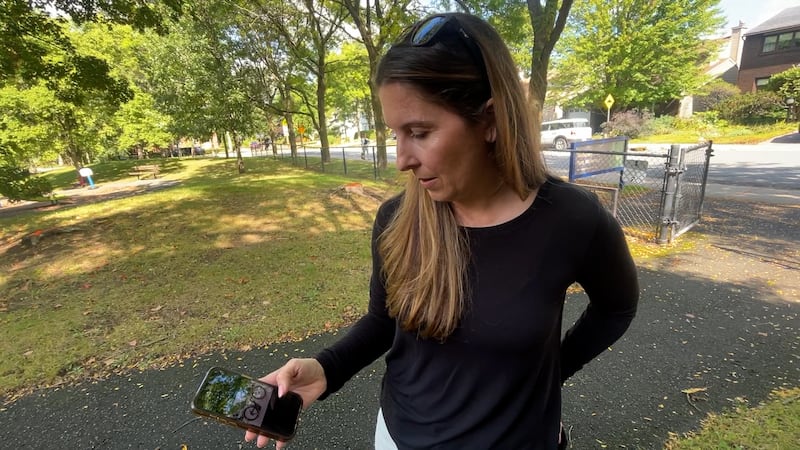
Dr. Paola Marignani is a scientist in the Faculty of Medicine at Dalhousie University and for the past several years she has dedicated her research to a specific form of breast cancer. “Years ago we discovered that in one of the more aggressive forms of breast cancer, HER2- positive breast cancer, there was a specific type of protein that was not doing its job and this protein is called LKB1 and we were trying to understand why in HER2-positive breast cancer this protein was missing,” says Marignani. They mimicked the cancer in mice and removed the protein. They saw the tumours grow and become metabolically active. “We came up with different drug combinations to try and stop the tumor from growing and to our surprise it actually worked and the tumours stopped,” says Marignani. In 2022, her team received $250,000 from the Breast Cancer Society of Canada to start precision oncology, which is basically testing on human tumours. “What we have done this time is we have taken the tumour and separated all the individual cells of a tumour. Each individual tumor cell is actually deep dive, next generation sequencing for each cell. So rather than get one piece of data from a tumour, we now get 8,000 pieces of data from that same tumour,” says Marignani. Over three years, they were able to make quite a bit of headway. With each test, Marignani is one step closer to answering the question that started her research: Why does HER2-positive breast cancer come back despite the fact the treatments are quite good? “With the funding, we were able to discover genes that are involved in early detection of HER2-positive breast cancer and possibly how the cancer may come back or be resistant to treatment and so the next steps would be to test these new animal models based on the ones we have already done and test new compounds, molecules, chemicals to see if we can shut down the tumours from growing,” says Marignani. Marignani says she is fortunate everything worked out during the three years and she attributes the success to her team’s hard work. One tool that she says has been key in advancing the research has been artificial intelligence. “Rather than looking at half a million tumour cells we can look at two, three, four or five-million tumour cells at the same time because of machine learning. We have all these algorithms that are basically agents going out looking for markers that 10 years ago we couldn’t do, or even five or six years ago we couldn’t do,” says Marignani. Digital research Giles Crouch says artificial intelligence is helping speed up research. “Machines are really good at pattern recognition. So are we humans, but machines do it much faster at this scale of data. That’s what it’s doing, looking for patterns. And cancers all have patterns in our bodies no matter where we get the cancer, so that’s what it’s doing, looking for the patterns. And looking for the anomalies because we have lots of scales for healthy bodies and un-healthy bodies so that’s what it’s comparing them,” says Crouch. Crouch says it’s a benefit that humans and machines are working together and that’s what the near future looks like. “It’s not about replacing jobs, it’s about how we learn to work with these tools just like we did with writing and the printing press. The concerns of course are how are we using this data so that there is privacy protection that comes into place and it’s also the accuracy. And I think that is why we still see humans in the loop on these tools because there is discernment of the eyes and we can’t leave it all up to the machines yet,” says Crouch. At the lab, Marignani says it’s too difficult to do this research using the traditional methods, so she got an AI certificate from MIT. “What we now can do with machine learning is not only can we integrate deeply our own data, but we can also mine data bases from around the world. There are tumour bank databases all around the world that are open to scientists to access. That means we can look at all the data and we can integrate that data into our own data set,” says Marginani. The team is looking for more funding and time to further their work. “Ultimately once we have finished our preclinical trials in the new re-engineered mice, if they are positive the outcome we can then propose to do clinical trials in humans. Ultimately, we want a new diagnostic tool for early detection of HER2- Positive breast cancer and new treatments to target these protein pathways that are causing the HER2- positive breast cancer,” says Marginani. For more Nova Scotia news, visit our dedicated provincial page