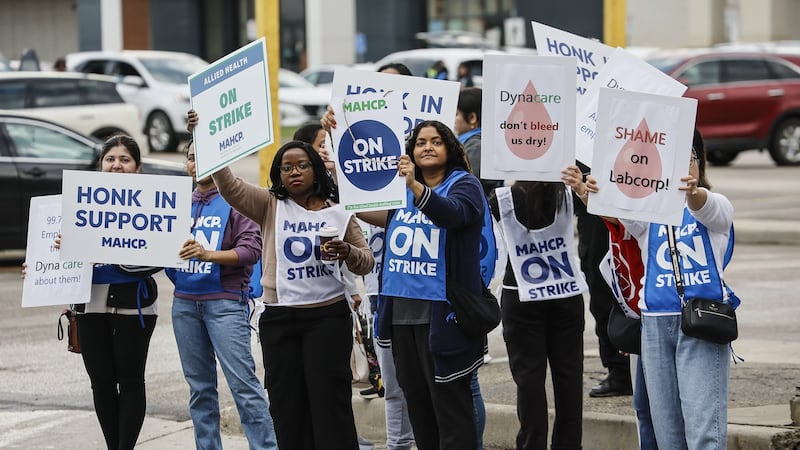
WINNIPEG — Several hundred workers who carry out medical diagnostic testing in Manitoba hit the picket lines in a provincewide strike Tuesday morning, but by the end of the day were ordered back to work. Their union says the Manitoba Labour Board ordered the 350 workers back as of Wednesday to 22 Dynacare labs across the province. The decision came after lawyers for Premier Wab Kinew’s government argued to the board earlier Tuesday that the workers were too valuable to the functioning of the health system to be allowed to strike. Jason Linklater, the president of the Manitoba Association of Health Care Professionals, say they will abide by the decision while it explores options. But he said Kinew’s NDP will pay a price. “A significant outcome of all of this is the profound erosion of trust in this NDP government,” Linklater said in a statement. “If government is willing to take away the rights of these laboratory professionals to save themselves money, then they will do the same to other Manitoba workers.” The government said in a statement that it went to the labour board because its fundamental responsibility is to make sure essential health-care services are provided. It encouraged Dynacare to return to the bargaining table. Dynacare is a private operator under contract to the province. It is the primary collector of routine lab work, including blood samples, urinalysis and prenatal testing. The company said it was grateful the labour board acted quickly. It said it will be notifying all employees they are required to return to work at their next scheduled shift. “We recognize this has been a stressful period for our team, and they will have our full support as they return to providing health-care services to Manitobans,” it said in a statement. Dynacare said it remains committed to reaching a fair deal with the union, which hit the picket lines at 8 a.m. in a dispute centred on wages. “Dynacare! No care!” they chanted. The union says its workers earn as much as 20 to 50 per cent less than counterparts in the public system. Just hours after the workers walked out, government lawyers were before the labour board, asking for an interim order to get the technologists and technicians back on the job. Lawyer Keith LaBossiere, representing the province, told the board these are “exceptional circumstances,” as Dynacare is deeply integrated into the provincial health system and that any shutdown of services would result in immediate and accumulating effects on the health of Manitobans. He noted Dynacare provides about half of blood sampling services and 40 per cent of lab testing. In pushing for an interim back-to-work order, LaBossiere said the labour board didn’t have to fully determine the extent Dynacare workers are essential but that the halt of services was enough of a health threat that they should be forced back to work for now. The union pushed back on these arguments. “The sky is not falling,” lawyer Jacob Giesbrecht told the hearing. He said the talk of a catastrophe is hyperbole and that the 82 Shared Health labs – which are part of the public system and carry out the lab testing for hospitals -- will make sure all critical testing gets done. He said the government had months to challenge the joint company-union decision that Dynacare services aren’t essential. He said it’s not the labour board’s job to save the government now. The staffers have been without a collective agreement since March 31. That same month, the union and Dynacare agreed an essential services agreement wasn’t necessary. Linklater has criticized the province for interfering with contract negotiations. “We should be bargaining and Dynacare is not bargaining with us,” he said. “There’s nothing stopping that from happening, and they are simply relying on government interference to prevent a deal from getting implemented.” Dynacare has said it attempted to reach an essential services agreement earlier this year, but the union rejected every suggestion. This report by The Canadian Press was first published Sept. 8, 2026. Brittany Hobson and Ian Bickis, The Canadian Press