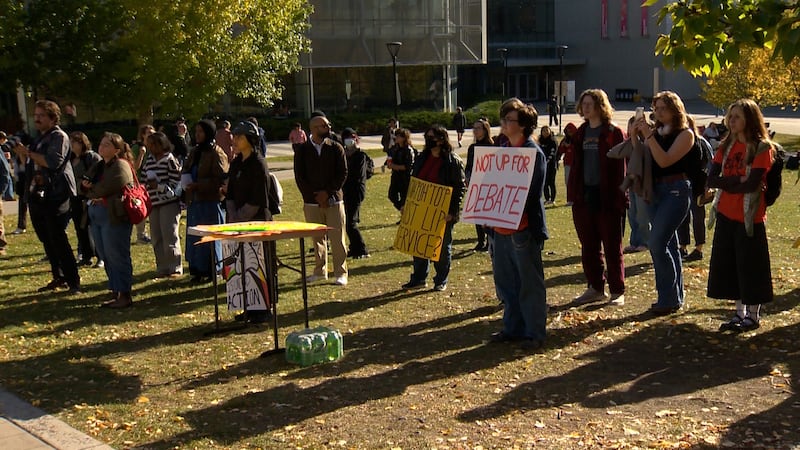
After years of controversy, public consultation and time in storage, statues depicting Canada’s former prime ministers are once again on display in Wilmot Township. The reinstallation of the Prime Ministers Path was marked Saturday at Castle Kilbride in Baden by the unveiling of four new statues that had been commissioned years ago but never previously put on display. The new statues, known as “The Unfortunate Four,” depict four prime ministers who served during what was described as a “turbulent five-year period” in the late 19th century: Sir John Abbott, Sir John Thompson, Sir Mackenzie Bowell and Sir Charles Tupper. “This is why I wanted to put them in a group,” sculptor Nathan Scott said. “They all knew each other. They’re all in the same cabinet. And so I have created a conversation with these guys.” The Prime Ministers Path was meant to honour Canada’s political history. The goal was to create 22 bronze statues depicting former Prime Ministers to celebrate the 150th anniversary of confederation. A group of private citizens started raising money for the project in 2013. However, once the first few statues were installed, there was public backlash. The City of Kitchener rejected a plan to put the statues in Victoria Park. Wilfrid Laurier University once offered to host the statues, but later backtracked after a petition started circulating about Sir John A. Macdonald’s role in the residential school system. In 2016, the Prime Ministers Path was moved to Castle Kilbride in Baden. Statues of Sir John A. Macdonald, Sir Robert Borden, William L. Mackenzie, Lester B. Pearson and Kim Campbell were installed over several years. Sir John A. Macdonald’s statue was removed in 2020 following repeated vandalism, while the remaining statues were placed in storage the following year. Organizers say history is the focus Createscape Waterloo Region chair Don Bourgeois said the statues are intended to serve as the starting point for a broader educational project. “I think the key part of it is that the statues are deliberate public art that are intended to generate an emotional reaction,” Bourgeois said. “All art should provide an emotional reaction for people, but they also are the foundational piece of an educational program. And it’s more the educational program that I think is critical.” He said each statue includes details, or “Easter Eggs,” intended to highlight aspects of the prime minister’s life and legacy. Bourgeois said the broader goal is to give Canadians more context about how the country developed and to examine both the positive and negative consequences of political decisions. “The fundamental part is to educate Canadians about Canada’s history, how we got here, why we got where we are,” he explained. “Not just for the sake of understanding that, but rather what is the dialogue we should be having going forward? Having this piece of an understanding of Canada’s history and laying the foundation for more enhanced educational materials, such as how prime ministers related their decisions, the impact of their decisions, the positive impact, the negative impacts of their decisions, some of which we only know now were negative or positive.” The educational component, Bourgeois said, was one of the key recommendations that emerged from a public consultation process. Bourgeois acknowledged Saturday that all of those resources are not yet in place. “Our hope and our desire is that this is an ongoing project. It’s not a one and done situation,” Bourgeois said. “Rather, long after I’m gone, our interpretation of these prime ministers here and other prime ministers that will be endorsed, commissioned and installed in the future, our understanding of what their role was, of what Canada is, how Canada got to its stage 20, 30 years from now.” Bourgeois said the organization plans to continue developing educational materials. “It’s the First Nation issue, the internment of immigrants and Canadians during the First World War and the Second World War. How do we deal with those type of issues? Because those stories are also as a result of decisions by prime ministers. We also want to develop a number of symposia to help us understand Canada’s history.” Macdonald statue moved One of the most prominent changes to the site was the relocation of Sir John A. Macdonald’s statue. The former prime minister is no longer positioned at the entrance to the path and is instead located further into the park. Bourgeois said the change was based on a recommendation that the statues be publicly accessible while requiring visitors to deliberately enter the park to see them. But the move did not satisfy some critics. Benny Skinner, who was involved as a consultant during the community engagement process, said Macdonald’s statue remains visible from the nearby public road and sidewalk. “I do think there is a version of the path I would consider appropriate. It would have to decentre the prime ministers,” Skinner said. Cost of reinstallation Another recommendation in the public feedback report was that Wilmot Township should not spend any more public money on the project. Wilmot Township previously spent $102,367 on the community engagement campaign prior to Createscape’s involvement. That was more than the $60,000 originally budgeted to collect feedback. In the spring, the township offered Createscape up to $78,000 for the reinstallation. “Each statue ranged in price from around $80,000 to $120,000. And then there’s the installation cost, which is a few thousand dollars after that. All of that, by the way, was paid for by Createscape... the reinstallation, we estimate [as] the bills are still coming in, I expect it to be around $60,000 to $65,000.” Skinner said the use of township resources remains a concern. “Another piece that I think is really important that came up a lot in the consultation was not spending any more township dollars on this project, especially because it’s already being resourced by township staff... one of the biggest asks was please do not use the the public levy to fund any parts of this project.” Calls for different approach Skinner said they attended Saturday’s event to ensure critics of the project were represented. “The reason why I’m here today is to make sure that the counter-narrative to this project is present,” they said, addressing a crowd of people. Skinner said they would support a version of the project that focuses broadly on leadership and includes figures from other communities. “I had given the idea of centering leadership overall,” Skinner said. “Therefore, you’d be able to include leaders from other communities who were barred from being able to hold the prime minister title... by including other leaders of other peoples, not just the Canadian populace.” “I think that making sure that they have deep relationships and collaborations with Indigenous groups from all over this region would be critically important,” they added. Sculptor welcomes return Scott said he was pleased to see his work finally installed. “To be able to be a part of this, I love it,” he said. “I just love history and I love to be able to bring a knowledge and awareness to these guys.” He created the statue of Sir Robert Borden, which he said was his first project for the Prime Ministers Path after being commissioned in 2016. He also created the four statues unveiled Saturday. Scott acknowledged the controversy surrounding the project, including vandalism of the statues. “There’s the bad and the ugly,” he said. “But there’s also something that history holds us together and gives us purpose. It gives us community. It’s everything, even if it can be negative.” Scott said he believes the project can encourage people to learn more about Canada’s history and form their own opinions. “Read it for yourself. You make your own decisions on that,” he said. A project still evolving Bourgeois said the long-term goal is not simply to reinstall the existing statues. “I think there’s aspects of that. One of which is we have two, three or four more statues that have been commissioned and installed,” he explained. “And the commissioning installation period is a year to 18 months because artists have an artistic side to them that they want to express. The other aspect as well is the development and the continuing development of the educational materials, making sure that they’re reflective of a variety of different perspectives on history.” For Skinner, success would look different. “Success would look like a really strong working group that’s made up of both Indigenous peoples as well as the old settlers. And specifically, I would say Wilmot residents because I know it’s most impactful, I guess, for township residents. I would also say, what success would look like, is changing the name of this exhibit,” they said. Skinner also said the years of debate have divided the community. “What I am most worried about, and disappointed about, is the fact that this project has divided the community of Wilmot Township and caused a lot of harm,” Skinner said. “And it’s also been contentious around the entirety of Waterloo Region since its conception and still, it has not been reconceptualized meaningfully.” Bourgeois believes the debate itself is part of the reason the project is worth continuing. “We’re not commemorating [the prime ministers]. And I understand the position,” he said. “One of the major things of these prime ministers, and other prime ministers, was embedding in Canada’s laws the freedom of expression, the freedom to protest, the freedom for us to have disagreements over what should occur, how it should occur and even what is appropriate public art, an emotional response. That dialogue, that discussion is absolutely critical.” With reporting by Shelby Knox and Jeff Pickel