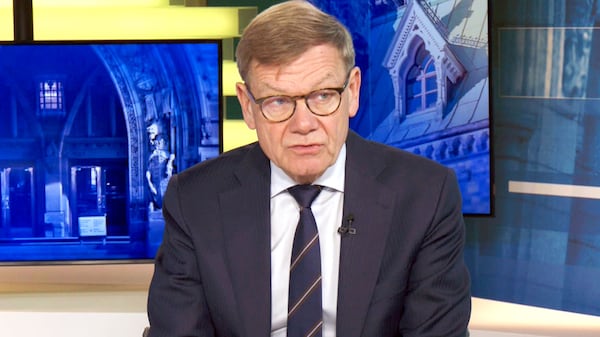
German Foreign Minister Johann Wadephul says his country wants more liquified natural gas (LNG). In an interview with CTV Question Period airing Sunday, he told host Vassy Kapelos that “of course” there’s a market for more Canadian LNG in Europe. “We do have to diversify, not only because this Russian war against Ukraine, but also with regard to the situation in the Middle East, if we look to the Strait of Hormuz and also recently to the situation around Bab-el-Mandeb, we know that our supply chains are under threat,” Wadephul added. Russia’s war on Ukraine has prompted Germany to strategically change direction when it comes to its energy supply, away from a dependence on Russia. “We are looking to Africa, for instance, to Nigeria, but also to Canada and to the United States, this is true,” Wadephul said. “But also, I would say we do have to speed up with changing our whole energy infrastructure into the new renewable system,” the minister added. “So, this is, I would say, the future, and the whole geopolitical circumstances are another very strong argument to do all of that faster.” Asked whether the acceleration toward more renewables will impact the trade Germany does with Canada when it comes to more conventional energy sources, such as LNG, Wadephul said emphatically: “No.” “I wouldn’t say that, because that takes still some time,” he said. “And also, renewables are a thing we should exchange with.” Wadephul said not only does Germany have “a huge need for gas,” calling LNG a “very needed source,” but there is also space for Canada to work with the European country on renewable energy technology. The record on that is mixed, however. A 2022 deal signed under former prime minister Justin Trudeau — the Canada-Germany Hydrogen Alliance — has been plagued by delays and missed its initial target of starting exports by 2025. Still, leaders of both countries continue to pledge their support for the program. Canada and Germany, meanwhile, announced an agreement in May between Ksi Lisims LNG on British Columbia’s West Coast, and Germany’s state-owned Securing Energy for Europe (SEFE) to purchase one million tonnes per annum of LNG for up to 20 years, with deliveries expected to begin by the early 2030s. European officials have expressed strong interest in Canadian LNG for years. In separate interviews on CTV Question Period in 2024, both Greek Prime Minister Kyriakos Mitsotakis and then-Polish president Andrzej Duda said they would be interested in purchasing Canadian LNG. Under Trudeau, the government insisted a business case for those exports to Europe didn’t exist. The government led by Prime Minister Mark Carney says the opposite. Canada has one major LNG export terminal up and running — LNG Canada, located in Kitimat, B.C. — which began shipping Canadian gas in summer 2025. There are currently a half a dozen other LNG export projects in the works. And, according to industry sources who spoke with CTV News, an announcement is coming next week on LNG Canada Phase 2, which will see the facility expanded to double its production from current levels. Wadephul in his interview also discussed Russia’s escalating aggression towards European countries supporting Ukraine, and the recent comments by European Commission President Ursula von der Leyen that she would like to explore the possibility of Canada becoming the first associate member of the bloc. You can watch German Foreign Minister Johann Wadephul’s full interview on CTV Question Period Sunday at 11 a.m. ET.