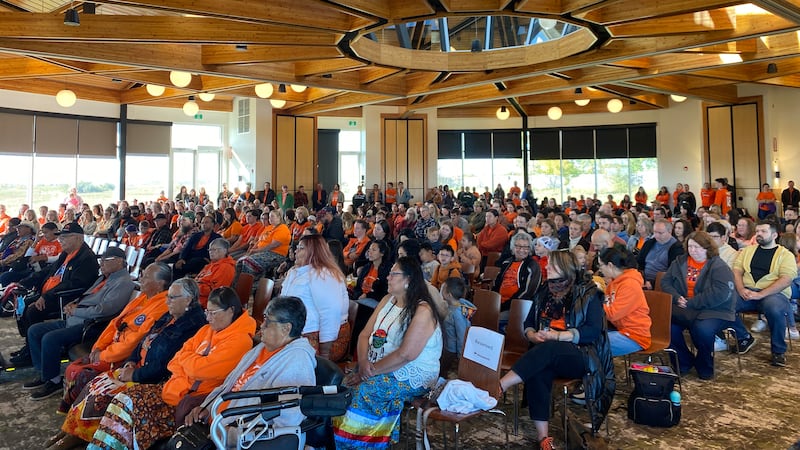
Thousands gathered in East Vancouver on Wednesday afternoon to mark Canada’s sixth National Day for Truth and Reconciliation. The event began with a police-escorted march up Commercial Drive towards Grandview Park. Although the crowd marching stretched for several blocks and appeared to number in the thousands, Vancouver police traffic control officers only blocked one side of the street. Southbound marchers filled that side, while northbound traffic continued just feet away with no barrier separating the marchers from moving vehicles. Despite the close proximity to traffic, there were no reported incidents between pedestrians and drivers. Once in the park, event attendees—almost all clad in orange T-shirts—gathered on the sloping main lawn facing a stage. Speakers reflect on intergenerational trauma Emcee Josiah Amaya, who is Kwakwakaʼwakw, Coast Salish, Nisga’a and Cree on his mother’s side, with roots in El Salvador on his father’s side, welcomed the crowd. “I’m an intergenerational residential school survivor,” Amaya said. “My grandmother went, and all of her 13 siblings as well.” While it was a solemn day, marked by stories from residential school survivors and those experiencing intergenerational trauma, many community members who attended said it was good to see so many people coming together. “It is a great way to celebrate. And the resiliency of the First Nations communities is an inspiration to all of us,” said Rebecca Lennox. The Grandview-Woodland neighbourhood has a large urban Indigenous population that was joined by many non-Indigenous community members to mark the day. “(It’s) just really important to come out and be an ally and show support and just honour our true history of what has happened in this country,” Jesse Lennox said. Eric Campbell, an Anishinaabe and Cree man who traces his roots to northern Manitoba, was at the park with an orange Every Child Matters flag. “Everybody needs to recognize, regardless of what colour you are, we’re the human-race and we are here for all children,” he said. “We’re all here for the same reason, right? And we all carry that in our hearts.” The evolving national conversation around truth and reconciliation Campbell also reflected on the first National Day for Truth and Reconciliation in 2021, and the way the conversation around Indigenous rights and issues has evolved since then. Provincial political leaders of almost all stripes spoke out against a demonstration at Tk’emlúps te Secwepemc native reserve near Kamloops, B.C. on Sunday. Photos of the group showed them wearing white masks and matching uniforms with shoulder patches similar to those of the Second Sons, a white nationalist group. Images like that so close to a former residential school has led to conversations about whether public support in general for truth and reconciliation is as strong as it was five years ago. “I feel like things have slowed down, but it definitely hasn’t stopped. I mean, you can see what’s going on behind me right now,” Campbell said, gesturing to the large crowd in the park. “So, I believe that it’s like with waves. It’s like anything it’s going to have its ups and downs. So, the fact that people are still showing up, of all cultures, that’s amazing to me.” There has also been tension in B.C. over Indigenous land rights and the Declaration on the Rights of Indigenous Peoples Act, which some politicians campaigning in the provincial election have vowed to significantly alter or outright repeal. “I feel like it’s been polarized and politicized. And really, this is something that affects everyone. Everyone should be partaking in reconciliation in whatever way they can,” said Rebecca Lennox. “That includes learning about it. That includes showing up for events. That includes on the day to day. Keeping in mind that we are walking on First Nations’ lands everywhere we go.”