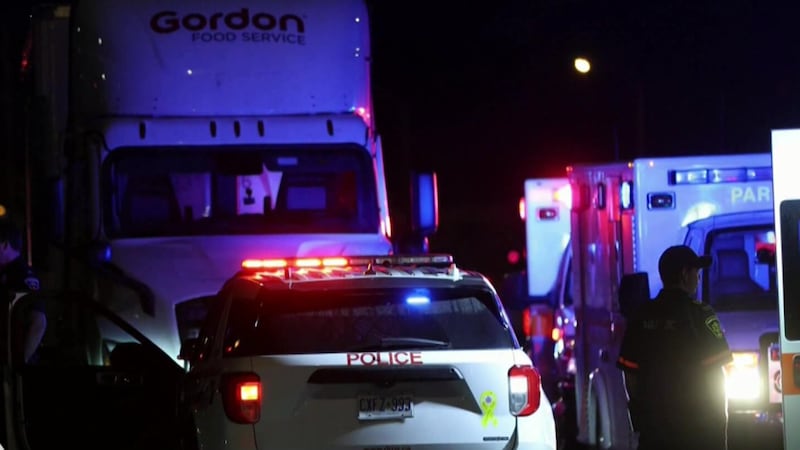
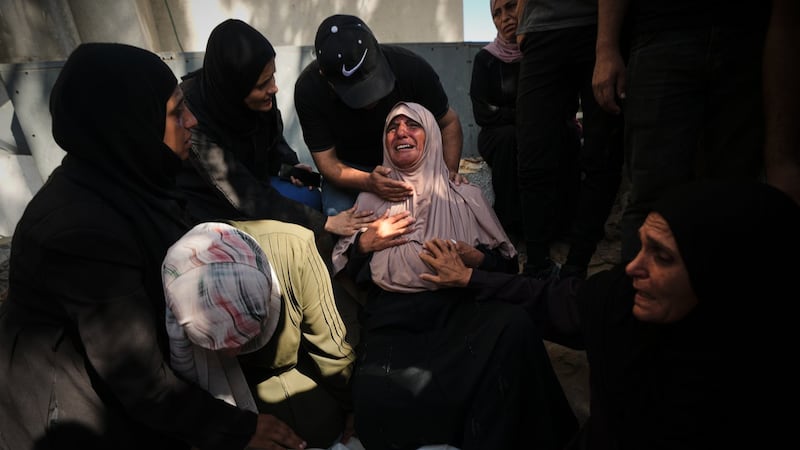
Marching to the beat of the drum, a couple of dozen Indigenous people, allies, North Bay police officers and paramedics marched from the North Bay Indigenous Friendship Centre to the Lake Nipissing waterfront, reflecting on a dark chapter in the story of First Nations. May 5 is the National Day of Awareness and Remembrance for Missing and Murdered Indigenous Women, Girls, and Two-Spirited People (MMIWG2S+). “It’s a very hard day to be here,” said Ashley Fudge, a member of the Kebaowek First Nation in Quebec. “Being here brings hope that in the future we have a safer place for our people.” Red Dress Day began with the REDress Project, created by Métis artist Jaime Black in 2010. Black displayed more than 100 red dresses around the University of Winnipeg campus to raise awareness of the issue. On this day, red dresses were draped in trees, hanging from windows, pinned to jackets, worn as earrings and red hands painted across faces. Red dresses, shirts and ribbons are a visual reminder of the lives that have been lost, and the ongoing calls for justice, safety and accountability. A number of dresses were hanging for all to see at the Kiwanis bandshell and several were laid on the ground on the hill nearby. “We have to look out for our women,” walker Dot Beaucage-Kennedy said. “It doesn’t matter who you are, whether you’re Indigenous or Polish or what nationality, women are very vulnerable and we need to work together.” Families of victims, survivors and allies gathered at the waterfront for remembrance, healing and awareness. “There’s a girl that’s gone missing in (M’Chigeeng First Nation.) They’ve been looking for her. Just all of a sudden, one day, she disappeared,” said Kathy Fortin, executive director of the North Bay Indigenous Friendship Centre. “Then we have the two girls that went missing quite a few years ago in Maniwaki.” Police data shows a woman or girl is killed by violence in Canada approximately every 48 hours, often from gender-based violence. Many are Indigenous. “Having to access medical care outside of our own town, we have to travel many hours ... As an Indigenous person and a single mother with my daughter travelling alone, it’s not safe,” Fudge said. “So, maybe in the future it will be.” According to the Assembly of First Nations, despite only making up a little more than 4.3 per cent of Canada’s population, Indigenous women make up 16 per cent of female homicide victims and 11 per cent of missing persons cases. “We need more investigating and more support for Indigenous women and girls to allow them to be in their communities and practice their culture,” ally Crystal Reid said. It’s that hope for change that pushes these advocates forward.