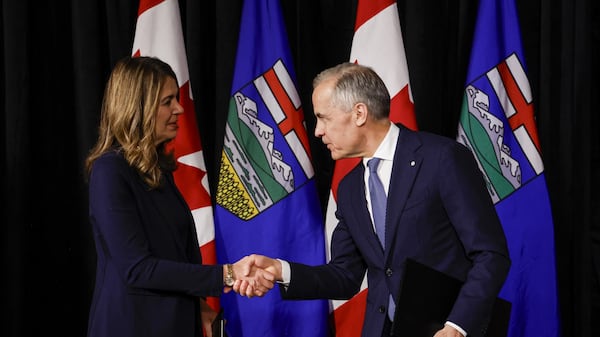
More than $1 billion in support for the softwood lumber industry is a sigh of relief for communities like White River, according to the town’s mayor. “It employs approximately half of our community, plus some from other communities, so absolutely vital to our region, to Canada as well,” Tara Anderson Hart said. Anderson Hart said White River Forest Products has already seen a lot of change because of the ongoing trade war. “Leadership has been working for months to find new contracts ... I think it was 93 per cent (of the company’s forest products) was exported to the States, from our mill alone,” she said. An announcement this week by Prime Minister Mark Carney made Canadian lumber a priority for his government’s ambitious home-building plans. To the delight of Anderson Hart. “Our supply in Canada number is going to increase with this government support,” she said. “So that’s definitely a win for our community and for our forestry industry.” Rocky relationship The rocky trade relationship with Canada’s southern neighbours has brought a lot of attention to industries hurt by tariffs. Danny Whalen, president of the Federation of Northern Ontario Municipalities, said not enough attention has gone to forestry, until now. “It was deeply concerning, because it’s such a major employer in northern Ontario,” Whalen said. The sector has seen plenty of ownership changes and closures across the region in the last decade. Whalen compares it to the focus that the auto industry receives in southern Ontario. “In the north, if you have a smaller lumber harvester shut down, you could be looking at 15, 20 employees,” he said. “It’s as big an impact as the automotive in the south. So it’s significant to other the smaller municipalities that’s basically their prime industry.” $10B in duties Ian Dunn is president of the Ontario Forest Industries Association, representing 53 companies that make forest products and manage crown forests. Dunn said Canada and the U.S. have had a fractured trade relationship for eight years when it comes to forest products. “Since the Department of Commerce began collecting duties in the current iteration of this dispute ... Canadian lumber producers have paid $10 billion in duty deposits,” he said. Dunn is glad to see the recent investment, saying it’s unlike anything he’s seen in his career from a federal government. He touted the $700 million loan program that allows lumber companies to borrow at commercial rates against those duties. Easier access to funding But Dunn added that few details are known about the program, and previous programs to help the industry haven’t been as accessible as lumber officials have hoped for. “From what I’ve heard from some of our members that, you know, some of these programs, you have to open up your books and essentially have to be on the verge of bankruptcy before you can access these programs,” he said. “So, hopefully there’s a little bit more flexibility this time around.” The timing of the programs is important. “We’re anticipating as early (Aug. 8) that the countervailing duty could go up, to 14 per cent or so combined,” Dunn said. “The duty would be 34.45 per cent. We have never seen a rate as high as that.” He added there may be more coming from the United States that would prove quite painful to the Canadian lumber industry. “There’s also additional national security investigations into all forest products, not just lumber but panels, pulp and paper products, even kitchen cabinetry going into the United States that could be subjected to an additional tariff on top of the 35 per cent for lumber that would be felt across the nation,” he said. At the end of the day, Dunn said Carney is committed to the lumber industry and that he sees ending the dispute as a top priority.