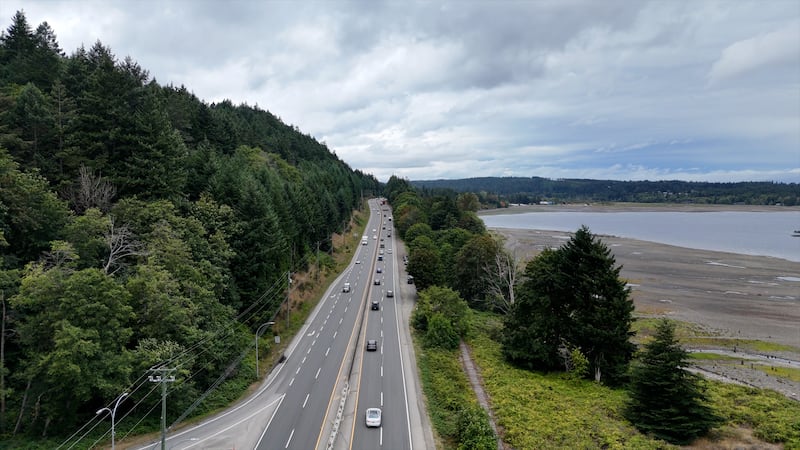
Any version of future passenger rail that shares track with freight trains so far misses the cost-benefit mark by a country mile, Alberta government officials maintained during a recent information session. And prospects over the next 30 years aren’t great either for stringing huge stretches of passenger rail next to existing tracks or highways, an online session heard. “To have frequent, reliable service for passenger rail, you need your own tracks,” said Chris Gentile, director of passenger rail with the province. “You can’t be sharing with freight trains and be at the mercy of co-scheduling and co-mingling.” Gentile called the need for purpose-built, dedicated track “one of the largest lessons learned” in research backstopping the plan. Three provincial staffers, including Gentile, discussed the executive summary in the July 23 session. The group also fielded written questions gathered from an audience that peaked at about 215 people. Plan builds out from high-speed spine Estimating a $60-billion spend in 2025 dollars over the first 30 years to create about 500 kilometres of service, the summary of Alberta’s plan for passenger rail first met the public eye June 5. The government has earmarked $15 million over three years to start the plan rolling on what it calls first-phase critical projects. That 30-year horizon puts forward a high-speed spine to connect Edmonton, Calgary, their international airports and Red Deer, plus clusters of commuter rail for bedroom communities of the two major cities. It also includes a regional off-shoot from the Edmonton-Calgary corridor to Banff. So far envisioned as “higher speed” rather than high speed, the Banff service would meet the south end of the centrepiece. The summary leans heavily into high-speed rail in a new rail corridor as “the leading option” for regional service between Calgary and Edmonton. As well, a new corridor is “the emerging preferred option” for regional service between Calgary and Banff, even though “further assessment on specific routes would be needed.” In planning parlance, the two types of routing are called brownfield and greenfield — brownfield for existing rail corridors, greenfield for new ones. Sharing rights-of-way along brownfield corridors has multiple drawbacks and would likely be used infrequently at best, the session heard. Existing corridors are often routed indirectly, increasing travel distances. Some sections are suitable only for slower-moving trains. And the way freight corridors mesh with urbanized areas presents costly design challenges. Culture of consultation germane to process, official says Session leaders acknowledged that continual consultation is critical as Alberta builds out a plan that funnels passengers along purpose-built tracks through rural Alberta. Joshua Mackintosh, the province’s director of stakeholder engagement for passenger rail, said consultation has already been key in developing Alberta’s plan since the process launched two years ago. And that’s going to continue as regional and commuter service beyond urban centres takes shape in the real world, he said. The team hopes “to hear some of the issues from communities — as well as the opportunities that they see with bringing in passenger rail — very early on so that we can plan accordingly,” Mackintosh said. Under the plan’s first 30 years, Edmonton and Calgary would have commuter links to bedroom communities like St. Albert, Spruce Grove and Stony Plain at the north end of the line and Cochrane, Strathmore, Chestermere, Okotoks and High River in the south. Regional service to Crowsnest Pass, Lethbridge and Medicine Hat are identified as 60-year possibilities in the plan. Also in the longer-term vision are Fort McMurray, Grande Prairie, Camrose, Lloydminster, Jasper, Rocky Mountain House, Lacombe, Sylvan Lake, Wetaskiwin and Drumheller. Mapping is qualified in the executive summary as conceptual — it doesn’t show exact routes or station sites. Growth metrics guide planning Demand, societal payback, and existing and future population density are key drivers in sequencing passenger rail. The plan predicts that the population of the Edmonton-Calgary corridor will grow by about 3.7 million people to about 8.1 million in 60 years. The entire remainder of the province is projected to grow by 400,000 people to 1.4 million. Online participants heard that the plan draws upon lessons learned from other planned or existing projects in North America and around the world. Among those is the building of 1,000 km of high-speed rail between Toronto and Quebec City, via Ottawa and Montreal. The envisioned privately operated service has drawn the ire of farmers and others in the East who say it doesn’t make economic sense and breaks up farmland. Under the ownership of a federal Crown corporation called Alto, the project will inevitably require expropriation because not all property owners will want to sell, the company has admitted. Alberta hopes to avoid that level of backlash and conflict. “We’ve been engaging with communities along potential corridors,” said Mackintosh. “We’ve been engaging with Albertans from all over the province. We held in-person sessions around the province. We held virtual sessions for those unable to attend in person. We conducted a survey. “We had regional groups where we engaged with municipalities. We also had a stream of engagement with Indigenous communities and organizations where we are doing what we consider to be early engagement.” Mackintosh concluded: “So we’re doing a lot to ensure that people are brought to the table very early on.” Rob Lonson, executive director of passenger rail with transportation and economic corridors, said the Alberta team has “direct connections” with officials on the further-advanced Alto project. Alberta is “actively asking” for information from there and elsewhere. “We’re keen to see what other jurisdictions are learning as they implement their projects and what their operating challenges are,” Lonson said. Inherent limitations diminish highway routing odds Although not entirely rejected, it’s unlikely Alberta will run high-speed or higher speed rail within long stretches of the pre-existing corridors for QE II and Highway 1. Track down the middle of divided sections would require the rebuilding of interchanges and overpasses. Medians are usually too narrow for stations and track. Beyond medians, even tracing highways would mean expensive guideways over interchanges and “significant community impacts” in urban areas, says the plan summary. Highway routes also feature “many locations” where corners are too sharp for fast trains. Along QE II, trains would be hitting speeds of 320 km/h, or nearly three times the speeds of neighbouring cars. The summary does leave the planning window open for highway-tracing tracks — but only a crack. Despite challenges, there may be opportunities for passenger rail to “follow portions” of the two highways, it says. George Lee, Local Journalism Initiative Reporter, The Macleod Gazette