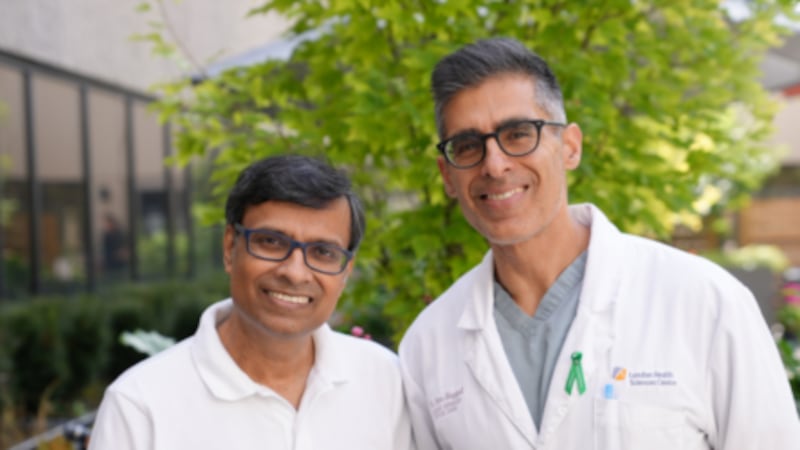
Some of the images in this article may be sensitive to some readers “It was really scary. You never plan for things like that.” Raj Mittal recalls the first time doctors at London Health Sciences Centre (LHSC) saved his life. In June 2025, the London man was working in his backyard when he began experiencing chest pain. His wife called 911 and he was rushed to hospital. “When I came in, I had a cardiac arrest and they needed to give me 45 minutes of CPR to revive me,” Mittal said. “All three of my arteries were blocked, so they had to do a triple bypass.” A series of health setbacks followed before Mittal was placed on the provincial wait list for a heart transplant. Earlier this year, a donor heart became available and he underwent transplant surgery. But this was not a typical transplant, said London Health Sciences Centre cardiac surgeon Dr. Dave Nagpal. “We were very fortunate at London Health Sciences Centre to be the first in Canada, but it was definitely a team effort,” Nagpal said. Nagpal was part of the medical team that performed Canada’s first heart transplant using the TransMedics Organ Care System, commonly known as “heart-in-a-box” technology. The system keeps a donor heart beating outside the body before it is transplanted into a recipient. “It’s technology that allows us to take a heart from a donor, place it on this machine with some of the donor’s blood and actually see the heart functioning,” Nagpal said. “We can make sure it’s suitable for the recipient.” Traditionally, donor hearts are transported in coolers, giving surgeons a window of about four to six hours before transplantation. The new technology can extend that timeframe to as much as 12 hours, allowing hearts to be transported from much greater distances. Nagpal said the technology could help shorten wait times and increase the number of available donor hearts. “We expect it could increase the donor heart pool by up to 40 per cent,” he said. “Recipients like Raj and others waiting for a heart transplant will hopefully spend less time waiting and be less sick when they receive their donor heart.” Mittal, 50, is still recovering but hopes to return to his job as an IT professional sometime next year. “I would like to thank the doctors and nurses who took care of me,” he said. “With the grace of God and the support of my family and friends, I’m here. This is my second life.”