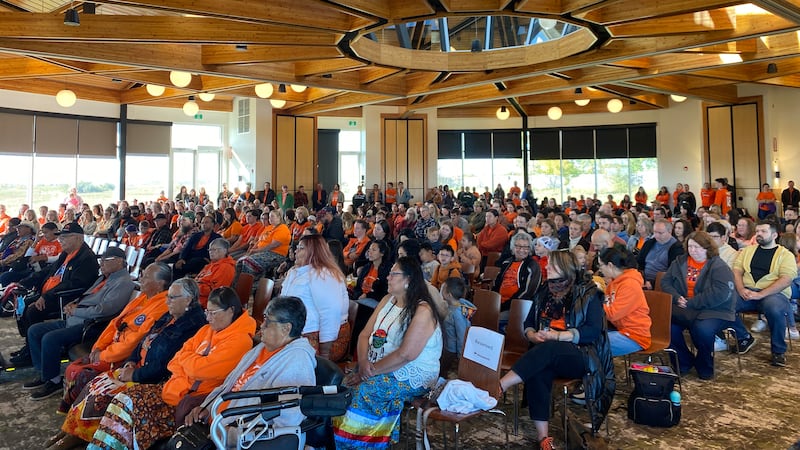
For Myeengun Henry, an Indigenous Knowledge Keeper at the University of Waterloo, Sept. 30 is about more than remembering the past. “You can never go forward unless you know your past... we need to make the word better,” he said. The university marked the National Day for Truth and Reconciliation on Wednesday with ceremonies, speeches, a walk around campus, drumming and a round dance, bringing students, staff and members of the community together to remember the children who never returned home from residential schools and honour survivors and their families. A day to remember The National Day for Truth and Reconciliation is observed each year on Sept. 30 and recognizes the ongoing impacts of Canada’s residential school system on First Nations, Inuit and Métis Peoples. Henry said the day is a reminder of a painful period in Canada’s history when Indigenous children were separated from their families, communities, languages and cultures. Remembering that history, he said, is essential to preventing it from being repeated. For Henry, the history is also personal. “My parents went to residential schools,” Henry said. “They were told they couldn’t give affection and love openly to their children. So, I was raised that way... we have to make sure that our next generation doesn’t have to go through this.” ‘Reconciliation is something that’s going to take a very long time’ That idea of looking backward while trying to build something better going forward was a common theme throughout Wednesday’s ceremonies. “We’re on a long journey,” John Lewis, associate vice-president of Indigenous Relations at Waterloo said. " So, reconciliation is something that’s going to take a very long time. There is really no definite end point." The university said it has been working to bring more Indigenous knowledge and perspectives into its programs, while encouraging Indigenous professors and creating space for Indigenous students and communities on campus. The university committed in 2022 to reconciliation, Indigenization and decolonization across the institution. “[We’re] encouraging Indigenous professors to come to the University of Waterloo to share their knowledge,” Lewis said. “And we work very closely... to incorporate Indigenous ways of knowing into the curriculum.” Remembering through family For Meagan Boyter-Mandawoub, a member of Saugeen First Nation, the residential school legacy is also woven into her family history. “She attended the Spanish Indian Residential School for girls... she attended for eight years,” Boyter-Mandawoub said. “She never knew the language growing up. She was never a part of the culture growing up. She would attend church, she were her cross. It wasn’t until later on in life, I didn’t even know she attended residential school.” For Boyter-Mandawoub, sharing those stories is part of keeping that history visible — and making sure Indigenous voices remain part of conversations about reconciliation. “Always keep your minds open,” she said. “You never know when you’ll see something that you can appreciate, or something you can get behind.”