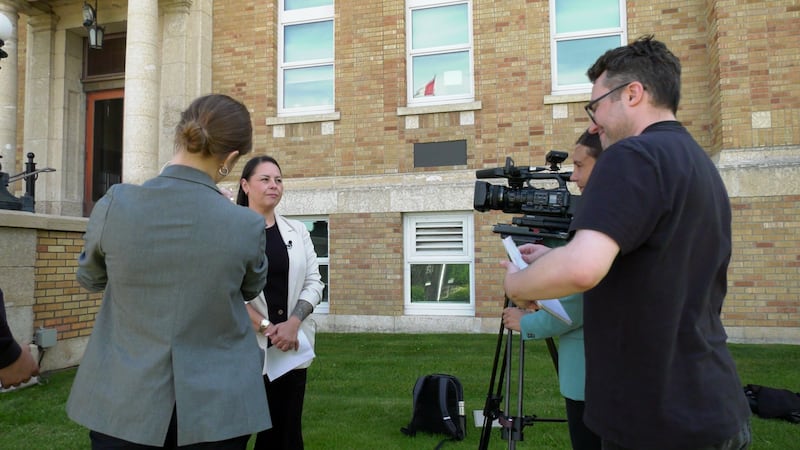
The province is making good on a promise to transit riders in Waterloo Region – more GO train trips on the weekend. The new schedule begins on Nov. 23, marking the first step towards two-way, all-day service between Kitchener and Toronto. “I had to go into my archives today and pulled out this old report from 2015,” Kitchener Mayor Berry Vrbanovic said at Monday’s announcement. “[It was from] the region, Kitchener, Guelph, Waterloo, Wilmot Township, Brampton and Communitech that called for a business case for a two-way urban commuter rail on the CN North Main Line. One of my colleagues reminded me, as he looked at it this morning, it’s a little dusty and that’s a good thing! It demonstrates what happens to perseverance and a government that works together with their local municipalities.” Ten years later and the province is getting closer to making that dream a reality. “We have reached an agreement-in-principle with CN Rail to purchase the land necessary to construct additional tracks to separate fright and passenger service,” explained Prabmeet Sarkaria, Ontario’s Minister of Transportation. The deal includes the construction of 40 kilometres of additional track which will eventually be used for two-way, all-day GO service on the Kitchener line. Additional work will also be needed on re-alignments, signal upgrades, bridge work and platform expansions. “We’re also adding 18 new weekend trips between Bramalea GO and Union Station, along with new weekday trips to keep people moving, making life a whole lot easier for people who count on this line to get where they’re going,” Sarkaria said. Starting on Nov. 23, four existing weekend trips that previously stopped at Mount Pleasant GO will now continue to the Kitchener station, while a weekday trip that stopped at Guelph Central GO will instead carry on to Kitchener. Metrolinx has yet to release a formal schedule for the weekend but commuters can expect two trains on Saturdays and two trains on Sundays once service begins. The trains will leave Kitchener in the afternoon and return in the evening in order to align with major events in Toronto. Timings are expected to be confirmed on the GO Transit website in the coming weeks. “I’m very excited about this because I’m the only one living in Kitchener,” said one rider. “My near and dear ones are living in Brampton so it’s very hard for me to go on buses.” “I think this will make it much easier,” added another. “You don’t have to worry about parking. You don’t have to worry about long waits on the highway.” Both Sarkaria and Vrbanovic cited the clear demand for better service. “September was our busiest ridership month ever – 7.42 million trips – topping the previous record from October 2019,” the transportation minister said. “That’s real confidence in the system and proof that when transit is frequent, reliable and affordable, people choose GO.” “This past weekend [ridership] numbers [were] up over 50 per cent over last year,” added Vrbanovic, referring to the extra trips added for Kitchener-Waterloo Oktoberfest. Increased service could also shape the region’s future. “This agreement with CN will help to connect communities, unlock the economic potential of 170,000 news jobs and create new opportunities for residents, businesses and industry across the Waterloo Region Toronto Innovation Corridor,” the mayor said. “This is critical now, more than ever, as we work together to protect Ontario’s economy.” “For local tech companies, connectivity, whether it’s rail, on [Highway] 401 or air, is really huge for their ability to grow, scale and attract and retain top talent here,” said Matthew Klassen, the vice president of external relations for Communitech. Regional Chair Karen Redman was also on board with the plan. “It’s an economic driver,” she said. “It’s about less time in traffic and more time for things that matter. It’s about quality of life. Waterloo Region is growing to one million residents.” Despite the optimism, there is still no definitive timeline for two-way, all-day GO service to Kitchener. “Now starts the dedicated planning for the twinning of that track, as well as things like the rehabilitation and replacement of legacy freight bridges on the network in places like Guelph, Mimico Creek, etc.,” explained Michael Lindsay, the president and CEO of Metrolinx. “We need to get out to market, procure those constructions works and then come back with an update on what a total timeline looks like.” Jeff Casello, a professor of transportation, planning and engineering at the University of Waterloo, said it all depends on the province. “I would hope that would be less than a two-year project. I think that’s really reasonable,” he told CTV News. “The construction companies that know how to do that work, we have that. What it really is about is a government priority to moving this forward and dedicating the resources in a meaningful way.” When all the work is complete, a trip between Kitchener and Toronto is expected to take just one hour. - With reporting by Krista Simpson