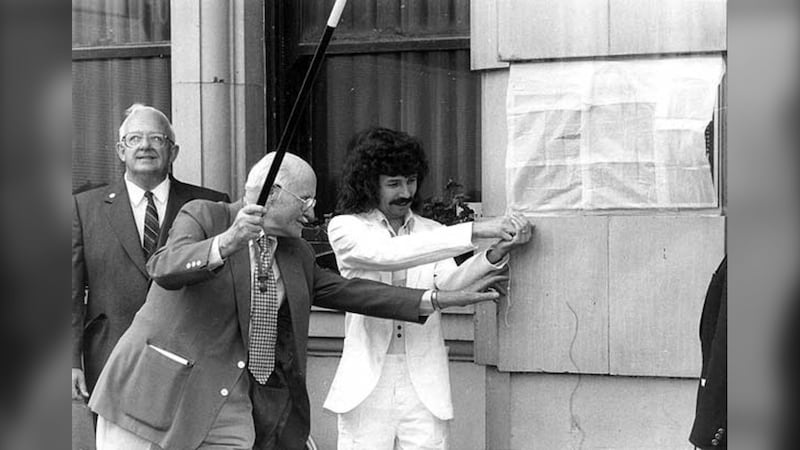
On a sunny mid-October day, a group walked through downtown Edmonton learning about the lesser known parts of the city’s queer history. For example: one of the last remaining icons of a safe place for gay and bi men to meet, the Georgia Baths, now memorialized with a sign in the Neon Sign Museum. Or: Womonspace, Edmonton’s longest-running social and educational society for lesbians, on 106 Street. “We are living in a time in which it is more important than ever to talk about queer history and trans history,” said tour participant, Allesio Ponzio. Ponzio is the director of MacEwan University’s Centre for Sexual and Gender Diversity and an associate professor whose research has focused on gender and sexuality, fascism, history and youth education. He called the tour – which is provided by the Edmonton Queer History Project in-person several times throughout the year as well as year-round as a self-guided activity – a way to make history and social connection accessible. “It’s an opportunity to learn what is the history behind a building, a door. Maybe a place that now has a completely different function and maybe a few years ago was an important centre for queer people here in town,” Ponzio told CTV News Edmonton. Morgan Evans, one of the tour guides and one of the project’s directors, said participants are often unaware of the city’s queer history, especially younger people. “This creates a sense of disconnect, I think, within the community where there’s not really been this sense of continuity,” she said, pointing out that queer landmarks are sometimes less visible. “(My students) often have no idea. If they know anything about queer history, they might know about Stonewall or something American. I think it’s really important to know that this happened in Edmonton,” added another member of the project, Kristie Benson, a program assistant at MacEwan’s Centre for Sexual and Gender Diversity. The tour explores positive history, like one of the longest-running LGBTQ2 groups in Canada, the Imperial Sovereign Court of the Wild Rose, negative history, like the fraught relationship with Edmonton’s police service, as well as morally grey history, like the story of Chrstine White, a transgender woman who became a bank robber instead of a sex worker in the 1990s when she couldn’t find work. “Sometimes people think that queer history (and) trans history are for some and they’re not for everybody. But I really do think that everyone should be interested in learning about something unknown because in the end, queer people (and) trans people are people, are Edmontonians, (and) are part of the city,” Ponzio said. “It’s just a way to connect individuals that have come from different backgrounds, different stories, different reasons to be here, but they decided to be here because they want to learn something new.” The tour was published as a book last year, called Cruising the Downtown. Edmonton Queer History Project also provides a queer history tour for Old Strathcona. With files from CTV News Edmonton’s Connor Hogg