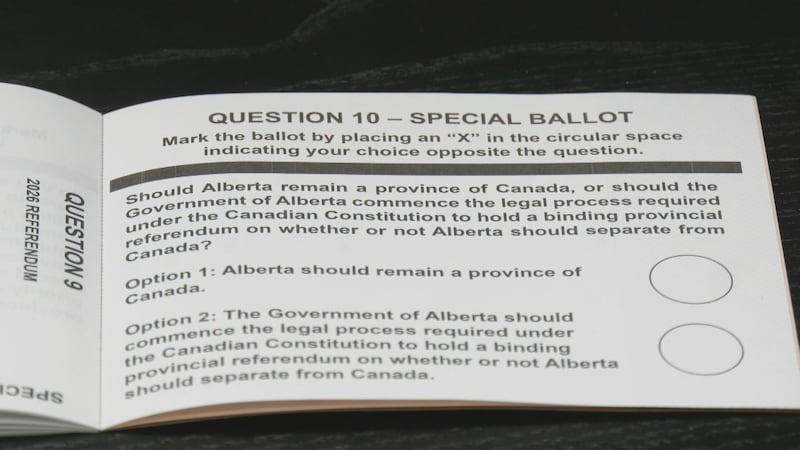
The majority of respondents to a new online survey believe Alberta should not be holding a referendum on separation from Canada, according to polling conducted by Abacus Data for the Alberta Federation of Labour (AFL). The survey, conducted between Oct. 7 and 13, found 56 per cent of respondents believe the referendum should not be held, compared with 30 per cent who support going to the polls. Another 14 per cent were unsure. Opposition to the referendum extends to some supporters of Premier Danielle Smith’s United Conservative Party. Among respondents who voted UCP in the last provincial election, 44 per cent said the referendum should not take place, while 47 per cent supported holding it. Ninety-two per cent of NDP supporters said the vote was unnecessary. Political scientist Lori Williams says the findings raise questions about the political consequences for Smith, regardless of the outcome of the referendum. “The bigger question for Danielle Smith going forward, even if she were to win on all of these questions, is the reality that (the) majority of Albertans didn’t want this referendum,” Williams said. She says the decision to hold the vote has created challenges for that could extend well beyond referendum day for the premier. “She’s got a set of issues around anger and trust, and an opportunity between now and the next election to try to win that back.” The survey also asked respondents to describe their feelings about the referendum, allowing them to select up to two answers. Frustration was the most common response, selected by 43 per cent, followed by anger at 31 per cent. Another 20 per cent described themselves as hopeful, 12 per cent as excited and six per cent as happy. Of the 598 respondents who expressed anger or frustration, 52 per cent placed the most blame for calling the referendum on Smith, while 26 per cent blamed separatist groups. The cost of holding the referendum was the most frequently cited reason for those negative feelings, followed by concerns about its impact on Canadian unity. The survey also found 44 per cent of respondents believed the UCP government should have sought an electoral mandate before calling the separation referendum. Another 32 per cent said they saw no issue with the government calling the referendum without seeking that mandate, while 24 per cent were unsure. Concerns about foreign interference The survey found 61 per cent of respondents were either very or somewhat concerned about foreign interference in the referendum process. Among those expressing concerns, 74 per cent identified the U.S. government as a potential source of interference, while 46 per cent cited groups funded by American billionaires. The Russian government was identified by 35 per cent and the Chinese government by 33 per cent. The survey also found 53 per cent of respondents believed it was somewhat likely or very likely that the U.S. government would attempt to make Alberta its 51st state after the referendum. Another 49 per cent considered it somewhat or very likely that members of the UCP government were under the influence of foreign governments or other foreign actors. Those findings reflect respondents’ perceptions and concerns, not evidence that foreign interference has occurred. Support for other policies The AFL-backed survey also examined public attitudes toward several provincial policy proposals, including some advocated by organized labour. It found 70 per cent support for increasing Alberta’s minimum wage to $20 an hour and adjusting it annually for inflation. Another 67 per cent supported rent controls, 62 per cent supported reregulating electricity providers and 52 per cent backed an excess profits tax on oil and gas companies. Support for those measures extended across party lines. Among UCP supporters, 65 per cent backed the proposed minimum wage increase, 64 per cent supported re-regulating electricity providers and 63 per cent supported rent controls. The survey found considerably less support for some other policies, including replacing the RCMP with a provincial police force — a measure supported by 27 per cent — and withdrawing Alberta from the Canada Pension Plan to establish a provincial pension plan, which was supported by 25 per cent. Referendum set for Monday The poll comes out as Albertans prepare go to the polls on Monday to cast a ballot in a historic referendum to answer 10 questions — including one on Alberta’s independence. Question 10 asks whether Alberta should remain part of Canada or whether the province should begin the legal process required to hold a future binding referendum on separation. The October vote will not itself determine whether Alberta becomes independent. Elections Alberta says the results of the referendum questions are non-binding. Williams says the non-binding nature of the vote means the government retains the ability to pursue many of its policy objectives regardless of the results. “It’s important to understand that …not none of the referendum questions are binding, and the premier could act on all of these things without this referendum authorizing her to do so,” Willams said. But Williams says that doesn’t mean the results will be without political consequences. “Things are unquestionably more challenging because she (Smith) has chosen this very complicated referendum process that’s costing a lot of money and a lot of effort on the part of many Albertans,” she said. She says Smith will also have to convince voters her government is focused on the issues that matter most to them, such as health care, affordability and education. Smith has said she supports Alberta remaining part of Canada and that the referendum will allow Albertans to express their views on the province’s future. Survey methodology The poll surveyed 1,021 Alberta adults recruited through multiple opt-in online panels. Results were weighted by age, gender, education and region to reflect census demographics. Because participants weren’t randomly selected, a conventional margin of error doesn’t apply. The report’s figure of plus or minus 3.07 percentage points, 19 times out of 20, represents a comparable probability-based sample, not this survey. The survey was commissioned by the AFL, which has publicly opposed the separation referendum. The full findings are available in the Abacus Data survey report.