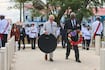
The Alberta government has announced plans to lower and standardize the provincial education property tax rate, saying a new rate will be introduced through Budget 2027 and locked in for three years at a time. The change is intended to create a fairer, more predictable tax system across all municipalities while reducing the tax burden for property owners and saving municipalities nearly $100 million. Alberta Premier Danielle Smith made the announcement in Calgary on Friday, saying a one-time transition tax credit will also be introduced in 2027 to help homeowners and businesses in communities where the new rate would otherwise be higher than their current rate. “Because no matter where Albertans live, they should be able to count on a fair, consistent, and predictable approach to education property taxes,” she said. Smith said the measures are part of the government’s broader efforts to make life more affordable for Albertans. Finance Minister Jason Nixon said all municipalities will apply the same provincial rates based on current property assessments, starting in 2027: Nixon said the current system, which sees rates vary between municipalities, makes tax bills harder to understand. “Currently, rates vary from town to town. Bills are hard to follow, and the rates we announce in the budget don’t match the rates that you find in your mailbox,” he said. Under the new model, municipalities will continue collecting education property taxes on behalf of the province. Nixon said there will be no separate bills or additional administrative steps, and the government says approved education funding will not be reduced. Education property taxes cover about one-third of the province’s public education operating costs, including teacher salaries and classroom resources. “Albertans expect the Alberta government to be clear about the tax that it collects and disciplined in how we spend those dollars,” he said. “And while we work hard to make every tax dollar count, the current education property tax calculation does not always meet that clarity test.” Nixon said Alberta has added more than 80,000 students since 2021 and remains committed to hiring 3,000 teachers and 1,500 educational assistants over the next three years. Calgary mayor expresses gratitude Calgary Mayor Jeromy Farkas had long been critical of the province’s education property tax hikes, introduced in Budget 2026. Smith said Farkas had advocated “very, very, very, very strongly” for change. For Calgary, the announcement could help limit the overall property tax increase facing residents. “It gives municipalities all across our province greater certainty as we prepare our budgets,” he said. According to Farkas, about 58 cents of every residential property tax dollar goes to the City of Calgary, and the other 42 cents goes to the province “We collect the whole bill, but we don’t control the whole bill.” Farkas said the standardized provincial rate will give council greater certainty as it prepares its budget and plans investments in public safety and infrastructure. He pointed to growing demands on city services, including a request from Calgary’s police chief for 309 additional officers and 214 civilian staff over four years, as well as increased pressure on firefighters and aging infrastructure. Farkas said the provincial changes will help the city pursue those investments while keeping affordability in mind. He called the move a “generation leap in fairness and transparency” for municipalities across all Alberta. “Thank you for following through on telling me you would look at this,” he said. “We serve the same taxpayers, and they expect us to work together and deliver results. We’re going to keep. We’re going to keep making Calgary safer, fix our infrastructure and keep life affordable.” In a Friday news release, Education Mayor Andrew Knack said he welcomes the change, which “simplifies the process for calculating the province’s education property tax while also providing more transparency to Edmontonians.” ‘Won’t fall for this’: Nenshi The leader of Alberta’s Opposition NDP called Friday’s announcement a “fake” property tax freeze that “does very little to help Albertans.” “Last year, the province increased property taxes for the average Calgary home by over $350. Today, the UCP announced they will reduce that increase by a maximum of about $75 – for houses that don’t go up in value at all,” In a statement, Naheed Nenshi said. “This year, they’re paying for this by shifting that property tax burden to rural homeowners who would see increases. But conveniently, only after the next election date. “Meanwhile, Albertans province-wide are still struggling through this affordability crisis. The UCP has consistently voted down every single proposal to reduce grocery prices, the cost of housing, and other costs that are making it harder for Alberta families to get to the end of the month. “They’ve downloaded costs on municipalities, driven property taxes higher, and wasted hundreds of millions on a divisive referendum that only their separatist pals wanted. “Albertans know who Danielle Smith is and has always been. They won’t fall for this.” Progress, but not enough: Alberta Municipalities Speaking to CTV News, Dylan Bressey, president of Alberta Municipalities, said while they welcome any simplicity that’s introduced to property taxes, the $100 million reduction offsets only a fraction of the $1 billion increase in provincial property taxes over the past three years. “I’ve seen provincial grants to municipalities cut by 50 per cent over 10 years,” he said. “There is billions of dollars worth of infrastructure deficit in our municipalities right now, and what that means is the amount of money we need spend not to build new infrastructure — but just to get current infrastructure up to a reasonable state of repair — that amount is in the billions, and it’s more money is needed every year than municipalities even collect. “I’d rather just see the province get completely out of the business of property taxes,” Bressey added. “There is no real reason that we need to fund provincial services with property taxes — and don’t get me wrong; I like seeing our schools well funded, but there are other revenue sources available to the province that are not available to municipalities.”