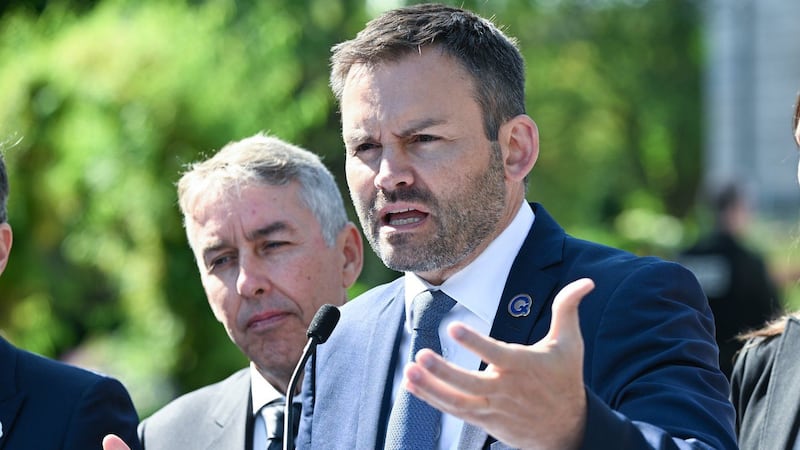
The spring sitting of Alberta’s legislature began Tuesday, and some Albertans are watching how the government addresses health-care concerns, with growing questions about a plan that was supposed to immediately address emergency room capacity issues. Monday, while Premier Danielle Smith announced historic funding for physicians would be in Thursday’s budget, she said the province has not followed through with its band-aid idea for overcrowded ERs. Just before Christmas, an Edmonton man died after waiting eight hours in Grey Nuns Hospital to see a doctor about chest pains. Alberta health-care workers highlighted other recent deaths and near misses and called for a state of emergency. Matt Jones, hospital and surgical health services minister, said Alberta would add a new set of ER doctors. Smith says they are still working on that. “I hope the (Alberta Medical Association) will work with us on getting those positions in place,” Smith said Monday. “I think we share a common aspiration of improving the conditions in ERs. If it turns out to be the case that doctors are not interested in filling those triage positions, we can look at nurse practitioners, we can look at physician assistants, but we want to make sure the AMA and their professionals have the first opportunity to help deliver this new form of care for those in the emergency departments.” AMA and emergency room doctors say they have not been contacted about the triage doctor role. AMA president Dr. Brian Wirzba provided a statement to CTV, saying, “There have been no meetings to date, and nothing is currently scheduled.” He says a “key challenge” is representing members are split between Hospital and Surgical Health Services and Primary and Preventive Health Services. “We believe this structural barrier should be addressed and removed, as doing so would be beneficial for all parties,” Wirzba said. Medicine Hat emergency physician Dr. Paul Parks says doctors want to find immediate solutions to ongoing health-care problems. “Things aren’t better. We’re still seeing prolonged diagnoses of cancer not getting treatment, people with surgical delays,” he said. “The premier and Minister Jones both were given those cases of some examples of deaths and near misses, and they haven’t even acknowledged receipt of them … they have not arranged a meeting with the section of emergency medicine leaders or with the AMA leaders to discuss the triage role—the waiting room emerg doc role.“ Parks says doctors had their own meeting after hearing about the ER triage doctor plan in January and hope to hear from the province soon about working together to implement a plan. “It would take extra shifts from the same amount of docs to work,” he said. “We discussed how we’re willing to do it if the resources and terms are correct, but the government has not met with us or done anything. Zero. Nothing.” It’s not just doctors feeling the strain. It can lead nurses to change positions more often. The head of the Alberta Association of Nurses said although nurses usually find other positions within the province, the moves come with challenges. “There are a number of things that could help start to alleviate the retention issues that we’re having fairly soon,” said Annjanette Ridsdale-Weddell, Alberta Association of Nurses CEO. She said changes to promote and allow unit managers to be more available to support nurses in hospitals could help with retention. In the longer term, more people are applying for nursing and health-care programs at Bow Valley College. “Two to two and a half, up to three applications for every seat that we kept, so we can see how high the demand is there,” said Taren Taylor, Bow Valley College’s Health and Wellness dean. Learning opportunities for doctors in rural areas and different funding models for clinics are also promising steps, according to a representative at the University of Calgary. “Eventually, Alberta will be a net importer of physicians as opposed to an exporter. That’s the goal,” said Dr. Todd Anderson, Cumming School of Medicine dean. But critics say immediate action is needed. “The reality is the government does have a plan, and that plan is inaction, and that is putting the lives of Albertans at risk,” said Sharif Haji, NDP shadow minister of Primary and Preventative Health Services.