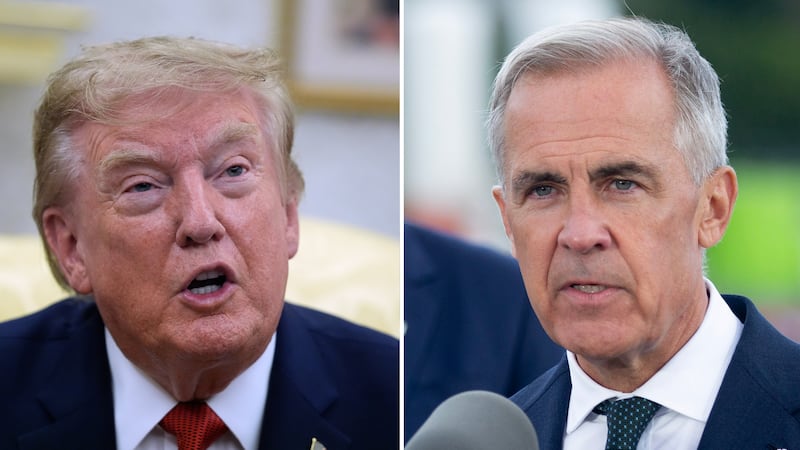
U.S. President Donald Trump has delayed his new 50 per cent tariffs on Canadian goods after he said the two countries reached a tentative deal and that the Keystone XL pipeline “may be awoken from the grave.” Prime Minister Mark Carney released his own statement that does not mention a deal, nor a pipeline. Though, he said, “substantial progress has been made.” Trump’s 50 per cent tariffs have been delayed by three days. Follow for key updates: Read Trump’s statement Trump posted the following message on his Truth Social platform late Tuesday evening. “I have paused the 50% Tariffs against Canada, that were scheduled to kick in tomorrow morning for a three day period, based on the fact that Canada and the U.S.A., subject to the finalization of documents, have a DEAL! The great Keystone XL Pipeline, long ago killed by Sleepy Joe Biden, may be awoken from the grave! Thank you for your attention to this matter. President DONALD J. TRUMP.” He then published an AI-generated image of himself hoisting the Keystone XL out of a gravesite marked by a tombstone labelled “BURIED BY BIDEN.” Read Carney’s statement Carney posted this message online on Tuesday. “Over the last number of weeks, Canada has engaged in intensive discussions with the United States to address outstanding trade issues and deliver greater certainty and real benefits for Canadian businesses, workers, farmers, and families. “Substantial progress has been made, although there is important work still to be done. As this work is ongoing, the United States has agreed to postpone the implementation of its 50% tariff on a range of Canadian goods under Section 338 of the U.S. Tariff Act of 1930 until end of day, August 21. “While we continue this work, Canada remains focused on building a stronger, more independent, and more competitive economy at home.” Quebec’s ‘red line’ Quebec Premier Christine Frechette passed CTV News cameras on her way into the legislature. She said she has not seen all the terms of Canada’s agreement with the U.S. to provide a statement on trade. But she reiterated her “red line, not to be crossed:” Supply management on dairy and “the protection of culture and language.” She added, “what businesses need is confidence and stability and stability and predictability.” Luca Caruso-Moro, CTVNews.ca journalist ‘Shooting themselves in the foot’ For the auto industry, the president of the Automotive Parts Manufacturers’ Association says any negotiated tariff rate must be below the profit margin. Flavio Volpe told CTV News, “It’s got to be below six per cent, and for 60 years we’ve been working at zero per cent.” Volpe, a member of the federal government’s group of insider advisers said if automakers are forced to absorb or pass on hundreds of millions of dollars in extra costs to consumers each year, plants in places such as Brampton or Woodstock, Ont., could move to the U.S. or elsewhere where they may be more profitable. “They [the United States] are just shooting themselves in the foot if they’re going to charge their own companies a penalty to sell to their own customers.” Ted Ballantyne, CTV News senior multiplatform writer 13M jobs at risk: U.S. business group The imposition of higher U.S. tariffs would put 13 million American jobs at risk, according to U.S. Chamber of Commerce’s senior vice president, Neil Herrington. That’s the number of U.S. jobs that “depend on trade” under the Canada-U.S.-Mexico Agreement (CUSMA), according to Herrington. “The introduction of higher tariffs would damage both economies, drive up costs for U.S. families,” and “further disrupt critical supply chains,” he wrote in a Tuesday statement. Luca Caruso-Moro, CTVNews.ca journalist Relief in ‘limbo state’ Candace Laing, president and CEO of the Canadian Chamber of Commerce, said in a statement Tuesday that the tariff delay provides some relief on both sides of the border. She said an extension doesn’t bring the certainty of a signed interim deal. “This limbo state is not anyone’s preferred outcome — time is of the essence,” Laing said. “We commend the negotiating team for their work and sense of urgency this week, and call on them to keep it up: ultimately, a resilient and integrated North American economy would be a stronger one for all.” The Canadian Press The Keystone? Former U.S. president Joe Biden signed an executive order to revoke the permit for the Keystone XL pipeline, which would have transferred oil from Alberta to Nebraska, over long-standing climate change concerns. Trump returned to office set on changing that decision. Earlier this year, he signed an executive order for permits to revive parts of the project. It’s not clear how much of the trade talks between Canadian and American officials focused on the energy project. Carney spoke with Trump by phone Tuesday, hours before the U.S. was to bring in the punishing tariffs. The Canadian Press