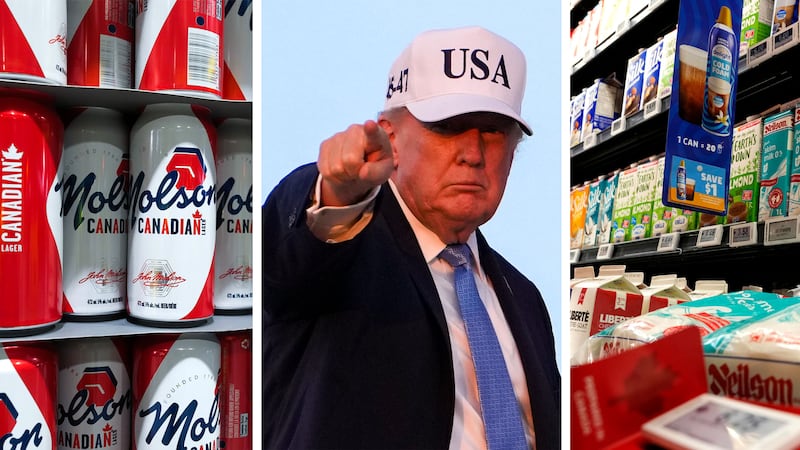
A U.S. ban on certain Canadian imports took effect at midnight on Tuesday after U.S. President Donald Trump signed an executive order in response to Canada’s retaliatory tariffs following the collapse of trade talks in August. The ban affects key industries, including alcohol, dairy and motorcycles. The White House justified the measure earlier this month, saying Canada’s restrictions on U.S. alcohol, autos and dairy products put American exporters at a disadvantage. In the meantime, Prime Minister Mark Carney is seeking to reduce Canada’s reliance on the U.S., by positioning Canada as a critical mineral superpower, strengthening ties with the European Union and India and attracting investors to Canada. Key Details: U.S. ban on US$1B of Canadian imports begins U.S.-Canada relations, already tense, are likely to deteriorate further after the United States went ahead early Tuesday with a decision to ban nearly US$1 billion worth of Canadian imports, including alcoholic beverages, dairy products and motorcycles. The ban amounts to barely a ripple in $880 billion worth of a two-way annual trade between the two neighbours. But it marks another ratcheting up of U.S. President Donald Trump’s second-term trade war with America’s longtime ally and trading partner. The import ban “certainly won’t do anything to help the trade tensions between the United States and Canada,’’ said trade attorney Patrick Childress, a partner at Holland & Knight and a former U.S. trade official. The Associated Press, Read the full article here LeBlanc promotes barrier-free interprovincial trade Canada-U.S. Trade Minister Dominic LeBlanc says he’ll meet with provincial and territorial counterparts this week to work on the shared goal of ensuring Canadian goods can move freely across the country. “To be our own best customer, we must be ambitious in ensuring that Canadian goods, services, and workers can move across Canada barrier-free,” he posted to X, hours after the U.S. import ban took effect. “We have an opportunity to meet the moment by building a more unified and competitive Canadian economy.” Kayla Thompson, CTV News, journalist U.S. group ‘Toasts Not Tariffs’ calls on Trump to end war The U.S.-based group Toasts Not Tariffs, which represents farmers, distillers, retailers, restaurants and bars, said in a statement Tuesday it appreciates the Trump administration’s efforts to encourage Canada to reopen its markets to American spirits and wine. “However, as this ban on Canadian spirits and wines takes effect today, America’s restaurants, bars, retailers and consumers are being pulled further into a trade dispute that has already taken a significant toll on U.S. wine and spirits producers,” the group said, calling for a negotiated resolution to the dispute that restores sales on both sides of the border. The Canadian Press Trump says Canada will ask for trade deal Just hours before import bans on certain Canadian goods were set to take effect, U.S. President Donald Trump said Monday he thinks he can make a trade deal with Canada in the coming weeks. Speaking to reporters in the Oval Office, Trump said he thinks the Canadian side will contact him in the next three or four weeks and the United States will “win everything.” “They’re gonna come in and they’re gonna say, ‘Sir, we are sorry,”’ Trump said. “They’ve treated the United States very, very badly. I think a deal will be made but it’s gonna be fair.” The Canadian Press, Read the full article here Canada’s economy was vulnerable before Trump: analyst Amid the increasingly bitter trade war between Canada and the U.S., a business analyst argues that recent American trade policy changes did not create the issues plaguing the Canadian economy, they have simply exposed long-standing flaws. “We created a series of policies that made us weaker as an economy,” Ian Lee, business analyst and professor at the Sprott School of Business at Carleton University, told CTV News Channel on Tuesday. “(Donald) Trump did not create our weaknesses; they existed long before Trump was (U.S.) president. What he did was he maliciously and savagely exploited our weaknesses, which is what we are living through now.” Lee said that while certain individual sectors within Canada’s economy may be able to absorb the nominal impact of U.S. tariffs, the cumulative effect of the levies on businesses and consumers will be significant. The trade war will also continue to weigh on overall confidence, Lee said, something harder to measure in the short term. “I think the impact is more indirect. It’s driving down confidence… it’s disrupting supply chains, it’s disrupting the customer relationships,” he said. “So, it’s not the tariff per se that is causing the damage, it’s the undermining of business confidence and traditional relationships that have been on going on for decades.” Jordan Fleguel, journalist, CTVNews.ca Trump is ‘alienating’ Canada: analyst CTV News U.S. political analyst Eric Ham said the way that Trump speaks of China, a one-party state, “makes clear where the president stands,” considering it’s the only other country aside from Canada that retaliated against the U.S. “The United States is now alienating and isolating its most closest and ardent ally and trading partner, while authoritarian nations seem to actually have Donald Trump’s ear as well as his affinity and affection,” he told CTV News Channel on Tuesday. With new tariffs going into affect, Ham said that he suspects the trade war between Canada and the U.S. won’t end any time soon. “The president is hoping that this will somehow force Canada to actually agree to something that will give up much of their sovereignty and independence, and what we’re seeing here is Canada continues to dig in,” he said. Ham added that no matter who wins in the midterm elections, the trade war could pit the White House against Congress, with Congress seeking to take back some trade authorities, which could leave Canada out in the cold. Elianna Lev, CTVNews.ca, journalist Trump announces new $15B steel plant U.S. President Donald Trump on Monday announced a new US$15 billion steel plant being built in Iowa, highlighting an economic victory in a key battleground state where Republicans face competitive midterm races. Trump announced the new plant at an Oval Office event alongside steel executives and Iowa Republicans, including two running for office. The event highlighted Iowa’s elevated status for Republicans and for Trump, who on Monday pledged to campaign there in coming weeks. “We’re going to do a great rally. We’ll all be there together,” Trump said alongside Rep. Ashley Hinson, who is running for the U.S. Senate, and Rep. Mariannette Miller-Meeks, who is up for re-election. Also joining him were Gov. Kim Reynolds and Sen. Joni Ernst, who are not seeking new terms in office. The new steel plant is being built by Mesabi Metallics, a Minnesota company owned by India’s Essar Group, an industrial conglomerate. Trump said the project will become the largest steel plant in the United States. It is expected to produce 10 million tons of steel a year after it’s fully built out. The Associated Press 350 steelworkers laid off at Ontario plant The union representing steelworkers at Stelco Holdings Inc. has confirmed to CTV News that 350 employees at its plant in Hamilton, Ont. will be laid off. United Steelworkers Local 1005 verified the planned layoffs on Monday afternoon but did not provide any further details. Stelco declined an interview but in a statement to BNN a spokesperson said its Hamilton Works facility is currently idling its finishing operations while continuing to concentrate steel production in Lake Erie. “Very importantly, job opportunities at Lake Erie Works will be offered to Hamilton employees. We expect that a significant number of employees affected by the indefinite idle at Hamilton should be absorbed at Lake Erie Works,” a spokesperson wrote in an email. Stelco also said the amount of steel they produce will not be impacted by the Hamilton plant’s idling, though there will be a “change in product mix, with a higher concentration of hot rolled steel products.” Alex Arsenych and Joanna Lavoie, CTV News & CP24, journalist Read the full article here