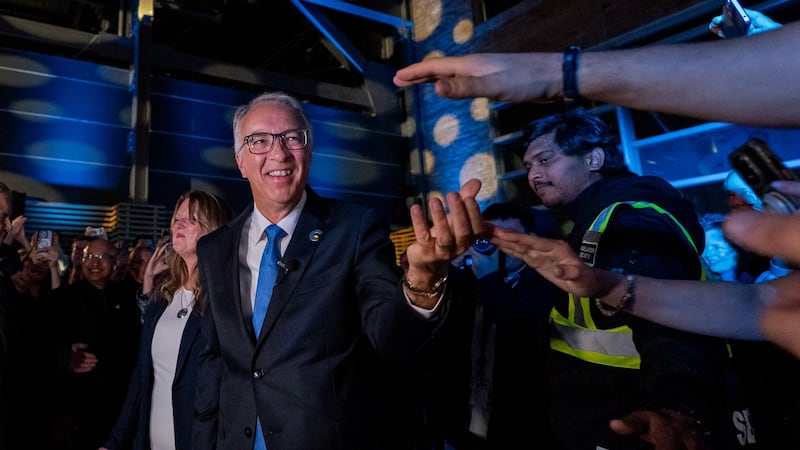
A campaign video targeting Drew Dilkens’ taste in American alcohol and his choice of vehicle sparked a sharp exchange with fellow Windsor mayoral candidate Fred Francis, as both outlined new platform commitments Thursday. Francis released the video Wednesday, questioning whether Dilkens’ message about protecting local jobs and buying local matched his personal choices. “But he’s also said he likes American bourbon and American wine,” Francis says in the video, before it cuts to a portion of a CNN interview in which Dilkens discusses those drinks. The video also takes aim at his vehicle. “He says he’ll protect the Windsor auto worker, but he drives a Tesla,” Francis says. Dilkens responded Thursday morning with a video of his own, including a longer excerpt from the CNN interview. “Oh, I love a good U.S. bourbon. I love a good California cab, but not so much that I can’t find alternatives if it means that I can just hold out a little while longer and get a better deal between the United States and Canada,” Dilkens says in that excerpt. Speaking with reporters Thursday, Dilkens accused Francis of selectively editing his remarks. “He’s willing to do Donald Trump U.S.-style tactics where he clipped a portion of an interview without giving the full picture,” Dilkens said. Dilkens also defended owning a Tesla, saying local companies contribute to the North American supply chain that produces the vehicles. He pointed to Windsor-area tooling, automation and parts businesses whose work supports production in the United States. Francis rejected the suggestion that his video misrepresented the CNN interview, saying it showed Dilkens expressing a preference for American bourbon and wine. “That’s literally what that clip shows. We didn’t say anything other than that,” Francis said. He also pushed back against Dilkens’ characterization of his campaign tactics, saying he uses his opponent’s proper name while Dilkens calls him “Freddy” and says “Freddy isn’t ready.” On the vehicle criticism, Francis said people are free to purchase whichever car they want. His argument, he said, was about consistency between a politician’s message and their actions. “If you’re going to be prepared to tell people to buy local, if you’re going to tell people that, you know, you should be supporting our local union workers and our local plants, then your actions should match your words,” Francis said. Francis promises Tunnel Bus return, transit fee cap The exchange came as Francis unveiled a transit platform Thursday that includes restoring the Windsor-Detroit Tunnel Bus and capping Transit Windsor fees for at least two years. Francis said a restored Tunnel Bus could have a higher fare, however, as he looks at ways to help cover its costs. He also proposed extending Route 1000 through 2027 for students attending Vincent Massey and Holy Names high schools, while negotiating a permanent arrangement with the public and Catholic school boards. Francis put the cost of extending the school service at $110,000 and acknowledged it would require council approval. “We could work to find $110,000 for the betterment of our students and our families,” he said. His platform also calls for re-establishing a transit board with councillors, members of the public and stakeholders, exploring expanded regional service across Essex County, and reviewing the Transit Master Plan with additional public consultation. Asked how he would pay for his commitments, Francis pointed to senior-government funding, increased ridership and changes to how buses are allocated across routes. Some of those changes could mean suspending underused routes to put more resources into busier ones. “We’re going to have to make some hard decisions,” Francis said. “We might have to stop for the time being in order to focus on the routes that are overperforming.” Francis said he would seek to align the city’s transit planning with federal funding opportunities. He did not provide a complete costing of the platform during the announcement. For the Tunnel Bus, he suggested reviewing fares and routing, including whether buses could travel to Detroit through the tunnel and return over the Gordie Howe International Bridge. Francis also used the Tunnel Bus decision to repeat his pledge not to use strong mayor powers. In February 2025, Dilkens vetoed council’s seven-to-four vote to retain the service in the city budget. “I will not use strong mayor powers. I will not use them to get my way,” Francis said Thursday. “And I’ll work with all members of council to get a consensus.” Dilkens proposes expanded safety programs, police operations centre At his own campaign event earlier Thursday, Dilkens outlined a “Safety First” platform that would expand neighbourhood safety initiatives and build out a real-time operations centre for Windsor police. Dilkens said work on the centre is already in its early stages. His commitment is to secure the resources needed to bring camera feeds and other police information together to help direct responses. He estimated several million dollars in capital costs, depending on the scale of the facility. “I want to make sure that Windsor is there sooner rather than later,” Dilkens said. “And I’m committed to making sure the funding is there to get it over the finish line.” Dilkens said access to camera information could help dispatchers assess incidents and determine the resources needed. He acknowledged that integrating those systems would require addressing privacy requirements and putting appropriate agreements in place. His platform also proposes expanding Project Greenlight to all of Windsor’s business improvement areas and extending proactive bylaw outreach into every ward. Dilkens said the approach could pair bylaw officers with nursing or other support workers, depending on neighbourhood needs. “The solution is not always policing,” he said. “The solution is actually proper resources, whether they’re social resources or nursing resources.” Other commitments include more traffic calming, sidewalks, bike lanes and street lighting, along with an initiative targeting hate, harassment and intimidation. Other candidates outline priorities Three other mayoral candidates shared their priorities with CTV News. Kat Pasquach said she would focus on holding landlords accountable, addressing vacant properties and using evidence to guide decisions on downtown revitalization, homelessness and addiction. She also called for stronger advocacy for provincial and federal support. On transit, Pasquach said her first 90 days would include meeting with city workers and addressing concerns about working conditions. She said employee feedback should help shape improvements such as increased service and longer operating hours. Patrick Sutherland proposed a Housing First approach to homelessness, drawing on the model used in Helsinki, Finland, alongside additional affordable housing. His broader proposals included putting Windsor Arena to use for sports and entertainment, reducing commercial property taxes for small bricks-and-mortar businesses, and increasing transit funding. Sutherland also said he wants more express buses connecting east-end development with St. Clair College and the University of Windsor. Nick Kolasky said his priority would be addressing homelessness rather than spending on what he described as vanity projects. “I don’t believe a business owner who finds a homeless person passed out on their doorstep is thinking ‘a trolley car or a skating rink would surely fix this problem,’” Kolasky wrote.