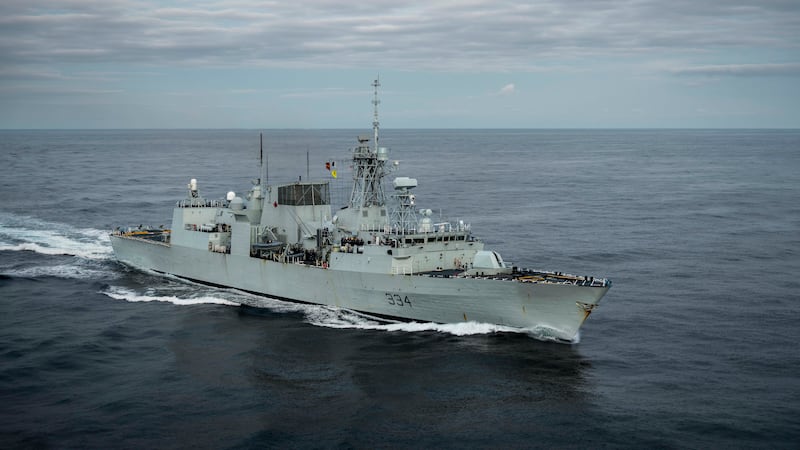
A Canadian warship is pressing ahead with exercises in the Indo-Pacific region despite a warning from North Korea that it would “mobilize all means available” in response to the multinational drills. HMCS Regina had just wrapped up its participation in Pacific Vanguard 2026, a multilateral exercise led by the U.S. Navy with the navies of Japan, Australia and South Korea, when Pyongyang denounced the maneuvers as a “war rehearsal” aimed at the country. The warning came from Kim Yo Jong, the influential sister of North Korean leader Kim Jong Un, as the Canadian frigate prepares to take part in another large-scale exercise with the U.S. and Japan. The ship’s commanding officer downplayed the threat this week in a video call from the frigate near Cambodia. “This is what navies do—and what they’ve been doing since they’ve existed—is practising for worst-case scenarios,” Cmdr. Darren Sleen told CTV News. “The exercise is not designed with any specific campaign plan in mind,” he said, adding that the training is intended to strengthen partnerships with allies and demonstrate collective deterrence. Both Pacific Vanguard and the upcoming Keen Sword exercise focus on air defence and anti-submarine warfare with partner militaries from across the region. But in an era of simmering conflict, Sleen said the scope of the exercises has been fluid. “Right now, the geopolitical climate, as you know well, is very dynamic,” he said. “So, ships that actually show up to the exercise have been a little bit different than we expected because assets are being pulled all over the world to deal with whatever their governments need them to deal with.” Missile test aborted HMCS Regina left British Columbia for a six-month deployment in June. The vessel joined the Rim of the Pacific exercise in Hawaii, where it was expected to conduct a live firing of the Evolved Sea Sparrow Block II missile, the navy’s most advanced air-defence weapon. The test was aborted at the last minute, however, after faults were discovered with two of the drone-like targets used at the U.S. missile range. “There was a technical failure with two of the targets, and so we didn’t actually fire the missile because it just didn’t make sense to expend those resources,” Sleen said. The fast-moving targets were supposed to follow a specific flight path before being engaged by the interceptor missile, but a problem with the target’s control system forced the crew to abandon the test. “The team worked for about three months prior to that, running through all of the requirements to fire that missile and to practise those tactics,” Sleen said. “We got we got all of the training value, except we didn’t get the thrilling conclusion to actually see the missile fly—a big disappointment for the team.” The ship is expected to undergo two weeks of maintenance in South Korea before conducting patrols under Operation Neon, the Canadian military’s longstanding contribution to enforcing United Nations sanctions on North Korea. The Department of National Defence says its participation in the maritime interdiction efforts limit North Korea’s ability to finance the development of nuclear weapons and ballistic missiles. HMCS Regina is expected to return to Canadian Forces Base Esquimalt in December.