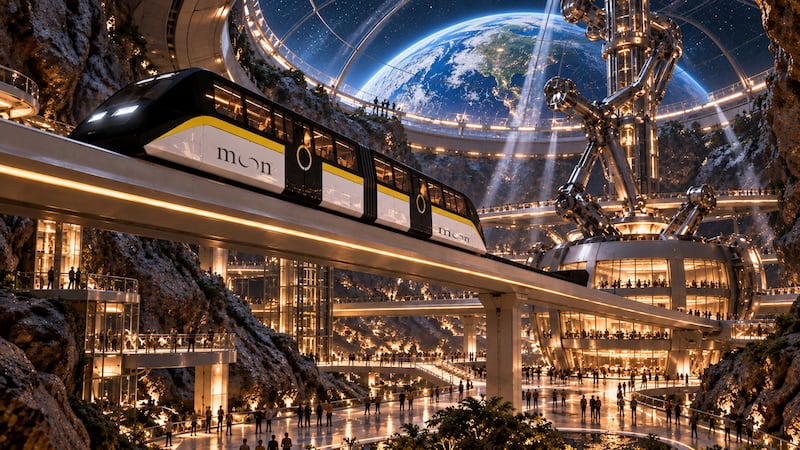
Canadian astronaut Jeremy Hansen has been closer to the moon than most people will ever get, and now he wants to help others get a little closer to the experience as well. A Toronto-based company that wants to build a series of moon-themed “smart cities,” complete with a luxury resort and 13-acre lunar surface simulation, has enlisted Hansen as a consultant. “When I was flying around the moon, I really wanted to go down to the surface,” Hansen told CP24.com in an interview. He admits he’s not sure if that will ever happen, but he says a simulated lunar surface could be the next best thing. “Sharing that with other people, that would be really powerful, and I think good for humanity,” Hansen said. Moon World Resorts Inc. is the Toronto-based company behind the venture, which they describe as being in “a category of one.” The concept includes a luxury resort and moon simulation within a master-planned city of 500 square acres. The concept includes a lagoon, monorail, park space, residences, corporate real estate for space-related businesses, wellness facilities, a “Sky Walk” elevated pedestrian track, and more. The centrepiece—a giant replica of the moon—would host the “authentic lunar surface experience.” “You can’t do the moon small because that would not do it justice,” co-founder Sandra Matthews told CP24.com. A pre-development program is underway at the moment to determine costing and other factors. But a 90-minute walk in a spacesuit on the simulated lunar surface would cost around US$500, while Matthews says the resort stays would be on-par cost-wise with the other five-star facilities. While the prices might seem high to some, Matthews said the aim is to actually create a sort of bridging concept that does make a taste of space more accessible. “If you want to go up and have a little bit of weightlessness, you’re going to pay $750,000 with (companies like) Virgin, and you have maybe a few minutes, and you come back down, and that’s incredible. But the rest of us will not be able to do something like this,” Matthews said. “So we want MOON to actually be that bridge to sort of say, OK, we’re going to create something unique and special where you’re going to get a feeling of that awe, and we have to do it large. That’s why the moon sphere is so large.” Potential locations are also being sorted out, but Matthews said they would need to be within proximity of existing major airports. The facilities could be used for conventions, entertainment, wellness retreats, and more. The company has created the concept, which they hope to license to developers who will build locations on every continent. They’re hoping to run a showcase in Madrid next spring for prospective licensees. Making concept a reality ‘not a leap’ Part of the reason Hansen is coming aboard now is to help develop the lunar simulation. He acknowledges he’s not yet sure how it’ll work, but he likes how the challenge echoes problem-solving for actual space problems. “I’ve seen this many times before when you partner with a large group and you bring the genius of people together and you start to talk about those realities. Solutions start to present themselves. So it’s not a leap for me,” he says. He hopes that the experience will help imbue ordinary people with the sense of awe associated with peering back at the earth from space. “Imagine standing on this simulated lunar surface and looking back at tiny Earth from the surface of the moon. That would be really profound for people,” Hansen says. “And then to be able to explore a moon base. Ideally, what people will see is what companies are actually using to build the real moon base. Hopefully, that is what will be showing up on the moon surface so that people are getting a real sense of what it’s like on the moon.” Having recently returned from the Artemis II mission, in which he did a slingshot around the moon with three other astronauts, Hansen said he came away with a new appreciation of the cosmos. “You get this real sense that surprised me, this real sense of three dimensionality to the galaxy that you can perceive,” Hansen said. “It kind of really blew me away, like left me with a sense of awe. So you know, trying to figure out your place and all of that is something I still absolutely wrestle with.” But there was a corollary to that feeling of awe. “When I say awe, I mean this sense of being and feeling infinitesimally small and insignificant, but then at the same time, as a collective, very powerful, that you know we could be there and bear witness to that,” Hansen said. “That was a very profound feeling.” Canada needs a ‘hat trick’ in space investments In addition to consulting on MOON, Hansen is continuing to advise the federal government on the Canadian space program. He shared his advice to them so far, which has been to go for a “hat trick” when it comes to space investment. That means boosting GDP through innovation and technology export, investing in space in a way that helps Canada meet its NATO spending targets, and investing in projects that help secure Canada a place in international ventures such as the lunar economy. “We also need nuclear on the moon,” Hansen said, noting Canada is an energy leader. “We have this huge challenge on the moon of, depending on where you are, but let’s just say 14 days of darkness, 14 days of light. So solar batteries just really doesn’t work. Rovers surviving the lunar night, how do you do this? Nuclear power is an obvious solution to that, and so we can use small micro reactors in the Canadian Arctic, for example, but we can also use them on the moon.” When it comes to the recent trade war with the U.S., Hansen said he thinks that on balance, cooperation will continue to prevail when it comes to progress on space exploration. “I think everybody knows that the end game is continued collaboration, and even amongst all this stress, there’s still a lot of collaboration going on,” Hansen said. “And so it can be easy to focus a lot on the negatives here, but I think there’s a lot of reason to focus on the positives. “Artemis II was an extraordinary example of what we can do when we create together and we give the best of one of our countries and the genius in our countries towards a common objective. And that was a beautiful example. I was so proud to see the American and Canadian flags hanging together in our capsule, and all four of us just giving that beautiful example of collaboration.” When it comes to actual space tourism on the moon, Hansen said he’s not expecting to see that happen anytime soon. “I think there will be opportunities in the not-too-distant future for non-government astronauts to do something like that. But it won’t be for just a tourist trip to the moon just because of how much risk there is living on a spaceship being part of that team, you got to be able to really help respond to the emergencies.” But with technology constantly advancing, he adds “you never know.”