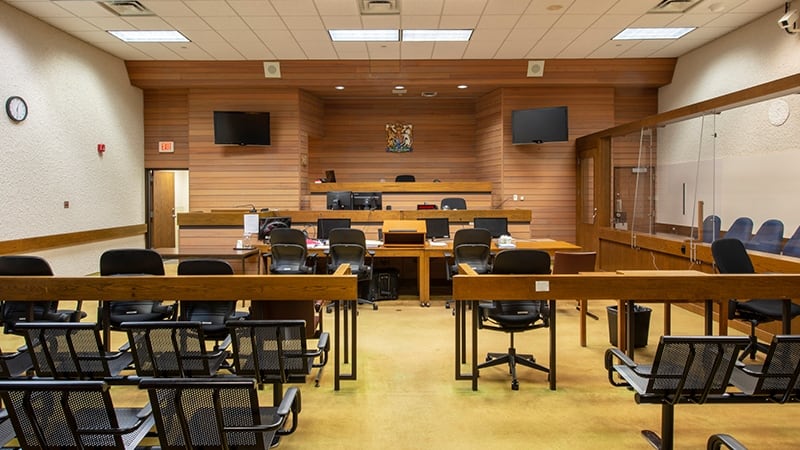
A Manitoba judge says he doesn’t want the parking lot beside the Granite Curling Club turned into “a crater” while he decides a legal challenge related to a housing project planned for the site, and he will bar the developer from digging it up in the meantime. On Friday, Court of King’s Bench Justice Amiran Kotler said he will grant the club’s application for an injunction halting significant work on the lot until he rules on the club’s judicial review. “The thrust of the order … is everything can go ahead except digging up the lot,” Kotler said. “My order is intended only to maintain the physical status quo while I decide the substantive issue before me.” He said the order does not apply to any preparations “behind the scenes” or to administrative efforts needed to advance the project. At a hearing in June, the club’s lawyer, James Mercury, urged Kotler to quash a rezoning bylaw that would clear the way for a housing tower on city-owned land next to the club, which has used the site as a parking lot for decades. The club has argued the loss of parking would jeopardize its operations and that an alternative parking plan devised by the city is not adequate. Kotler has yet to rule on the judicial review and says he is focused on completing his decision “as soon as humanely possible.” The club’s lawyer claims excavation began on the site in November. The city’s online permit database shows partial foundation permits have since been issued and a development permit for a proposed 12-storey, 111-unit building. Kotler said the application met the requirements for an injunction, including the risk of irreparable harm should the project proceed. “It seems intuitively apparent that digging up a parking lot that is the subject of a pending decision and replacing it with a crater meets the threshold,” he said. Kotler said the developer pointed to a term in its lease agreeing that, should the lease be terminated because of an injunction, it will backfill the lot and restore it to its original condition. He called that “a compelling argument” but said the club is not a party to the lease and has no way to enforce it. Even if the lot could be backfilled, Kotler said, that will all take time and the risk remains that a parking shortfall could endanger the club’s financial viability. “While the lease does go some way to addressing the club’s concerns, it does not sufficiently remove the risk of irreparable harm,” he said. Lawyers for the city and developer also argued the club, whose lease on the lot has been terminated, has no ability to delay development. Kotler agreed the club has no legal right to the lot but said that “does not end the inquiry.” “In my view, the curling club … is seeking to enforce a recommendation imposed by the municipal board and rejected by the city that before development occurs, a parking plan be put in place that satisfies both the city and the curling club,” Kotler said. “The injunction seeks simply to ensure that should the curling club succeed in its application, the lot is still available to form part of that plan. It is not necessary that the club have a legal interest in the property to seek that relief.” The city and developer also pointed to mounting costs from the delay and the risk that funding for the project will disappear if progress is not made. Kotler said he accepts those are real risks that the parties are trying in good faith to avoid. “This engages the public interest in affordable housing, which no one can realistically suggest is not pressing and vital,” he said. In a statement, Christian Pierce, club board vice-president and secretary, said he is pleased with Kotler’s decision. “In practice, it means the city can’t ignore the judicial process,” Pierce said in part. “Once the (rezoning bylaw) decision is rendered, the Granite board will meet to decide on how to proceed next in the best interests of the club and its members.”