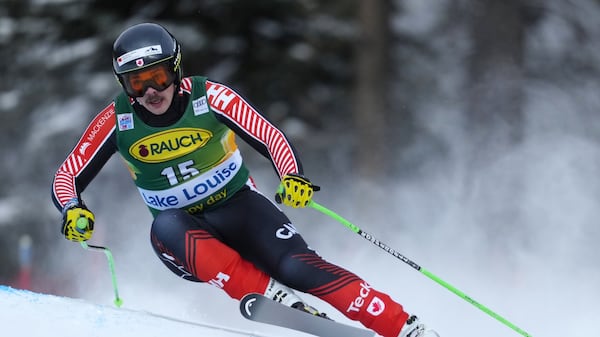
CALGARY — Alpine racing and biathlon have skis and the need for speed in common. The two sports have merged their federations in Canada and hope others will join them. Alpine Canada and Biathlon Canada announced their merger Tuesday. That move follows an amalgamation of Luge Canada and Bobsleigh Canada Skeleton, announced Oct. 29. The sliding sports were the first to execute a recommendation by the Future of Sport in Canada Commission that national sport organizations unite to share athlete services and save money. The commission’s report, authored by Lise Maisonneuve earlier this year, stated “there are too many organizations vying for too few resources.” While a melding of sliding sports was intuitive given their shared venue, the union of alpine skiing and biathlon seems less so. Alpine Canada is the larger NSO with participation of over 2.6 million, a national team of almost 50 athletes and an operating budget of about $19 million annually. Biathlon, which combines cross-country ski racing with precision rifle shooting, is smaller with roughly 2,000 Canadians participating, a national team of 14 athletes and an annual operating budget of about $2.6 million. “We’re looking at creating a new organization that supports multiple sports and creates space for others to come,” Alpine Canada chief executive officer Andrew Baker said. “It’s not necessarily the partnership that you would expect to see as a first go-around.” Winter-sport power Norway unites alpine, cross-country, freestyle, ski jumping, snowboarding and Nordic combined under the Norwegian Ski Federation umbrella. “It works really well in some other countries for snow sports,” Biathlon Canada chief executive officer Kerry Dankers said. “The number one thing that I’m looking forward to with working with alpine is that we will be a bigger organization. “We will have access to a back office, which is totally a step change for Biathlon Canada. Human resources, marketing, finance, IT, all of these things, when you have an organization that has five full-time employees, which Biathlon Canada has, those types of things are done either by the administrator like myself or with fractional employees or with board support.” Two-time Olympic biathlete Emma Lunder, who is an athlete representative on Biathlon Canada’s board, says biathletes have paid “pretty severe team fees” to compete. She hopes the merger could free up money to ease that burden. “All I could think about was what an opportunity that it could be for our sport, access more resources, more funding and how we could grow it,” Lunder said. What Canadian alpine skiers and biathletes have in common is chasing success in Eurocentric sports that get far more television and commercial attention there than at home. “There could be a lot of interesting research and development benefits to working together with other sports on that front, but also just putting heads together on how we in Canada in all these different sport could do a better job at building the base of athletes,” alpine skier Brodie Seger said. “Getting people to pay attention to a lot of these sports more than once every four years I think has got to be one of the biggest goals, so that starts with community engagement.” The Future of Sport in Canada Commission’s report called on the Canadian government to encourage NSOs to adopt a shared-services model, and provide the funding to execute it. “Numerous participants told us that there are too many National Sport Organizations in Canada,” Maisonneuve wrote in the report, which stated there were 64 federally funded NSOs. Of the almost $3 million in federal funding given to sliding sports for 2026-27, about $1.5 million was for executing the merger of bobsled, skeleton and luge by 2027. “I’m really glad to see the co-operation and the elimination of redundancies between a couple of sport organizations thus far,” Secretary of Sport Adam van Koeverden said. “The mergers or collaborations of sport organizations have not required financial incentives. “That said, our new funding framework, which we launched a couple of weeks ago, makes it clear that sport organizations who can reach more Canadians, who can encourage participation across multiple events, activities or sport jurisdictions, will naturally have access to more funding.” Alpine Canada and Biathlon Canada will jointly get $9.6 million for 2026-27 from the federal government, but Alpine Canada also brought on board a sponsor who shares the amalgamation vision. Capital Power has invested $5 million in the first year of its sponsorship of Alpine Canada, plus up to $20 million over a five-year term, which gave Baker the bat to take a big swing at unification. “It started with a conversation of ‘well, maybe if we’re a first mover as a company, and we’re willing to put money in, would we encourage other category sponsors to step up?’” said Capital Power’s chief corporate officer Ferio Pugliese, who is an alpine ski racer himself. “With the Playground to Podium program, would we be able to unlock funds from the federal government to increase the budget for Alpine Canada so that we could encourage more people to take on the sport, afford to do that and then more kids to come up through development and then ultimately more athletes showing up on the world stage? “We agreed with Alpine Canada . . . that we would support their endeavours to amalgamate other winter snow sports.” National sport organizations were begging for an increase in core funding when the Canadian government in April committed almost $1 billion more over the next five years, dropping to $118 million annually thereafter, to the sport system. Of that new money, $660 million more over five years, and $110 million after that, goes to national sport organizations to invest in athletes, grow participation in sport and make it safe to play. This report by The Canadian Press was first published Nov. 24, 2026. Donna Spencer, The Canadian Press