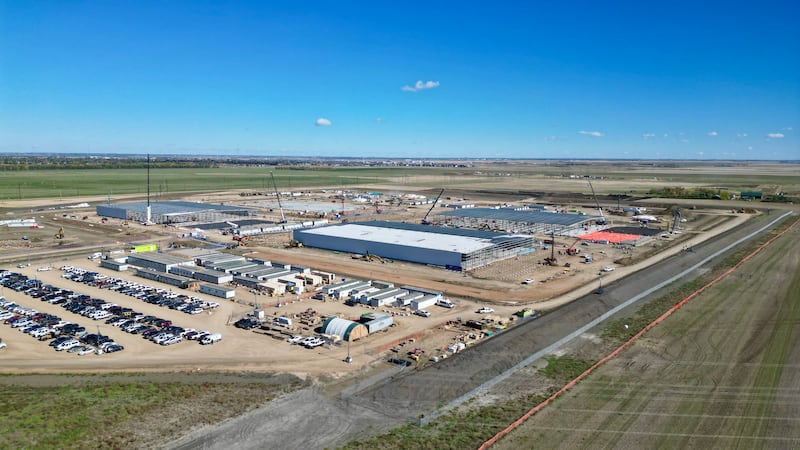
With discussion intensifying in the halls of the legislature regarding Bell Canada’s $52 billion Sherwood AI Data Centre project, one question has been repeatedly asked – when is an environment impact assessment required in Saskatchewan? The answer depends on numerous factors, according to the province. Speaking to reporters following question period on Nov. 17, Wes Kotyk, the assistant deputy minister of the Environmental Protection Division, said Saskatchewan’s Environmental Assessment Act did not require the first phase of Bell Canada’s project to undergo an assessment. The reason for this, Kotyk told reporters, is that any of the environmental factors of the project’s first phase are already covered by existing regulations and permits. “Not all projects do require an environmental assessment, and in our dialog with the company, we have determined that effective environmental controls can be handled through the existing permitting processes,” he explained. Kotyk went on to say permits will be required for activities such as fuel storage and air emissions. Will there be an environmental assessment of the Sherwood AI Data Centre? Those calling for the province to take a more detailed look at the Sherwood AI Data Centre will have their demands met – as Bell Canada has confirmed the project’s expansion will undergo an environmental impact assessment and public review. “Bell has followed the province’s regulations and processes at every step of this project and the proposed expansion will go through Saskatchewan’s provincial environmental impact assessment, including public review,” the company wrote in a statement to CTV News. “We are committed to being good neighbours as we partner with the community to bring jobs, economic growth and responsible technological advancement that will help build Saskatchewan’s future.” In its statement, the company added that protecting the “land, water and people” living near the development has guided the design of the project from its inception. Both Kotyk and Environment Minister Darlene Rowden have said the project’s dedicated power generation would have likely mandated an assessment. Originally announced as a 300-megawatt (MW) AI data centre campus, the project was drastically scaled up in September when it was revealed further phases of the project would increase its required power generation four times over to 1.2 gigawatts (GW). Under new provincial policy, all new data centre projects must supply their own power – meaning 900 MW of the data centre’s electricity will be provided by Bell Canada. When are environmental assessments required in Saskatchewan? According to Saskatchewan’s Environmental Assessment Act, an assessment is required if a project is deemed a “development.” There are six criteria a project can meet in order for it to be classified as a development. They include if the project: When asked about recent public pushback against the data centre project, Kotlyk said “general concern” does not meet the threshold under the legislation as the concerns must be solely based on environmental factors such as the air, land, water, plant, animal and human life. “One of six criteria to determine whether or not it would be a development, but public concern alone is not,” he said. “It needs to be based on environmental changes, and it needs to be widespread.” Providing another example of a major project that did not require an environmental assessment, Kotyk said the Cargill canola crush facility recently built near Regina was not subject to an assessment. “[It] was determined to not be a development, but they still have all of the environmental regulatory requirements,” he said. “We permit them. We inspect the facility to make sure they’re in compliance.” So far in 2026, three new projects in the form of a proposed uranium mine at Patterson Lake, a solar farm near Weyburn, and a wind farm near Assiniboia, received environmental impact assessments and were approved by the ministry. The rest of the listed projects on the Ministry of Environment’s website were deemed not to be “developments,” were self-declared as developments by the company which proposed them or were simply production increases and expansions of existing projects that were approved by the ministry. Projects reviewed by Ministry of Environment in 2026 CTV News, CP24 and BNN Bloomberg are divisions of Bell Media, which is a wholly owned subsidiary of BCE Inc.