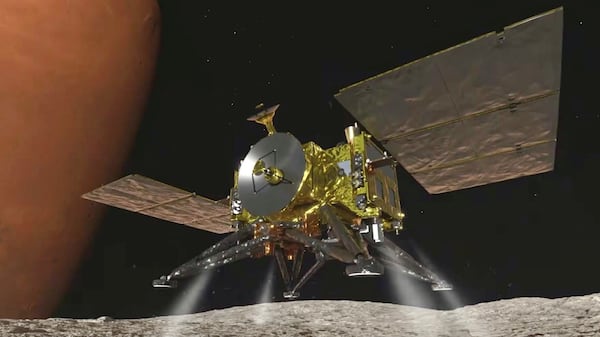
TORONTO - Japan has launched a spacecraft on a five-year round trip to a strange little moon of Mars. If all goes well, it will bring a piece of it home. “It’s just a whole new level of challenge and excitement,” said Paul Delaney, professor emeritus of astronomy at York University in Toronto. The Martian Moons eXploration mission, or MMX, lifted off on a rocket from Japan’s Tanegashima Space Center before dawn on Tuesday. Its target is Phobos, the larger of two small moons orbiting Mars. “The Japanese have a habit of doing exciting missions, in my opinion, and this one is absolutely no exception,” Delaney said. “MMX is trying to do something which nobody has done before.” While the Japan Aerospace Exploration Agency (JAXA) had twice previously returned samples from asteroids, no space agency has ever brought back material from a moon other than our own. Tiny moons, big question Phobos is only about 22 kilometres across, and Deimos, Mars’ other moon, is roughly half that. By comparison, our moon is more than 3,000 kilometres wide. “Really, really tiny,” Delaney said of the Martian moons. But they hold a big mystery. “The simple question is: Where did the moons of Mars come from?” Delaney said. One theory is that something smashed into Mars long ago and blasted debris into orbit, which clumped together into the moons. Scientists believe our own moon formed in a similar way. The other theory is that Phobos and Deimos are asteroids that wandered too close and got caught by the planet’s gravity. “Are they captured asteroids?” Delaney asked. “It sounds (like) a simple-enough question, but the answers actually speak to the earliest moments of (the) solar system and planetary formation.” He expected the answer to come quickly once the sample of moon dust reaches a lab on Earth. “That’ll be pretty obvious the moment we start analyzing those few grams.” Grab and go Japan is leading the mission, with help from NASA and European partners. The spacecraft should reach Mars in August, about 10 months from now, and spend more than a year studying Phobos from above. It will then drop off a small French-German rover to scout the surface. After that, the main spacecraft will touch down, grab at least 10 grams of moon dust then head for Earth. A capsule carrying the sample is due to parachute into the Australian outback in 2031. Why bring that dust all the way back to Earth, instead of having the spacecraft analyze it? “We’ve got vast laboratories with far more sophisticated equipment to analyze the sample,” says Delaney, who calls sample return missions “the holy grails of solar system exploration.” What else could be in there? The launch comes as a plan by NASA to bring back rocks from the surface of Mars has stalled. The Perseverance rover spent years collecting samples, but the U.S. Congress cut funding this year for the mission to retrieve them, after its costs ballooned. “Will those samples that Perseverance collected ever see the laboratories here on Earth? Probably, but who knows when?” Delaney says. As for the sample from Phobos, he thinks it could hold some surprises: potentially traces of the chemical building blocks of life. “We’ve often found organic molecules in the strangest of places, the most unlikely places in our solar system and in the universe,” Delaney says. There’s a long road ahead, and plenty could go wrong. But Delaney is rooting for it. “This really is a very exciting mission,” he says. “A tip of the hat to them if they can pull it off.”