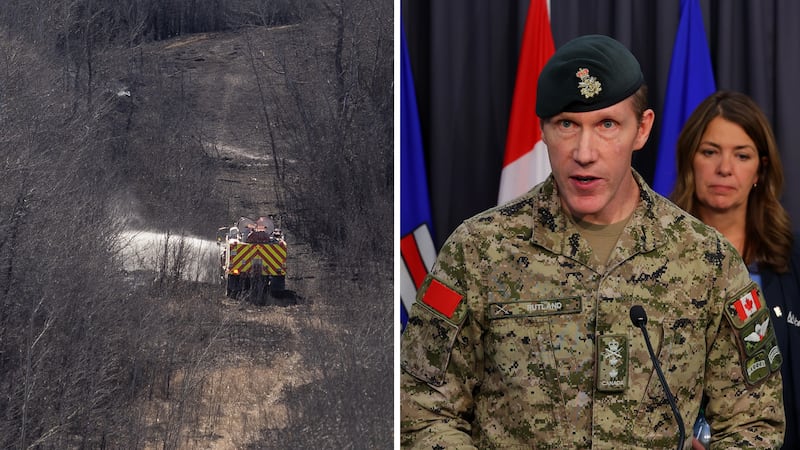
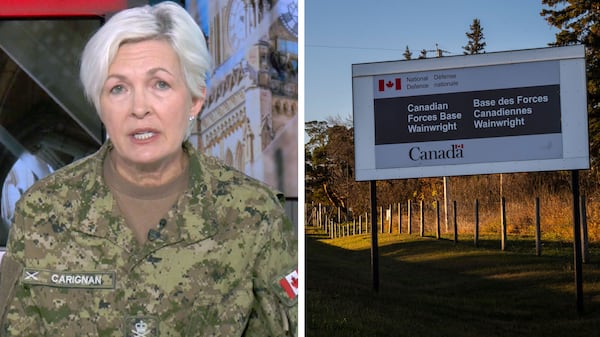
Four soldiers are dead and dozens are injured after a grass fire swiftly overcame a training exercise at the Canadian Forces Base in Wainwright, Alta., on Saturday. Wildfire specialists are saying the grass fire, which was about one kilometre away from the base at the time of the training, was fuelled by dry autumn foliage along with high winds. Mike Flanagan, a professor of wildland fire at Thompson Rivers University in Kamloops, B.C., said as a rule of thumb, grass fires typically spread 10 per cent the speed of the wind. “If it was a 50 km/h wind, it grew five kilometres an hour,” Flanagan told CTV News Edmonton Monday. “Grass fires are not uncommon in spring and fall when the grass is cured, turned brown or yellow. It’s easy to burn this time of year.” Given the unseasonably warm temperatures on Saturday along with low humidity, Jen Beverly, an associate professor of wildland fire at the University of Alberta, says the dry grass fuels were able to sustain ignition. “If you’re dealing with very light or no wind with a grass fire, it’s not a huge concern. It can be easily contained,” said Beverly. “With high winds, it becomes something very different, and you can end up with a very fast-moving fire front that’s very difficult to control.” Another contributing factor was the wind shift prompted by a cold front, accelerating winds in a different direction rapidly. “With the passage of the cold front, you get escalated wind speeds. Those are known to be very volatile conditions from a fire behaviours perspective,” said Beverly. Flanagan said winds were blowing the fire northeast before the wind shifted, blowing the flames southeast. “Grass fires are generally lower intensity than forest fires, and this can lead to the perception that grass fires aren’t dangerous,” explained Flanagan. “But under these conditions, the flames can be much larger, and unfortunately fatal.” Fire likely human-caused Because there was no lightning in the area as of late, Flanagan said the fire was likely caused by human activity. “As to what activity caused the human-caused fire, it’s really hard to say … You can speculate. There’s all sorts of ways fires start: windy conditions, downed power lines, unexploded munitions – which is a high probability given that they use live munitions at this range,” said Flanagan. “But we have to wait to see.” Investigators are working to determine the cause of the fire. With files from CTV News Edmonton’s Evan Kenny