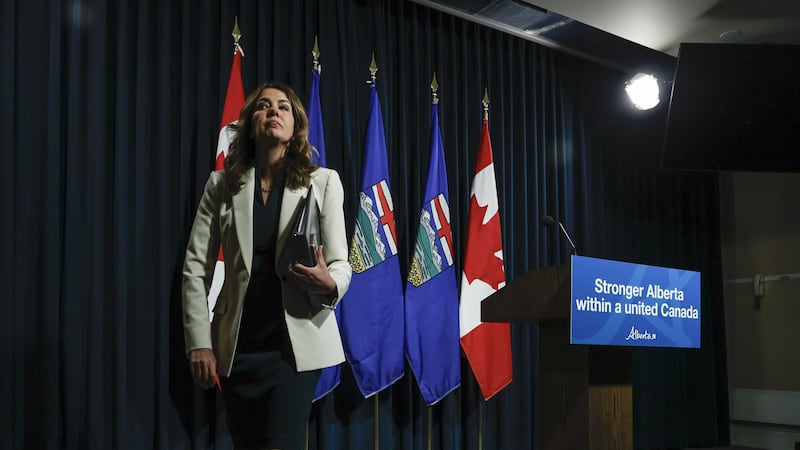
Premier Scott Moe says he was pleased with Alberta’s referendum vote, but he agrees with Alberta voters looking to gain more control over immigration. While one question during Monday’s referendum vote was focused on whether or not Albertan’s wanted to separate from Canada, nine others focused on immigration and constitutional challenges. The first asked Albertans if they supported the province taking increased control over immigration for the purposes of decreasing immigration to more sustainable levels, prioritizing economic migration, and giving Albertans first priority on new employment opportunities. According to preliminary results from CTV News, more than 56 per cent of voters said yes. “Any time we’re talking about immigration across Canada and Saskatchewan, it should very much be focused on economic immigration,” Moe said Tuesday. “I think there should be that cooperative federalism, that discussion that is happening, because the priorities might be different in Saskatchewan or Alberta than maybe they are in Atlantic Canada, for example.” Moe said he believes economic immigration is good for the immigrant arriving in Canada and the communities they’ll live in, and good for the province and nation as a whole. On Tuesday, Prime Minister Mark Carney acknowledged the vote results and said much of that work getting immigration to “sustainable” levels is already under way. “This government has recognized from the start, the need to take back control on immigration, and we’ve done so,” Carney said. “I believe, for example, on the issue of immigration and co-operation between the federal government and the provinces for a sustainable immigration system that works for Canadians, works for our economy, works for our society, and treats those who come to our country, choose to come to our country, with the dignity and standards that they deserve, that we can accomplish that without constitutional change.” Immigration levels in Canada reached a record high in 2024. According to the federal government, 483,640 immigrants were admitted as permanent residents that year, which was in line with targets set out in the Government of Canada’s Immigration Levels Plan at the time. In 2025 that number dropped to about 393,500 new permanent residents. Daniel Westlake, a Yaroslavsky senior research fellow at Vancouver Island University, said the country has seen a major shift on immigration since 2024. “A lot of the rhetoric around that flip were questions about stress on housing, stress on social services, the idea - whether or not this is true or not - that immigration was creating challenges in these areas of Canadian society,” Westlake said. “I think that speaks to a broader picture in the way people in Canada think about immigration, in that Canadians seem to be quite favorable towards immigration when it can be sold in economic terms.” Westlake isn’t surprised to see Moe reiterate his stance on immigration. He said that falls in line with the traditional thinking of Western alienation wanting to take more control over areas of provincial jurisdiction combined with the recent shift in immigration rhetoric. Two factors in this discussion are Saskatchewan’s current control over immigration, and the province’s co-operative relationship with Ottawa, according to Westlake. “Saskatchewan selects most of its economic migrants,” he said. The latest information available shows Saskatchewan has issued 4,023 nominations out of its 5,261 total allocations for the 2026 Saskatchewan Immigrant Nominee Program (SINP). Through SINP the province is able to select and nominate workers and entrepreneurs to apply for Canadian permanent residency. It doesn’t account for all newcomers, however, such as temporary foreign workers or international students. “Saskatchewan already has a substantial amount of control over their immigration. That hasn’t prevented Scott Moe from saying that Saskatchewan needs more,” Westlake said. Canadian premiers are set to meet in Ottawa with the Prime Minister next week, where Moe believes immigration has been pushed on to the agenda. Given the level of cooperation between the provinces and Canada in the last two years, Westlake doesn’t imagine there will be much change to the current status of immigration in the country. “I don’t know how much more you offer a province like Saskatchewan,” Westlake said. “You can say, ‘Well, you already have the provincial nominee programs.’ Do you just say that the provinces are going to have full control over economic immigration? I think that would be an odd stance for the federal government to take.” With files from Spencer Van Dyk