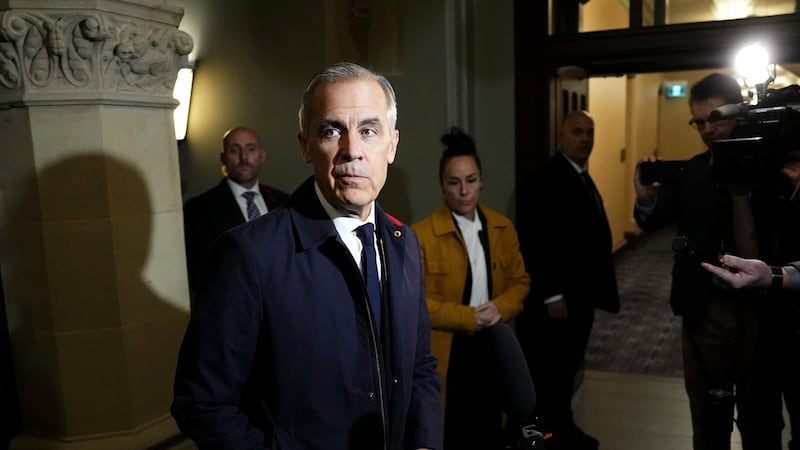
OTTAWA — The Canada-EU Summit being held this week in Montreal will serve to launch more formal negotiations on a deeper partnership over the next year, Prime Minister Mark Carney said Tuesday. Carney will meet with European Union President Ursula von der Leyen and other EU officials on Thursday and Friday in Montreal, where they are expected to announce the next stage of an enhanced alliance. “This is the launch of further formal discussions, negotiations, over the course of the next year,” Carney said on his way into the weekly cabinet meeting. The exact nature of the new pact between Canada and the EU has been unclear — even to the leaders themselves. In September, von der Leyen said the new arrangement could make Canada an “associate” member of the 27-member bloc. But “associate membership” does not actually exist in the EU and Canadian officials have downplayed the use of that term. “It doesn’t matter about specific names or nomenclature. What matters is the difference that it will make to lives of Canadians, young Canadians, in terms of opportunities to study work and travel, our Canadian businesses in terms of new opportunities,” Carney said Tuesday, adding it could open up new research opportunities as well. Carney used the term “alliance of the future” to describe the deal, which was first made public when he spoke to the EU Parliament in Strasbourg, France, last month. Jonathan Wilkinson, who took on the Canadian ambassadorship in Brussels earlier this year after spending more than five years in the Liberal cabinet, told The Canadian Press the labour policy discussions with Europe are focused on “specialized areas” where employers on both sides of the Atlantic could benefit from access to a shared labour pool. He said any measures that would make it easier for workers and students to move between the two jurisdictions must be approached in a “thoughtful way.” “We’re not talking about free movement of labour between Europe and Canada. But what we are talking about is, in some specialized areas, it may be actually interesting and useful for both countries to have the ability to tap into labour pools,” Wilkinson said. The ambassador did not cite specific sectors where labour mobility between Canada and the EU could be eased. The EU and Canada have been discussing increased collaboration on critical minerals, technology, defence and clean energy. Wilkinson pointed to work already done by Canada and Europe on mutual accreditation for architects and said any future decisions about labour mobility would be focused on areas of “mutual benefit.” Michelle Rempel Garner, the Conservative immigration critic, has called on the government to explain what these negotiations mean for people coming to Canada. “Canadians are already struggling with the cost of living due to immigration levels which are too high and have contributed to jobs becoming more scarce and workers getting paid less. Canadians deserve transparency on any EU immigration deal and how it would impact our jobs, homes, and health care,” she said in a statement. Canada has also discussed joining Erasmus+, the European Union’s student exchange program, which offers study and training opportunities in member nations. This week’s summit will take place on the 10th anniversary of the signing of the Canada-Europe Union Comprehensive Economic and Trade Agreement, or CETA. Nine EU members — France, Italy, Belgium, Ireland, Poland, Bulgaria, Cyprus, Greece and Hungary — have not yet ratified that trade deal. Wilkinson said he’s spoken with all 27 of his EU member nation counterparts and there is momentum in Europe to get more countries behind CETA. He did not name specific nations. “I think there are a number of countries that will be moving in that direction over the coming months. So that’s a process that will go along with the rest of this deepening of the relationship,” he said. One of the EU’s leading nations may have a new government soon. Marine Le Pen, leader of the far-right National Rally, is the current polling favourite to succeed Emmanuel Macron as president this spring. Le Pen delivered a nearly hour-long speech to supporters Sunday that focused on her party’s nationalist, anti-immigrant positions. Wilkinson said politics is always dynamic and Europeans and Canadians will go on sharing values regardless of which party is in power in a particular nation. “I think in France, it’s a very important debate that they are having. And I think that if in fact the government were to change, people will have to take stock of that,” he said. “But I do think that the European Union is a much bigger project than any one government in any one country. And I have a lot of confidence that Europeans will find their way through this and be just fine.” Wilkinson said energy and critical minerals — including natural gas, hydrogen and nuclear power — will play a crucial role in the enhanced partnership between Canada and the EU. “We’re looking at … how can we, for example, encourage significant additional European investment in Canadian minerals projects. We’re talking about how can we think about things like stockpiling together so that we actually can help to stabilize the market,” Wilkinson said. The European Investment Bank applied for an exemption from Canadian foreign banking rules earlier this month that would allow the state investor to operate in Canada as part of a critical minerals agreement. Wilkinson said Canada and the European Union are both looking for ways to build up the infrastructure to refine and ship critical minerals and reduce China’s market dominance. “That’s not a dependency that’s good for Canada. That’s not a dependency good for the European Union. So we are looking at that,” he said. With files from The Associated Press. This report by The Canadian Press was first published Oct. 27, 2026. David Baxter and Emilie Bergeron, The Canadian Press