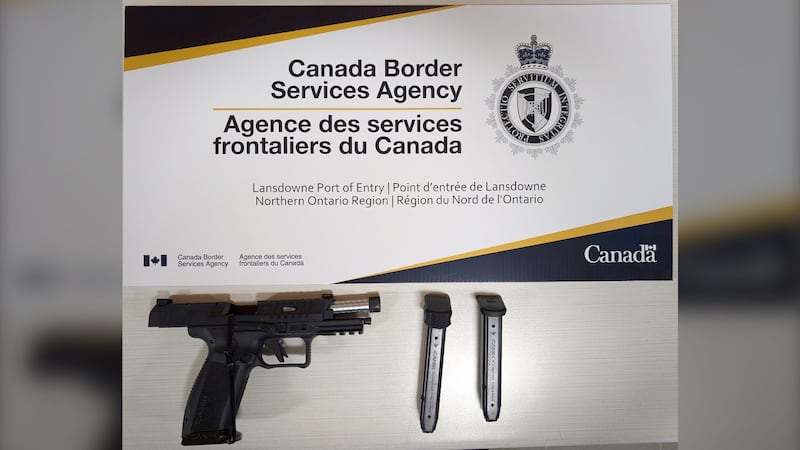
Border service agents in northern Ontario seized several guns last month from Americans trying to bring them into the country illegally, along with 17 prohibited weapons and 11 ammunition cartridges. The weapons – mainly handguns, but at least one rifle – were seized at border crossings near Fort Frances and Thunder Bay, as well as from the Landsdowne Port of Entry, which is near Kingston. Canadian Border Services Agency’s Northern Ontario Region is a huge area that begins north of the Greater Toronto Area, stretching to the Manitoba and Quebec borders and also includes Nunavut. Charles Fisher, district director of CBSA’s Northwestern Ontario District, said in an interview that the firearms were not declared by the drivers when the vehicles tried to enter Canada. “They were discovered during secondary examinations of the vehicles, which is just a normal part of the customs process,” Fisher said in an interview with CTV News. In many cases, he said Americans are just used to carrying guns with them and don’t realize they can’t bring them into Canada. “They are used to carrying a firearm in their vehicle with them throughout the United States, and sometimes they don’t realize (or) they forget about it,” Fisher said. Some travellers arrive at the border and declare they have a weapon in their vehicle. In those cases, they can get their weapons back. “They’re trying to do the right thing even though they’re not allowed to have it,” he said. “They’re given the opportunity to export it and take it back to the United States ... But sometimes, they are trying to sneak it into Canada. Sometimes they’re up to something worse, like trying to smuggle it in to be used (in) a crime.” In cases where undeclared weapons are found, the gun is seized along with the driver’s vehicle. The person must pay a fine to get their vehicle back. “They could be issued a deportation order right there at the port of entry, which means that they cannot come back to Canada without first applying for permission through the Government of Canada,” Fisher said. “So it really depends on the mitigating and extenuating circumstances and the seriousness of the offence.” Whether it’s a handgun or a heavy automatic machine gun, he said “a prohibited firearm is a prohibited firearm.” “So the monetary penalties will be roughly the same,” Fisher said. “It just depends on the circumstance.” If there was a criminal motivation, the suspect would be charged. Otherwise, the American would be sent back home and the weapon would be “seized and, ultimately, destroyed.” Across Canada in 2025, he said border officials seized a total of 830 firearms, including 39 in northern Ontario. In criminal cases, the weapons are confiscated and officials try to trace their origin as part of the investigation. “We tried to identify crime guns,” Fisher said, and find out if they have “popped up somewhere else.” He emphasized that Americans can bring in hunting rifles, as long as they follow the proper procedures. “Long guns, rifles, shotguns, they are perfectly legal to bring to Canada for the purposes of hunting,” Fisher said. “There is a process to go through where the traveller needs to apply for and get a non-resident firearm declaration that needs to be approved by CBSA.” There are a number of different ways that weapons are found by border officials, he said. There are random searches, background checks of people with a criminal history, as well as training border staff receive on what to look for. “When you pull up to the window and speak to the officer, they’re looking for different indicators,” Fisher said. Agents look for indicators “Verbal and nonverbal. They’re trained to watch how people respond to questions. (But) there is no magic tool.” They also receive information from colleagues on the U.S. side of the border about persons or vehicles to watch out for. They do have X-ray and large-scale imaging they do of trucks, which requires drivers to leave the vehicle first for safety reasons. Some criminals go to great lengths to hide weapons in their vehicles. “There are more and less sophisticated methods of concealment,” Fisher said. “We’ve seen lots of examples of some pretty interesting hides in vehicles coming into Canada.” Fisher’s advice for travellers is that, if you have something in your vehicle you’re not sure about as you cross the border, you won’t get into trouble if you declare it. “Even if it’s something that you can’t have, for the most part, we’ll figure out what we’re going to do with it,” he said. “In terms of firearms, as an example, if somebody declares a handgun coming into Canada ... they’re not going to get in trouble for having declared it to us. So always, if you’re unsure, ask an officer.”