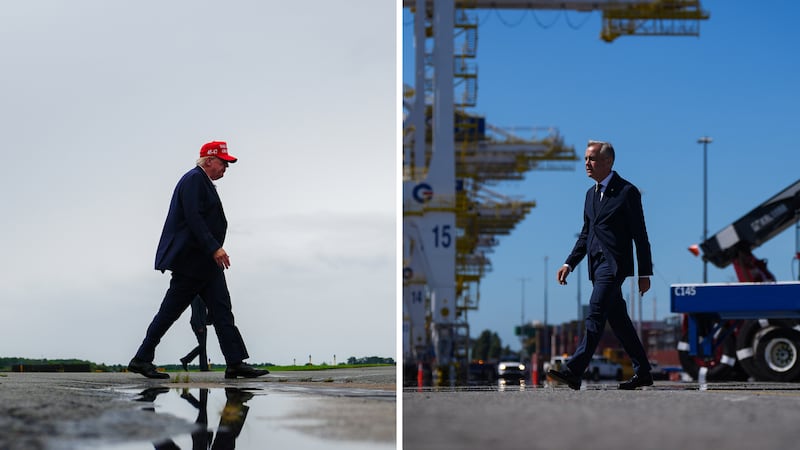
Quebec is launching two new programs for businesses in the province to help them cope with the breakdown of trade negotiations between Canada and the United States, as well as President Donald Trump’s imposition of 50 per cent tariffs on several products. Premier Christine Fréchette made the announcement Saturday at noon, shortly after a meeting with her ministers. “Trump is directly attacking our economic security,” Fréchette said right away. Businesses will be able to apply for both programs starting next week. The first program is aimed at small and medium-sized businesses with annual revenue between one and two million dollars, and the second at businesses with annual revenue exceeding two million. “We will complement the aid measures that the federal government is set to announce,” said Economy Minister Bernard Drainville, who stood alongside Fréchette during Saturday’s noon press conference. Fréchette is scheduled to meet with Canadian Prime Minister Mark Carney on Saturday afternoon. She intends to stress to Carney the importance of protecting businesses and workers, as well as the need to consult with Quebec if Ottawa wishes to implement retaliatory measures. Opposition parties react Earlier on Saturday, the leaders of various political parties reacted to the imposition of tariffs and the failure of trade negotiations. In a statement posted on social media, the leader of the Quebec Liberal Party, Charles Milliard, said that Quebecers need a government and a premier who have credibility and understand current economic realities. “This is not the time to re-elect a government at the end of its term, one that has been unable to provide the leadership needed to build a more resilient economy and that is incapable of obtaining the necessary information from our Canadian partners in the context of the current negotiations,” he commented. “We are in an economic war against the world’s leading power.” The leader of the Parti Québécois, Paul St-Pierre Plamondon, also shifted into campaign mode by asserting that “a Parti Québécois government will do everything in its power to protect and support Quebec businesses.” In his view, the turn of events has highlighted what he considers to be the position of weakness and passivity in which the CAQ and Fréchette found themselves. “By her own admission, Christine Fréchette had no information about what was happening at the negotiating table. How can you defend Quebec’s interests when you have no idea what’s going on?” he argued. Quebec Solidaire spokesperson Ruba Ghazal applauded Canada’s withdrawal from the negotiations. “It’s a good thing that Canada is standing up to Donald Trump for once—he’s completely unpredictable and is saying and doing whatever he wants right now—and that’s hurting our businesses and our workers,” she said during a press briefing on another topic. She also welcomed Christine Fréchette’s willingness to respond quickly to the crisis caused by U.S. intransigence. “The fact that she wants to act quickly to see what emergency aid she can provide—that’s a good thing; I applaud Christine Fréchette for doing so.” Other reactions While praising the Canadian government’s “firm stance,” the Quebec Employers’ Council said it viewed the suspension of trade negotiations between Canada and the United States “with concern.” “This is a major setback for Quebec businesses that were hoping to finally regain a modicum of predictability in their trade with our main trading partner,” acknowledged Michelle LLambías Meunier, president and CEO of the organization. According to the Federation of Quebec Chambers of Commerce, this is the worst-case scenario for Quebec businesses coming to pass. To assist them, the organization is advocating for various measures, including significantly increasing non-repayable financial support for liquidity and working capital, and implementing a temporary income tax holiday or relief for affected businesses. “The vast majority of businesses want a quick agreement because existing U.S. tariffs are already undermining their competitiveness. Faced with the new tariffs, the responses from the affected businesses are equally clear: they need non-repayable financial aid, not additional debt, and they do not want retaliatory tariffs,” said FCCQ president and CEO Véronique Proulx. On the labour side, the CSN says it will closely monitor the assistance programs that governments propose to help workers affected by the imposition of new tariffs. “The CSN will evaluate the assistance plans for businesses and workers that Prime Minister Carney and Premier Fréchette intend to present, and will make every effort necessary to defend and protect the workers affected by these new tariffs,” said Caroline Senneville. The FTQ has called on the federal and Quebec governments to provide urgent support to workers and businesses that will be affected by these new tariff increases. “Now more than ever, we must implement a truly bold industrial policy to free ourselves from the White House’s economic blackmail, which is dictated by the whims of a president who has no respect for his friends and allies. This crisis must be used as a springboard to build an economy for the future—one based on predictability, the creation of quality jobs, and the secondary and tertiary processing of our raw materials rather than exporting them and buying them back once they’ve been processed,” said FTQ President Magali Picard. This report by The Canadian Press was first published if French on Aug. 22, 2026.