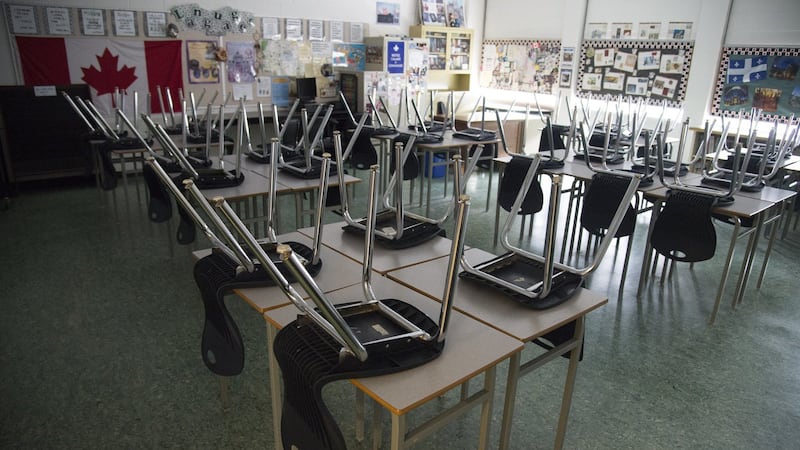
A few days before the return to school and the launch of the election campaign, Centrale des syndicats du Québec (CSQ) President Éric Gingras is calling on political parties to have the “courage” to say that “things are not going well” in education and to address the situation by reinvesting. “What does it mean to have courage in education? It means being able to say that things are not going well, that things are not going well because there is a funding problem. Things are not going well because there is a shortage. Things are not going well because workloads are heavy. Things are not going well because there is precariousness, which is causing problems with staff retention and recruitment,” Gingras said. The president of the CSQ and the presidents of its three federations, which represent teachers, professionals and school support staff, met with reporters Monday in Montreal for the traditional news conference ahead of the return to elementary and secondary school. Gingras and three of the CSQ’s federations, representing teachers, educational professionals and support staff, met with the press on Monday in Montreal as part of their traditional press conference to mark the start of the academic year in elementary and secondary schools. These problems are compounded by issues involving violence, digital technology, artificial intelligence and infrastructure. Gingras said he has already met with the political parties. Asked which party, then, has the “courage” he is calling for in education, Gingras replied: “This is a period when political parties are all courting us a little bit. They are always more willing to talk, more willing to listen. Now, will we be heard? I don’t have one political party that is more attentive than the others. I would say that being able to meet with them is one thing. Now, we’re waiting for the election campaign and we’ll be in a position to comment.” The CSQ is once again calling for a public inquiry into education that would bring together stakeholders from across the system to develop a 15- or 20-year education plan. The last major review of education dates back to 1995, Gingras noted. Professionals, support staff Eric Pronovost, president of the Fédération du personnel de soutien scolaire, said that as of April, Quebec was short 612 special education technicians and 888 school-based educators. “In 2016-17, we had around 180,000 [students]. In 2024-25, we have 250,000 students with special needs,” Pronovost said. Education professionals are also affected, including speech-language pathologists, psychologists and psychoeducators. “We had 500 fewer members in 2025,” said Caroline Desmarais, president of the Fédération du personnel professionnel de l’éducation. Unfilled absences, vacant positions and heavier workloads for those who remain are the result, she said. Richard Bergevin, president of the Fédération des syndicats de l’enseignement, stressed that teachers need help. A consultation with teachers last year found that “two to three students per class did not have the skills necessary to be at that level. Students are falling behind and that is obviously something that can lead to dropping out or to educational paths that do not lead to success,” Bergevin said. “Over the past two years, education budgets have not kept pace with inflation or with the cost of the system. There have been cuts. Obviously, teachers are often not cut because we need a teacher in the classroom. But all the staff around them, the professionals and support staff, have experienced cuts. We need these people in our schools and we need them alongside us, the teachers, to be able to provide services to students,” Bergevin concluded. This report by The Canadian Press was first published in French on Aug. 17, 2026.