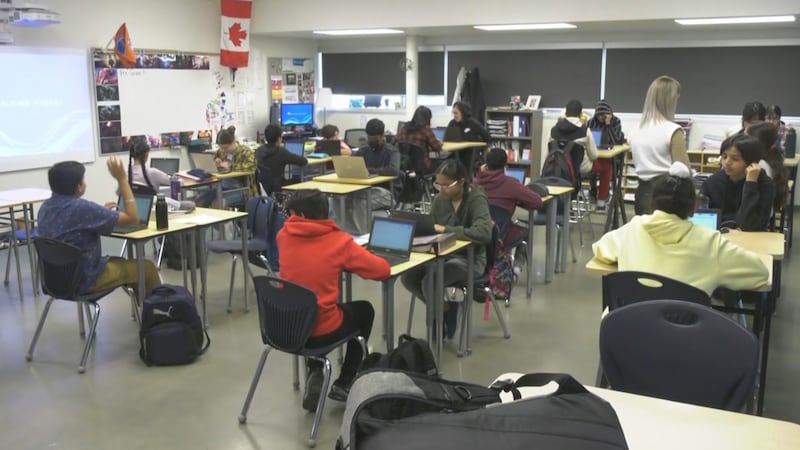
A new study finds a link between incentives that help students sleep better, which in turn resulted in improved academic performance. The study, published in the Journal of Political Economy, looked at 1,110 university students in the U.S., who were given small monetary incentives to build better sleep habits. They then looked at whether those habits would result in higher grades. The study is considered to be one of the most comprehensive behavioral field experiments ever conducted on sleep. Most students in study were sleep-deprived On average, the students slept 6.6 hours a night, with only 43 per cent meeting the recommended minimum of seven hours on weeknights. An overwhelming majority of students in the study – 85 per cent – didn’t get seven hours of sleep at least one school night per week. About half of them went to bed past 1 a.m. on average, and one in four went down after 2 a.m. For the study, students used Fitbits to track their sleep with a custom-built app that sent them bedtime reminders, feedback and digital payment as incentive. The app gave researchers a window into how the students engaged, and tested how cues, feedback and incentives impacted short-term sleep and longer-term habits. Students also filled out weekly surveys relating to their mental health and cognitive performance, which gave researchers insight into how sleep patterns played a role in students’ day-to-day routines, stress and productivity at school. Incentives helped sleep habits Students in the study got random personalized bedtime reminders, along with feedback in the morning, and if they met a seven-hour sleep goal, they were rewarded with $4.75 a night. Those measures helped boost the number of nights students got seven or more hours of sleep by 26 per cent. As a result, students in the incentive group also performed better during the semester Academic performance based on more sleep benefited first year students the most, the study found, specifically in STEM courses, and classes that took place in the middle of the day. Student participants in the study managed to build more regular sleep schedules and cut down on screentime at night. Physical activity and end-of-semester mental health scores weren’t changed significantly, however, students said they were better equipped to manage stress during the treatment period. “Our results show that helping students sleep more—and sleep better—can boost academic performance just as effectively as traditional academic interventions, but at a fraction of the cost,” researcher Osea Giuntella said in a release. Tips on improving sleep quality Robyn Stremler is a professor and dean at the faculty of nursing at the University of Toronto. She said this isn’t the first study to link between sleep and academic performance, with many focusing on children, adolescence or high school students. She noted that it makes sense that there’s a relationship between how sleep works and how our brain works. “We know that if you miss out on sleep, that does make it harder to keep on a task and pay attention,” she told CTVNews.ca. “Same thing for your ability to process information.” Stremler said that rapid eye movement (REM) sleep, in which we dream, is important for consolidating a previous day’s learning. “If you’re missing out on some of that, then it’s going to make it harder for you to retain new things that you’ve learned,” she said. When it comes to improving sleep habits, particularly in students, she said going to sleep at the same time and waking up at the same time is important. However, Stremler stressed that waking up at the same time in morning is more important, in order to feel more awake. “Part of that is because light is one of the biggest circadian cues that we receive,” she said. “Getting early sunshine or at least bright light is really important to keeping your circadian rhythm aligned, and similarly, trying to be in low light situations around bedtime is really helpful.” She added that the time when you eat also impacts the circadian rhythm, and suggests having breakfast to start the day. “If you eat breakfast, that too can help signal to your body, this is the time of day when you are awake,” she said.