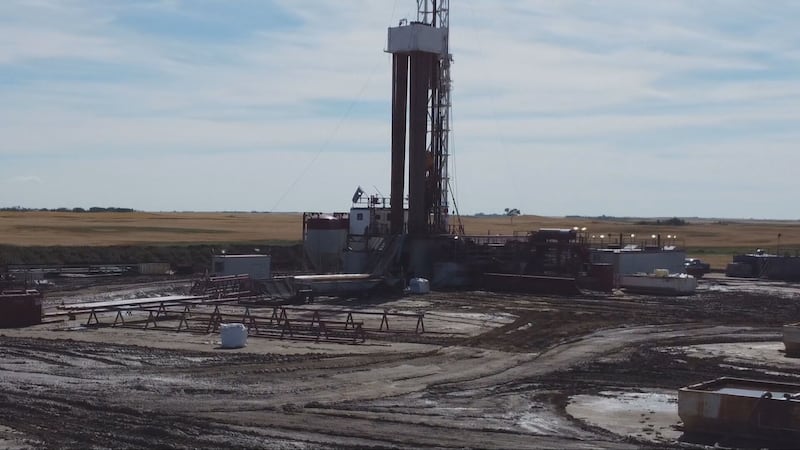
NEW YORK — Stocks are drifting on Wall Street amid the latest updates on the U.S. jobs market and further escalation in the U.S. war with Iran. The S&P 500 index rose 0.1 per cent Wednesday. The Dow Jones Industrial Average rose 189 points, or 0.4 per cent. The Nasdaq composite fell 0.1 per cent. Oil prices held steady as the U.S. and Iran intensify attacks against each other. That follows a monthlong lull in the six-month long conflict that has curtailed global oil shipments through the vital Strait of Hormuz. The jobs market is in focus this week. A private monthly report from ADP showed that employment slipped in August. THIS IS A BREAKING NEWS UPDATE. AP’s earlier story follows below. HONG KONG (AP) — World shares tumbled Wednesday after stocks slipped on Wall Street and as a global bond market sell-off deepened. The future for the S&P 500 lost 0.3 per cent and that for the Dow Jones Industrial Average was down 0.1 per cent. In early European trading, Britain’s FTSE 100 shed 0.6 per cent to 10,726.68. France’s CAC 40 fell 0.4 per cent to 8,260.77, while Germany’s DAX lost 0.6 per cent to 25,798.01. In Asia, Tokyo’s Nikkei 225 dropped 2.9 per cent to 64,325.64. Market heavyweight SoftBank Group, the Japanese multinational investment holding firm which invests in OpenAI, fell 6.4 per cent. South Korea’s Kospi lost 4 per cent to 6,562.72 on renewed selling of computer chipmakers. Samsung Electronics declined 4 per cent, while memory chipmaker SK Hynix fell 4.7 per cent. Hong Kong’s Hang Seng slipped 0.1 per cent to 25,311.21. Shein, the fast-fashion online retail giant that made its Hong Kong trading debut on Tuesday, fell 5.2 per cent. The Shanghai Composite index slid 1 per cent to 3,941.39. Australia’s S&P/ASX 200 fell 1 per cent to 8,978.40. Taiwan’s Taiex dropped 1.7 per cent, and India’s Sensex fell 0.6 per cent. On Tuesday, Wall Street’s benchmark S&P 500 slipped 0.7 per cent. The Dow industrials dropped 0.8 per cent, and the technology-heavy Nasdaq composite fell 1 per cent. The U.S. on Tuesday reported job openings grew slightly in July. Among some of the biggest decliners, Nvidia dropped 1.5 per cent, Amazon gave up 1.9 per cent and Advanced Micro Devices, or AMD, fell 2.4 per cent. Oil prices advanced after the U.S. launched another round of military strikes on Iran and Iran responded by firing missiles and drones across the region. Since the Iran war passed its six-month mark, escalating tensions between the U.S. and Iran have worsened worries over energy supplies. The Strait of Hormuz, an important waterway for oil transport, remains largely closed. Brent crude, the international standard, was trading at US$94.90 per barrel, up 0.1 per cent. It was trading at around US$72 a barrel before the start of the war in late February. Benchmark U.S. crude was 0.2 per cent higher at US$90.34 a barrel. Elevated inflation and growing government debt are helping drive bond yields higher as investors demand increased returns due to increased risks. Bond prices fall when bond yields rise, in an inverse relationship. The yield of the 10-year U.S. Treasury rose to around 4.81 per cent from 4.75 per cent on Monday. It was as low as 4.20 per cent in January. The 2-year Treasury yield, which tracks Federal Reserve interest rate moves more closely, was at about 4.40 per cent, up from 4.34 per cent on Monday. That’s compared to roughly 3.50 per cent back in early 2026. Japan’s 10-year government bond yield was at around 3.02 per cent early Wednesday, its highest since 1996 and up from around 2.94 per cent on Monday. The U.S. dollar fell to 159.84 Japanese yen from 160.17 yen. The euro was trading at US$1.1571, down from US$1.1593. --- Damian J. Troise, The Associated Press