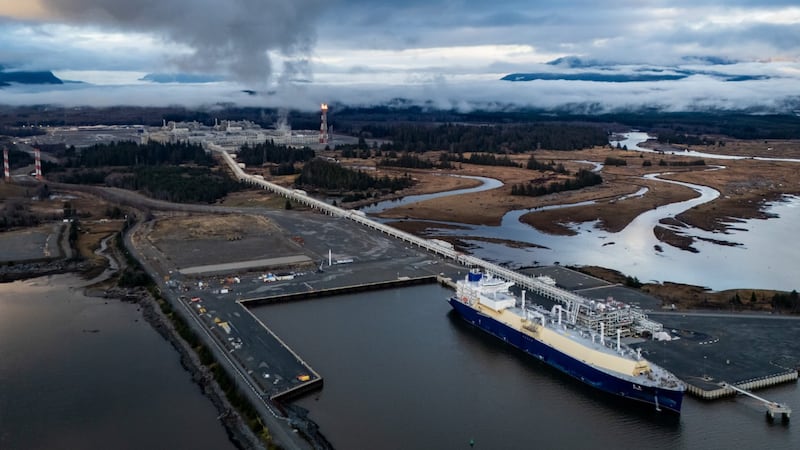
WINNIPEG – Beluga whales dominate the waters around Churchill, Man., during the summer months. Parks Canada says throughout the peak season, groups of between 3,000 to 5,000 beluga whales gather at the Churchill, Nelson, and Seal River estuaries, where they give birth and feed. This region provides much-needed protection for beluga whales from predators and is an essential habitat during a significant period of their lifecycle. But as interest in the region grows, so too does the prospect of increased shipping. “There will definitely be environmental issues, and whenever you have increased shipping, the risk is there,” said Feiyue Wang, a professor at the University of Manitoba and the director of the Churchill Marine Observatory. The return of Prairie grain is a signal that more activity will ramp up at the Port of Churchill moving forward. Approximately 30,000 tonnes of Canadian durum wheat, supplied by Saskatchewan-based AGT Foods, is being loaded at the Port of Churchill and will be shipped to customers in Europe this week. This marks the first shipment through the Port of Churchill since 2020, and is the first of three grain shipments expected out of the port this season, which will send more than 100,000 tonnes of grain to Europe. Chris Avery, who is the president and CEO of Arctic Gateway Group (AGG), which owns and operates the port, says the number of shipments – particularly for grain – will continue to increase. “We just expect more and more opportunities, whether it’s agricultural products, critical minerals or other energy products and any other commodities,” Avery told CTV News in Churchill on Monday. “We’re diversifying our trade, and we’re growing Canada’s exports to other markets.” Although renewed interest provides economic benefits, there are fears about the heightened environmental risk that increased shipping to the port brings. Wang and his team at the Churchill Marine Observatory are studying ways to prepare for potential disasters in Arctic waters as shipping traffic increases, including the possibility of oil spills. The observatory in Churchill has two outdoor seawater pools in the facility. The pools, which uses house water taken from the Churchill River, recreate Arctic conditions so scientists and researchers, like Wang, can see how oil behaves in cold waters. In warmer water, oil floats to the top of the surface and spreads, but in cold water, it can be trapped under sea ice and is harder to clean up. Wang says they are actively researching what impact increased shipping could have on marine life in the region – answers he and his team are trying to figure out. Year-round shipping in Churchill possible Currently, the shipping season out of Churchill is around four months, but new studies show year-round shipping is possible from the Port of Churchill. A recent report by the University of Manitoba, Fednav Ltd. and the Arctic Research Foundation, say advances in marine technology and declining sea ice due to climate change mean shipping can be greatly expanded from the current four-month window. It shows waterways could be navigated year-round by icebreakers costing between $100 million and $410 million, rather than the billions of dollars it would cost for more heavy-duty ships. Wang says researchers, like himself, are now looking at ways to mitigate risk to marine life, as year-round shipping is now a possibility. “By knowing where beluga whales are, where they migrate, what their migratory path and timing is, we could actually design the shipping route and the season to try to avoid, to try to minimize that risk,” he said. “There will be real environmental impacts, and there will be concerns there for other researchers,” he added. “As scientists, our job is to try to develop new technologies so that this risk could be reduced.” As Churchill looks to expand its role as a northern transportation hub, the mayor says the community will have a major say in what happens, bringing forth a challenge between balancing growth and the need to protect the Arctic environment and marine wildlife that call it home. “We’ll play a role in terms of how this all plays out, in terms of making sure that the lands that we occupy are done in a way that’s responsible,” said Churchill Mayor Mike Spence. Manitoba Premier Wab Kinew said earlier this year that Ottawa had indicated it wants to see liquefied natural gas shipped from Churchill by 2030. The federal Liberals have indicated upgrading the port is still of significant interest, but Northern and Arctic Affairs Minister Rebecca Chartrand told reporters in Churchill on Monday, that those plans are under review right now.