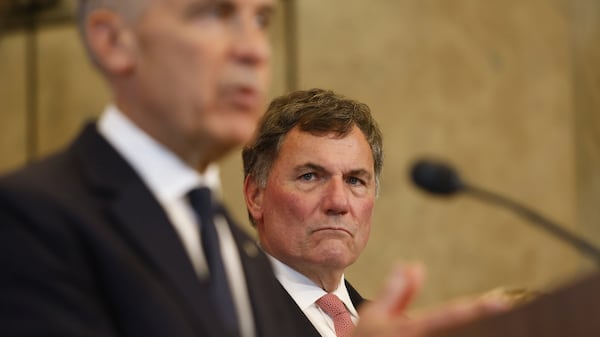
The Government of Saskatchewan and Bell Canada (BCE) are strongly denying NDP claims there is cause for concern over the involvement of two U.S. firms in the company’s Sherwood AI data centre project near Regina. Raising the issue during question period Monday, the Official Opposition called on the government to elaborate on how the inclusion of two future tenants of Bell’s AI data centre, Cerebras and CoreWeave, doesn’t undercut its argument on national data sovereignty. Cereberas Systems, a U.S. tech startup specializing in AI computing chips, lists 1789 Capital as an investor. Donald Trump Jr. serves as a partner at the venture capital firm. CoreWeave, formerly known as Atlantic Crypto Corporation, is an American cloud infrastructure tech firm based in Livingston, New Jersey. Trump reportedly purchased debt from the AI firm as part of a $50 million batch of purchases through December 2025 of various corporate and municipal bonds. Both firms are listed as tenants who will supply the centre’s compute hardware. In a statement to CTV News, BCE took issue with the NDP’s claims surrounding the nature of the Trump family’s connection to both Cereberas and CoreWeave. “There have been questions raised about the ownership of companies that are tenants of the first phase of Bell AI Fabric’s Sherwood data centre campus. Both are publicly traded companies with large market capitalizations and broad shareholder bases.” During debate on Monday, Crown Investments Corporation Minister Jeremy Harrison also pushed back on NDP criticism, highlighting Bell’s (BCE) Canadian ownership, the size of its investment in the province and the fact countless American firms work in the province. “There are a lot of American companies that are working here in Saskatchewan, who work subject to Canadian laws, subject to Canadian regulation, who pay taxes in Canada or royalties,” Harrison said, offering potash giant Mosaic as an example. “With regard to this project, Bell Canada is clearly not an American company, and Bell Canada obviously are running a business in which they have tenants.” When re-asked if the Trumps’ involvement with the two U.S. firms is worrying, Harrison minimized the concern. “I have no idea what the ownership structure of individual companies are. I think that this has been thrown out there on a whole bunch of different companies, about what their ownership or who owns shares or whatever,” he said. “The reality is these companies are subject to Canadian laws and regulations. That’s a partnership between Bell and them. The government is not involved in who Bell has as tenants in these projects.” CTV News meanwhile has learned the Trump family holdings are a fraction of one percent of each company and carry no control. 1789 Capital is not among Cerebras’s disclosed five per cent holders, and the CoreWeave positions are personal brokerage holdings worth at most 0.03 percent of the equity and 0.003 percent of the debt. The same family also owns small portions of Apple, Oracle, Nvidia, Microsoft and Amazon, all of which appear in the same disclosures and all of which the Government of Saskatchewan uses today. In its statement to CTV News, BCE reiterated the benefits and intention behind the project as furthering the cause of Canada’s data sovereignty. “Our focus is on building AI infrastructure in Canada that delivers for Canadians. With more than $50 billion in total capital investment, the Sherwood campus will be the largest AI data centre campus in the country and significantly increase the amount of AI compute available in Canada,” BCE wrote. “A significant portion of that capacity will be reserved for sovereign AI workloads, helping Canadian governments and businesses access the compute they need for sensitive workloads here at home. This is infrastructure being built in Saskatchewan, creating Canadian jobs, generating tax revenues in Canada and expanding the country’s AI capacity.” ‘Threat to our sovereignty,’ says NDP Saskatchewan NDP Leader Carla Beck and MLA Brittany Senger first raised their concerns during question period Monday. “This is absolutely a threat to our sovereignty,” Senger told reporters following the debate. “Having U.S. companies that Donald Trump, and the Trump family are investing in Saskatchewan, on Saskatchewan soil, frankly, should be terrifying.” Beck was blunt in her response to Minister Harrison’s claim of not knowing the details of the data centre’s operation. “The minister for CIC, who pretends, usually, to know everything, is suggesting he doesn’t know who is investing in these companies,” she told reporters following question period. “One of the companies was over a billion-dollar investment. In another, Donald Trump [Jr.’s] hedge fund bought out a significant portion of their debt. I think it’s frankly ridiculous to suggest otherwise by the minister.” In response, Harrison argued it would be impossible to keep every aspect of the data centre project a completely Canadian endeavour — given there are no domestic microchip manufacturers that could supply the project. “You actually can’t source these things from a Canadian manufacturer,” he said. “But as an example of how closely our economies are tied in a lot of ways. The architecture of NVIDIA chips is actually done in Saskatoon by Siemens.” Beck and the opposition renewed their calls for more transparency on the data centre project from the province, citing residents’ concerns as evidence of a lack of consultation. “Releasing the MOU or providing the public with information would be very helpful in terms of just even seeing if the minister truly does know anything about who the tenants are in this data centre,” Senger added. “That again is something that the government should have disclosed and should have an understanding of before this project goes through.” CTV News, CP24 and BNN Bloomberg are divisions of Bell Media, which is a wholly owned subsidiary of BCE Inc.