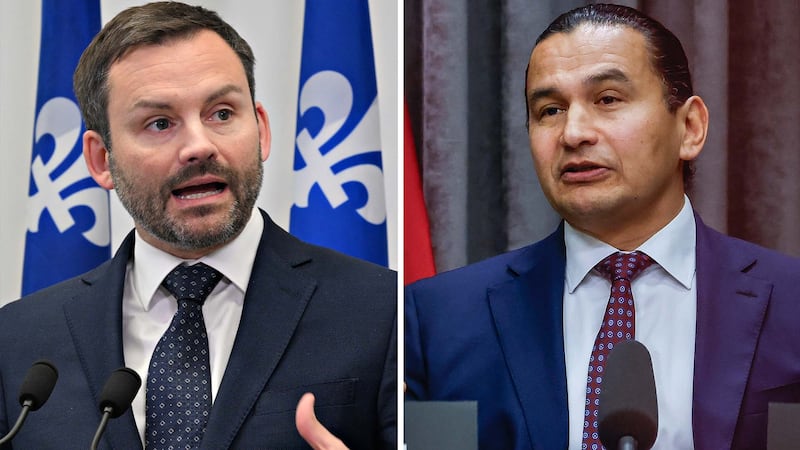
Tom Mulcair served as leader of the federal New Democratic Party from 2012 to 2017. He is a political commentator for CTV News and a columnist for CTVNews.ca. Canada’s Charter of Rights has just been dealt a body blow by a sharply divided Supreme Court. The ruling allows overt discrimination against religious minorities to continue and narrows the protection many believed section 28 offered to equality between women and men. The Supreme Court ruled that most of the law can remain in force because Quebec’s legislature invoked section 33 of the Charter—the “notwithstanding clause”—to shield it from certain Charter challenges, including those based on freedom of religion. That part of the ruling was not unexpected; it follows the Court’s earlier decision in Ford v. Quebec. Former prime minister Pierre Trudeau agreed to include the notwithstanding clause in the Constitution as part of the compromise that brought the provinces on board with patriation. Quebec’s government did not formally endorse the constitutional deal. The Court held that invoking Section 33 does not prevent judges from examining a law’s consistency with Charter rights or issuing a declaration of inconsistency. But the Court made no such declaration about Bill 21 in this case. It also recognized an important limit: all seven judges held that the ban on members of Quebec’s national assembly wearing religious symbols infringed their democratic rights. When Trudeau negotiated with the provinces some 45 years ago, the compromise included a way for legislatures to override certain entrenched rights. The expectation was that political pressure would make governments reluctant to use the notwithstanding clause. It must also be renewed every five years or it expires. Time, populism and growing intolerance have sadly proved that expectation wrong. Quebec is not the only province to have used the notwithstanding clause. Ontario, Saskatchewan and Alberta have also invoked it in legislation affecting rights, on issues ranging from labour relations to gender identity. The ruling also dealt a harsh blow to the guarantee of equality between women and men in Section 28 of the Charter. Section 28 says that, despite any other provision, the rights and freedoms in the Charter “are guaranteed equally to male and female persons.” The court divided 4-3 on whether section 28 could, by itself, prevent Bill 21 from taking effect. The four judges in the majority were men; the three dissenting judges—Justices Sheilah Martin, Andromache Karakatsanis and Michelle O’Bonsawin—were women. But the majority’s reasoning was not unanimous. Chief Justice Richard Wagner and Justices Suzanne Côté and Malcolm Rowe concluded that Section 28 is interpretive and does not create an independent substantive right to sex equality. Justice Nicholas Kasirer agreed that section 28 did not invalidate Bill 21, but on different grounds: he did not decide whether Section 28 created an autonomous right and concluded that it remained subject to section 33 in this case. Three women dissented. They would have found that Sections 6 and 8 of Bill 21 violated Section 28 and could not be saved by the notwithstanding clause. Section 6 prohibits certain people in public positions of authority from wearing religious symbols while carrying out their duties. Section 8 requires a person’s face to be uncovered when they’re providing or receiving certain public services. Justice Martin wrote separately; Justices Karakatsanis and O’Bonsawin also found that the provisions disproportionately burden Muslim women. The split is striking: three women judges dissented on this question, while the judges in the majority were mostly men. But the legal point is that the Court’s ruling means section 28 did not protect women from the effects of section 33 in this case. Why does this matter? The dissenting judges found that Bill 21’s restrictions particularly burden Muslim women. The law’s provisions do not apply only to Muslim women, but the ban on religious symbols can have a disproportionate effect on women who wear hijabs. Where does this lead? Bill 21 was only the beginning. Bill 94, adopted in 2025, has just come into force, and it extends restrictions on religious symbols to more people working or volunteering in schools. Further legislation has extended restrictions to daycare settings. Once again, Muslim women are being singled out in practice. Much of the news coverage of the Supreme Court decision has emphasized that Bill 21 targeted people in positions of authority, such as judges, prosecutors and police officers. Those were among the categories addressed in the Bouchard-Taylor Commission’s report to the Charest government. François Legault went further by including teachers who were not included in the Bouchard-Taylor recommendations. Quebec has now extended the restrictions further still. Under the expanded rules, a Sikh man who cannot wear his turban as a police officer may also be barred from working as a school janitor. Recently, a Gatineau mother was told she would have to remove her hijab if she wanted to volunteer at an extracurricular event—a hot-dog lunch and corn roast—at her child’s school. Asked about the case, Quebec Premier Paul St-Pierre Plamondon displayed what can only be described as an inability to understand basic notions of human rights. He simply said that an adult volunteer remains a person in authority: “La personne adulte bénévole demeure une personne en autorité.” Warming to his own argument, he added that “to maintain everyone’s confidence,” one should just accept removing the religious symbol and that’s not the end of the world! “Il y a des endroits où, pour maintenir la confiance de tout le monde, on accepte de le retirer [son signe religieux]. Ce n’est pas la fin du monde, on le remet après, là.” If there were any doubt about which religious symbols are likely to be treated as acceptable and which are not, St-Pierre Plamondon also said: “Si un signe peut être dissimulé, [s’il] peut être discret, moi, je suis de l’école de laisser quand même un peu de jeu.” In effect, he is saying that a small religious symbol may be overlooked, while a visible headscarf cannot. That is little comfort to the Muslim mother who was told she could not volunteer at her child’s school while wearing her hijab. Designed ‘to discriminate against Muslims’ Manitoba Premier Wab Kinew saw through the charade. He said, “Let’s just be honest here, this was designed to discriminate against Muslims primarily…” He added, “If I need to pick on somebody in order to get elected, I don’t deserve the office.” The Supreme Court’s high-sounding sociological explanation of Quebec’s unique history is a whitewash. People in Quebec are no less respectful of rights than people elsewhere in Canada. What is different is that successive Quebec governments have used fear of difference as a political weapon. And Quebec is not alone. The governments of Alberta and Saskatchewan have used public unease about complex questions of gender identity to shore up their political bases. That is equally shameful. Forget the rationalizations. As Wab Kinew put it, these governments are picking on people who are different. With friends and colleagues, I recently celebrated the 50th anniversary of our graduation from McGill’s Faculty of Law. We were fortunate back then to attend lectures by one of Canada’s most respected constitutional lawyers, Frank R. Scott. Scott famously fought for the rights of Montreal restaurateur Frank Roncarelli, whose liquor licence was revoked after he helped Jehovah’s Witnesses. That was in the 1950s, during Quebec’s “grande noirceur”—the Duplessis era. Even before the Charter, the Supreme Court of Canada was able to use the tools it had then to uphold rights that the government had trampled. The Supreme Court’s ruling on Bill 21 is a giant step backwards for rights in Canada.