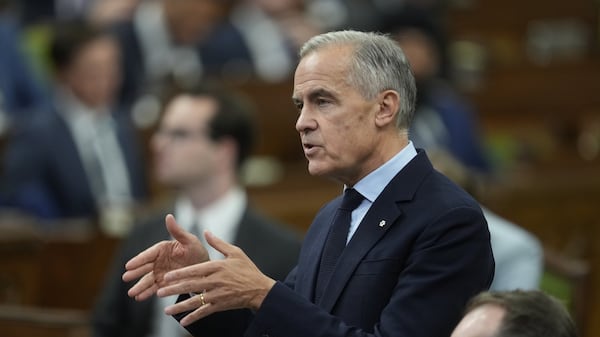
Greater Sudbury Mayor Paul Lefebvre held a news conference Thursday to offer the latest on what has been a very long recovery effort following Monday’s snowstorm. More than 40 cm fell on the city overnight Sunday and on Monday, largely shutting the city down. Many areas are still snowed in and recycling and garbage collection have been suspended for the week. Lefebvre said the first 24 hours were focused on supporting emergency services as more snow fell and roads became impassable. “Plows were deployed alongside police, fire and paramedic services to ensure they could reach residents in urgent need,” he said, as well as maintaining access to Health Sciences North. Aaron Archibald, the city’s chief of paramedic services, said they received 306 emergency calls as the storm unfolded March 15-16. “I can tell you that the decision to have key infrastructure assets available that could help paramedic and fire response and police response made the difference,” Archibald said. Police said emergency calls were actually down during the worst of the storm, but officers were out helping residents stranded by the storm. “Our officers were out moving and transporting individuals who became stranded during the weather event,” said Insp. Robert Norman. HSN CEO David McNeil said he was impressed by the extraordinary efforts volunteers, staff and physicians made to reach the hospital. “Many snowshoed, some skied, some snowmobiled, many carpooled and several walked through severe conditions so that our patients could continue to receive the care they needed,” McNeil said. “I spoke with one nurse in our critical care unit who walked eight kilometres to get to work just to ensure that care would continue to be provided. Their determination and sense of duty (are) truly, truly inspiring.” Once emergency responders were in good shape, Lefebvre said the focus shifted to getting roads open. It was a challenge because the volume of snow meant that traditional plows weren’t enough. “We have had to rely on loaders and graders because of the weight and the volume of the snow -- and even they have also been getting stuck,” he said. On Monday, 30 to 40 pieces of equipment got stuck, including city transit buses. CAO Shari Lichterman said all roads in the city should have been plowed at least once by the end of the day Thursday. The focus will then switch to widening them and helping residents whose driveways have been filled with plowed snow. “We have crews working to remove the large windrows at the end of driveways where possible, although it does take time to get to all of those,” Lichterman said. “We have also started clearing laneways and cul-de-sacs. We anticipate this work will take a few days because, once again, traditional methods are not working.” Crews need to pick up the snow and transport it somewhere, she added, to get the roads back to a more normal state. “We know there’s still a lot of work ahead of us, as we still need to address the large snowbanks,” Lichterman said. “Once all the access has been restored, we’ll turn our attention, as well, to bus stops and sidewalks in the coming days.” Full recovery will take weeks, she added, but they are acting as fast as they can. Borrowed snowmobile trail groomers “We’re also currently doubling the pieces of equipment that are out there,” adding that 160 pieces of equipment have been deployed, compared to the normal 80. “We’ve even resorted to some unconventional measures, including the use of snow machine groomers,” she said. “Thanks to a generous offer from the Sudbury Trail Plan.” Lefebvre acknowledged many residents are upset with the city’s response, but said a review of how things went will have to wait until recovery efforts are complete. “Right now our focus is on the work in front of us,” he said. “We are asking for your continued cooperation because the truth is, getting through a storm like this takes more than equipment. It takes a community.”