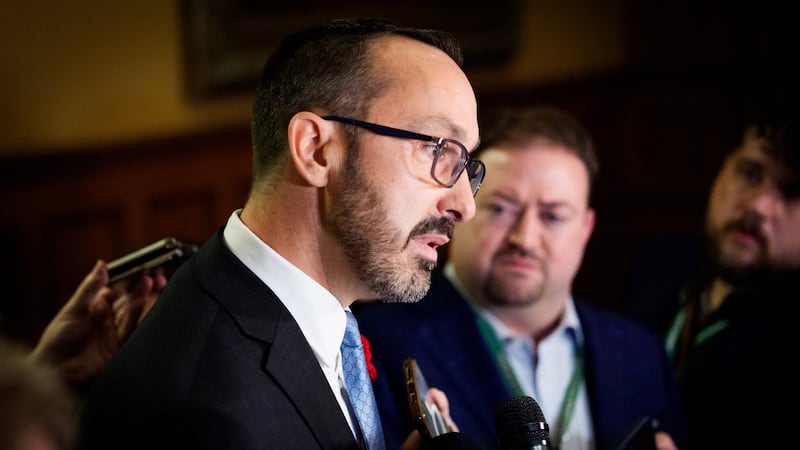
ST. JOHN’S, N.L -- Police officers in Newfoundland and Labrador have been leaving their jobs at “unprecedented rates,” according to a union president, giving police forces in the province a fresh set of recruitment and retention challenges. Const. Shane McClafferty, the new head of the Royal Newfoundland Constabulary Association (RNCA), says 35 officers have left policing over the past three years. He says it’s a rate that surpasses anything in recent memory. “We’ve never actually tracked it because it’s so unusual,” he said. “In my career, you know, a handful perhaps.” “That’s why it’s unique. It’s new territory for us, we’re navigating it.” McClafferty said rising crime rates, increasingly complex investigations, growing paperwork and judicial requirements and more violent crimes all add more stress to police officers — and push some to consider careers in the private sector, outside of policing altogether. “You see a bit of a shock factor because [it used to be] once you join policing, that was it,” he said. “You were police officer for three decades in some cases, or longer.” “And those days, I believe are over. You’re not going to see members working, you know, 30, 40 years because of the environment and how things have changed in policing.” Statistics Canada data suggests the total number of working police officers in Newfoundland and Labrador has been flat for more than a decade — even falling from 917 in 2009 to 870 in 2025. Meanwhile, criminal code incidents per police officer have increased, and so has the agency’s Crime Severity Index. McClafferty said police are increasingly being asked to respond to complaints rooted in mental health or addiction issues, where officers can struggle to offer solutions that can help the situation. “Whatever you have, the default factor is you call the police. And that’s just how society has evolved, and how everything has been put on a police officer,” he said. The new standards of length and complexity of investigations have also added stress to officers. McClafferty pointed to the investigators who built a case against Marcus Hicks, a Newfoundland teacher and volleyball coach sentenced to 18-and-a-half years in prison for sexual assault and child luring. Two RNC investigators won national awards for their work on the case — McClafferty said the investigation took “thousands of hours of police work.” “And you only have a certain number of officers that can put their time into it,” he said. “So, it puts additional stress into it.” Recruitment and retention challenges have been felt across police forces, particularly in remote and rural areas of Canada, according to Doug King, a professor in criminal justice at Mount Royal University. He says demographic shifts across the country are making it harder for police forces to recruit and a lot of their recruitment is coming at the expense of other jurisdictions. “The demographic shift is really important to consider,” he said. “Young people, between the ages of about 18 to 32, that percentage in Canadian society is actually shrinking because we’re an aging population. So that means the number of young people who would consider policing is actually shrinking.” An Auditor General report released in March 2026 highlighted recruitment issues at the RCMP. Auditors found the police force did not adequately plan to find out how many new recruits would be needed in its contract policing divisions across the country, did not meet its goals for graduating new cadets and did not fill the majority of its cadet training classes to capacity. According to the report, RCMP vacancy rates in Nunavut reached nearly 22 per cent and hit nearly 23 per cent in Northwest Territories. Only British Columbia and P.E.I. had a vacancy rate lower than seven per cent. The RNCA has begun negotiations with Newfoundland and Labrador’s provincial government for a new collective agreement. McClafferty said his negotiators will be looking for initiatives designed to improve work-life balance among police officers. McClafferty said one proposal would be to allow more flexibility and movement inside the Royal Newfoundland Constabulary itself, so officers could try different specialties within policing rather than leave the profession altogether. He’s also calling for more supports in communities that will take some of the most complex calls away from frontline officers. “I’m not naive enough to think that it’s just policing,” he said. “There’s other parts of our economy and our society that needs to be addressed.” “But right now, more investments in policing is absolutely essential in order for us to continue keeping the public safe.”