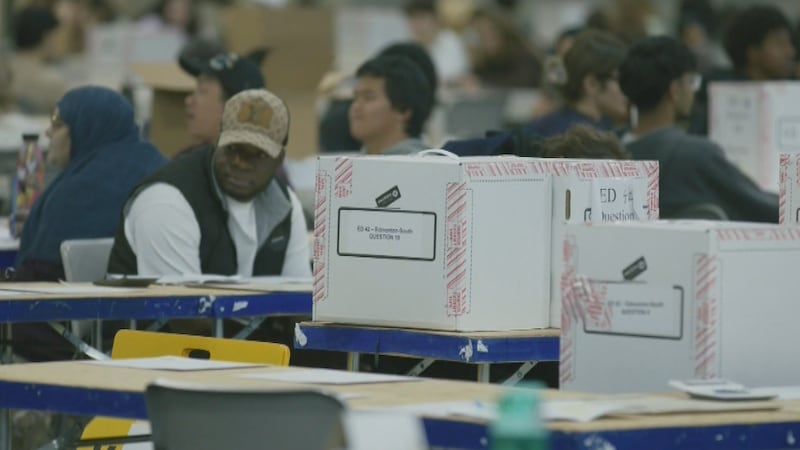
It was a resounding win for the pro-Canada side in Monday night’s historic Alberta referendum, but results for the other nine questions put to voters remain decidedly close. The vote count continued Tuesday afternoon on the first nine questions on the ballot, but the yes vote was leading on eight of those, including five questions on immigration proposals. Those questions asked whether Albertans supported the provincial government taking more control over immigration matters — including what kinds of social services newcomers to Canada could access, such as immigration and health care. Other questions sought a mandate to work with other provinces to change the Constitution and wrestle power away from Ottawa. The standout leading ‘no’ vote was held by narrow margins on Question 8, which asks whether the Alberta government should join forces with other provinces to amend the Constitution to allow provincial governments to opt out of certain federal programs. Ninety per cent of polls had reported as 5:45 p.m. on Tuesday. Elections Alberta says it expects all ballots to be counted by Wednesday. ‘We need immigrants in this province’ Since Smith announced the nine questions earlier this year, critics have called the questions anti-immigrant dog-whistling. Some voters on Monday night told CTV News said that sentiment remained true for them as they voted, and that immigrants are welcome in Alberta. “I don’t know what she (Smith) could do with those immigration questions,” Dominick Rotante, a No to the Nine supporter, told CTV News at a results party on Monday night. “We already control immigration and (when) immigrants come to this province, they provide more than they take. We need immigrants in this province.” Nketti Johnston-Taylor agreed that Alberta needs immigrants. “Immigration has been the driver of growth in Alberta and it’s going to continue to do so for a number of years,” the CEO of Centre for Newcomers told CTV News on Tuesday. Johnston-Taylor added many newcomers to the province work high-paying jobs, such as in engineering and health care, and contribute $4.1 billion in taxes each year. But still, the yes side was leading on immigration questions, with roughly 54 to 58 per cent of the votes as of 5:45 p.m. on Tuesday. One exception is Smith’s proposal to require proof of citizenship to vote provincially, which led by about two-thirds of the vote. The leader of the federal opposition believes there is a case for decentralizing immigration. “They (the provinces) have to provide the services, regulate the job market and the housing for people who come in,” Conservative Leader Pierre Poilievre said. What’s next? Smith is set to deliver a televised address to the province on Tuesday evening to further spell out what the results mean. Carney told reporters in Ottawa earlier on Tuesday the federal government will “take into account” the votes on the nine questions. He also warned constitutional change can be a “difficult” and drawn-out process. But some legislators and politicos are split on whether the premier has a mandate to change policy as the leading margins remain slim. “If she wanted a mandate, she should have been able to get 85 per cent on questions like this, and she was unable to carry the day,” Alberta NDP Leader Naheed Nenshi told reporters. He added the premier should stop scapegoating immigrants and “be a premier for all Albertans.” That sentiment carried as far as the Senate. “They were push poll questions designed to make people angry in the polling booth,” said Sen. Paula Simons, who is from Alberta. “Even though they won by a pretty slim margin, I don’t think that they give the premier a legitimate mandate.” But for one former UCP press secretary, the result marked a clear mandate for the premier. “Governments get elected on less than 50 per cent in this country, and then they move forward with implementing a mandate,” said Colin Aitchison, who is now a managing director with Enterprise Canada. With files from Alesia Fieldberg and The Canadian Press