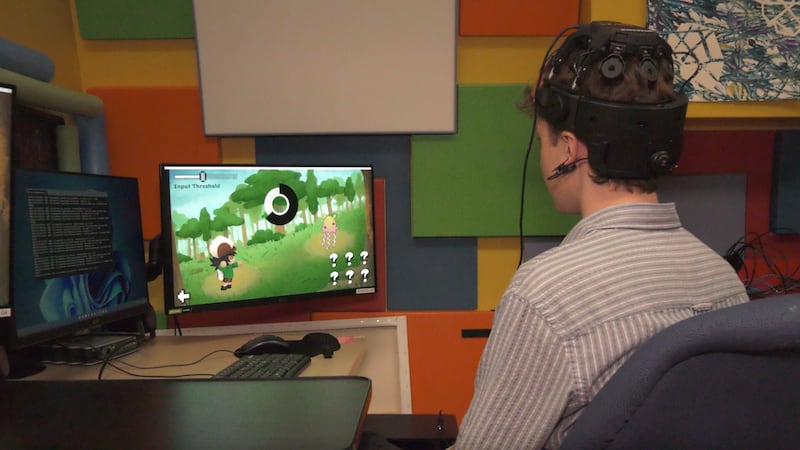
A group of University of Calgary student researchers are finding ways to better understand the brains of children with cerebral palsy and turning their findings into accessibility tools. The Cerebral Palsy UCalgary Network is researching and creating tools with a brain-computer interface — also known as a BCI. The interface can read brain signals and be used in a wide variety of tools to improve accessibility for those with cerebral palsy. “This could be a game, this could be a device, this could be something to help with mobility or communication,” said UCalgary biomedical engineering student Isabel Gonzalez. “We can help them use BCI to play video games, to listen to music, or to even scroll on TikTok,” added UCalgary neuroscience student Dakota Hofforth. Cerebral palsy — the most common child motor disability — impacts 80,000 Canadians. It can take many different forms and have varying levels of impact, and the researchers are optimistic their work can lead to a multitude of different uses. “The great thing about the BCI we work with is they don’t require surgical implementation,” Gonzalez said. “They are completely external, so you would place this headset on the participant or on your head and they have electrodes. These help read your brain signals.” The executive director of one Calgary-based advocacy group said the abilities the technology grants to those with cerebral palsy is “incredible.” “I have a son who’s 31 years old and these were things that we could have only dreamed about when he was young,” said Sheralee Stelter with Cerebral Palsy Kids and Families. Hofforth’s research focuses on strokes that happened near or around birth, looking at brain scans and imaging to see brain lesions that result in different movement and developmental patterns. He calls his work “preliminary,” but is optimistic it could lead to the creation of other technologies and accessibility tools. “My work is primarily the groundwork that lets the other researchers in the lab and outside the lab to build new technologies to provide ways for kids, like we see in BCI, to access different things and participate in life activities,” Hofforth said. Gonzalez and Hofforth demonstrated one case, being a prototype video game using a headset that detects changes in brain signals. “The user who is wearing the headset is going to be thinking of something that will activate their brain. For example, maybe they’ll be thinking about bouncing a basketball. That brain signal will then be detected by the headset and will be output into the game,” Gonzalez explained. She says this framework could extend beyond games, and it could be used to improve mobility in powerchairs, turn electronics on and off, improve communication and more. “For example, if we connect a BCI to a speaker and the participant thinks ‘go,’ the speaker can then read the hardware that is developed by the engineers, and the software can read this brain signal and interpret it as ‘they want to turn on the speaker,’ and the speaker can then turn on,” Gonzalez said. Within the Cerebral Palsy UCalgary Network, other students are implementing sensors and technology in other ways outside of brain scans. “The other research aspect that is also going to be explored is how we can use sensors in shoes of children with cerebral palsy to understand how they walk and move,” said the organization’s co-president and founder Muhammad Saim. You can learn more about the research being done at a free student research showcase on Tuesday from 5:30 to 7:30 p.m. at the University of Calgary’s Clare Christie Theatre on its Foothills Campus. You can register here.