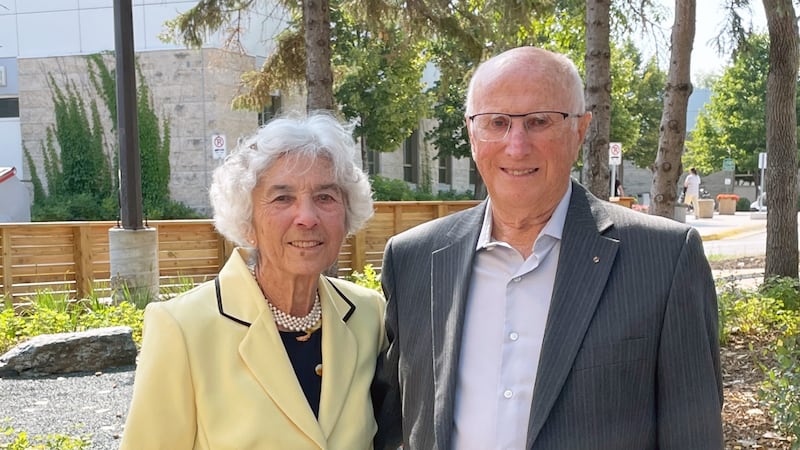
A new team-based health clinic has opened at the University of British Columbia, providing primary care to thousands of patients while giving health-care students hands-on training. UBC said the new clinic is the first of its kind in the province and is now accepting patients, with the capacity to provide primary care for up to 4,450 people. The Gateway Team-Based Care Teaching Clinic brings together licenced health professionals, while also serving as a training site for UBC students from a range of health disciplines. The clinic is located inside the newly named the 270,550-square-foot MacIsaac Health Building, which also houses several UBC health-related schools and programs. The building is named after the MacIsaac family, who donated $40 million to UBC—a gift the university said will support health education, research and clinical training. “We are deeply grateful to the MacIsaac family for their visionary, transformational gift to UBC and to the future of health-care in B.C.,” UBC President and Vice-Chancellor Dr. Benoit-Antoine Bacon said in a news release Friday. “The MacIsaac Health Building reflects UBC’s vision for the future of health education, research and care—one in which people across disciplines learn from one another, advance knowledge and put it into practice to improve health in communities.” Patients at the Gateway Team-Based Care Teaching Clinic will receive care from family doctors, nurse practitioners, pharmacists, physiotherapists, occupational therapists, dietitians, social workers and other health professionals. UBC said students will work alongside professionals in the clinic, gaining supervised experience while treating patients with health concerns that may require care from more than one discipline. Dr. Julie Tipping, the clinic’s program director and an assistant professor of teaching in the MacIsaac School of Nursing, said the model gives students experience working as part of a team in a real clinical setting. “Many patients live with complex conditions that extend far beyond any single discipline’s scope,” Tipping said in the release. “When students deliver care as a team in a real clinical setting, they quickly learn where their own scope ends, where a colleague’s begins, and how much better care can be when those perspectives are combined.” Physiotherapy student Max Szkarelat said the approach allows providers to work together rather than treating different health concerns separately. “When a patient tells us what matters most to their health, the team determines the best person for them to see,” Szkarelat said in the release. “If medical concerns arise, the family doctor and nurse practitioner are there to address them. Seeing that collaboration gives us a model for how we can work together.” The building will also be used for research, including simulation training with advanced medical mannequins that can mimic symptoms and respond to treatment. UBC said provincial funding will support the clinic’s staffing, operations and program development, as well as work to test models and education that could potentially be used in other clinical settings across the province.