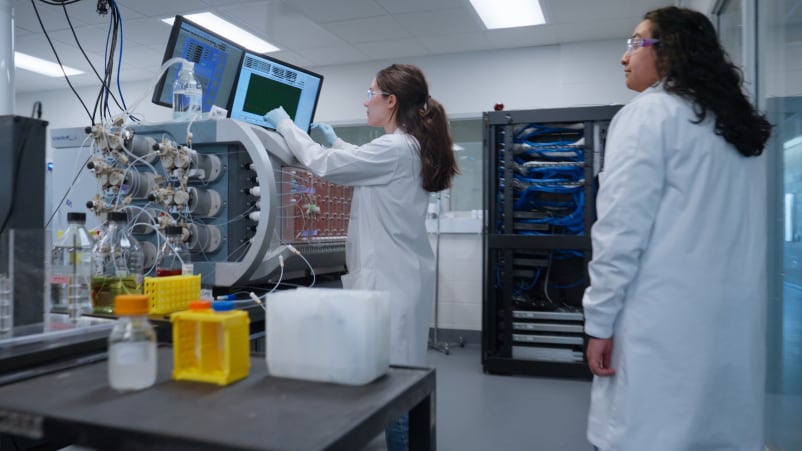
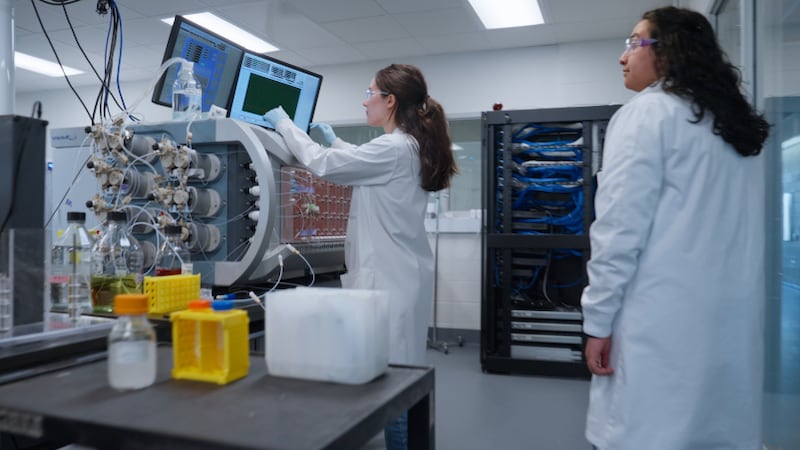
Inside the halls of McMaster University sits a laboratory researching how to optimize the manufacturing of therapeutic medications and, in turn, potentially lower the costs passed on to patients. Named the Sartorius Bioprocess Automation Lab, it was established in 2021 through a partnership between German life sciences manufacturer Sartorius and McMaster University. The Germany-based company was reportedly searching for a Canadian research and development facility where it could test biomanufacturing processes in an open and safe environment. “It’s a test track for biomanufacturing processes, we can push them to their limits and see where they fail,” David Latulippe, a professor at the university and co-director of the McMaster Biointerfaces Institute, said in an interview with CTV News. Biomanufacturing is the process of using living organisms, such as bacteria, yeast or animal cells, as microscopic factories to make everyday goods and medicines. When applied to medicine, biomanufacturing often requires significant space and operating costs, which can contribute to expensive medications and treatments. Prashant Mhaskar, also a professor at McMaster University and co-director of the program, says that him and Latulippe see the space as a “sandbox” to better understand these medications and develop new methods through the intersection of software and hardware processes. “We have this unique setup of being able to go into the lab, work with industrial partners, work on real problems,” he said. “It gives the companies, us, the research, like students and everybody, that opportunity to try out ideas to see if it works.” Sector has to be ‘conservative’ Companies producing these medicines operate out of good manufacturing practice (GMP) production facilities, which are subject to strict safety and production standards, with locked-in, validated processes for manufacturing medications. While important safety standards are maintained at research labs, including this one, the researchers behind the space say that its processes can be more flexible to allow for a creative workspace where they can better understand medications and how to produce them. According to Mhaskar and Latulippe, the lab has the same equipment found in major production facilities. “The lab was like designed to mimic a fully regulated manufacturing facility, what we would call a GMP facility. But we’re operating in a way that we don’t have any of the sort of those restrictions that would typically be in place, around paperwork and the quality of the material and everything that’s coming in,” said Latulippe. “Everything that we’re doing is purely for research purposes. We have all of the equipment that would be in those regulated facilities. So what does that let us do? It gives us a great training environment.” “We’re able to operate outside of those bounds because nothing that we produce goes into a patient,” added Mhaskar. Mhaskar likened biomanufacturing to cooking tomato sauce: when ingredients vary, you monitor the batch and adjust the recipe to get a consistent result. “If you are able to put sensors in our process you use that information to deduce… what changes must I be making to reject this variability, still get the same product,” Mhaskar said. Current progress One of the lab’s most recent breakthroughs, according to both professors, came from a student who developed a method for controlling a bioreactor used to produce a protein therapy for an unnamed autoimmune disease. A bioreactor is a vessel that provides controlled conditions for growing cells. In this case, engineered cells inside the vessel produce a therapeutic protein and the lab’s student-developed software is designed to help control the process. The lab currently works with bioreactors holding tens of litres, while larger companies operate at around 1,000 litres. The researchers said a key test for their methods will be whether they can be scaled up from the lab and work reliably at the volumes used by industry. The lab could help reduce medicine costs by making biomanufacturing research and development less expensive. Researchers can test processes in the lab before moving them into costly, regulated production facilities. “That’s where we feel we can have a significant impact is by shrinking the R&D costs of the process,” Latulippe said, while noting that medicine prices depend on many factors. “Companies want to do this. Regulatory agencies want this… They want better ways of doing this. It’s just you need that data to support it,” Latulippe said.