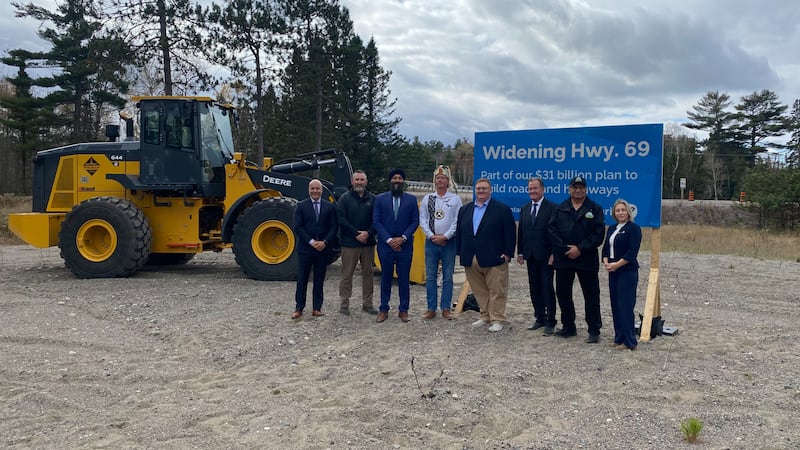
Ontario has completed 84 kilometres of four-laning on Highway 69, but drivers waiting for the remaining 68 kilometres to be widened learned Thursday that construction has not started — the province instead announced it wants to accelerate the work by five years. At a news conference beside the highway near Key River, Transportation Minister Prabmeet Sarkaria and Northern Economic Development Minister George Pirie said the government intends to introduce the Building Highway 69 Faster Act, legislation that would streamline the environmental assessment process and, if passed, allow the remaining two-lane section to be widened to four lanes up to five years ahead of schedule. Familiar frustration The announcement was the latest in a long series of news conferences on the side of the highway, and Graydon Smith, MPP for Parry Sound-Muskoka, acknowledged the repetition himself. “At recent public open houses, I heard the same questions repeatedly: ‘Why are we still studying things that we’ve already studied?’ It’s a fair question. We should be building on the environmental work already completed and continuing to protect our environment and fulfil our duty to consult with Indigenous communities,” Smith said. Sarkaria said the proposed legislation would establish a project-specific environmental assessment framework that builds on work already completed, modelled on similar measures introduced to speed up construction of Highway 413. “By streamlining the environmental process. That means building on environmental work already completed, removing unnecessary delays and allowing eligible work to move forward sooner, all while maintaining environmental oversight and fulfilling our duty to consult with Indigenous communities,” Sarkaria said. In a news release on Oct. 22, Sarkaria added that northern Ontarians have waited long enough for a safer, more reliable highway, and that cutting red tape would accelerate construction while improving road safety and strengthening the corridor connecting northern Ontario to the rest of the province. Six sections, three First Nations Sarkaria has said the remaining 68 kilometres will be built in six sections, with four under construction by the end of 2027. However, before any of that work begins, utility poles will need to be relocated and trees cleared from each site, he told reporters Thursday. The sections fall within the territories of three First Nations communities, all of which are negotiating with the government to provide land. Chief Adam Pawis of Shawanaga First Nation said the communities are at different stages but share a goal. “Our communities have been working with the province of Ontario for a number of years and although we’re all at different locations in our discussions, we have made the commitment to Ontario, to our people and to our region to ensure that this highway gets built as fast as is humanly possible,” Pawis said. Greg Rickford, Minister of Indigenous Affairs and First Nations Economic Reconciliation, said in the release that the project represents an important opportunity for responsible regional partnerships and development, and that continued collaboration with local communities and First Nations is central to advancing shared priorities of highway safety and economic opportunities. Economic stakes The ministers say a four-laned Highway 69 is essential to the economy, linking northern Ontario to the rest of the province. Pirie framed the project against shifting trade pressures. “As we pivot away from our dependence on US markets, it is critical that we have strong transportation networks that bind our province and country together,” he said. In the release, Pirie added that accelerating the expansion will improve road safety, strengthen supply chains and give Sudbury and northern communities the modern infrastructure they need to grow, attract investment and remain competitive. The province is also calling on the federal government to support the corridor by expediting outstanding environmental and regulatory approvals, advancing rail relocation work with Canadian National Railway and ensuring timely approvals for watercourse crossings. Ontario said federal support would help keep the project on track for shovels in the ground as early as next year. Sarkaria said the price tag for the four-laning won’t be made public until after the tendering process is complete, but added the benefit will far exceed the cost.