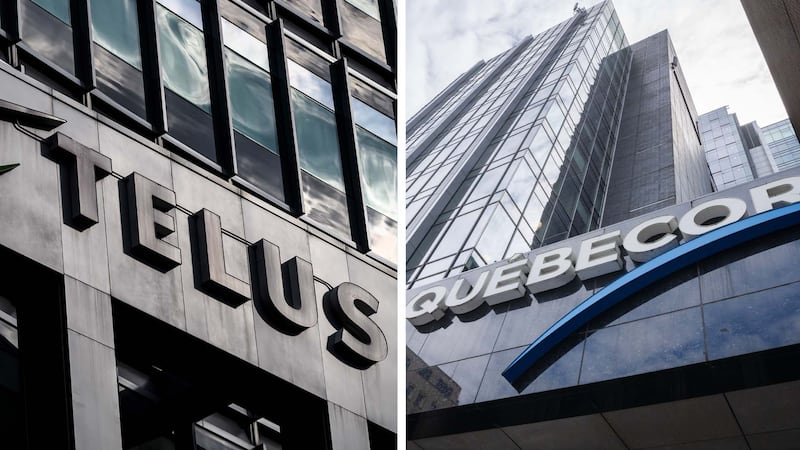
Quebecor Inc. revealed Monday it is proposing a merger with Telus in what would be a $31-billion, cash-and-stock deal. The Montreal company’s bid to buy Vancouver-based Telus raises questions ranging from the effect on your monthly cellphone bill to whether regulators would consider greenlighting the proposal in the first place. Here are a few question marks still dangling over the would-be deal: How would cell charges be affected? A merger could mean one less operator in Canada’s already sparse telecom landscape — dominated by Rogers Communications, Bell’s owner BCE and Telus, with Quebecor and a handful of regional players such as SaskTel and Cogeco rounding out the players. “With three instead four, there will be simply less competition,” said Erik Bohlin, the telecommunications chair at Western University’s Ivey Business School. “You would expect some upward price pressure, maybe not taking effect immediately, but over time.” It’s in the wireless sector where some of the biggest questions continue to arise. “The biggest problem is going to be on the wireless side,” said David McFadgen, managing director of institutional equity research at ATB Cormark Capital Markets. “Regulators are going to say, well, we don’t want to go from four competitors to three, then we could be back into a situation where just had the Big Three and they kind of all move together on price.” The Competition Bureau has said it found clear evidence that wireless prices are higher in areas without strong regional competition. The case could be stronger for merging services on the ground. Outside of Quebec, Quebecor has a minimal wireline network — a communications system that runs on ground-based cables — and has to buy internet access from the Big Three via a wholesale model. On the other side, Telus buys access wholesale in parts of Quebec. “It limits their ability as to how competitive they can be,” McFadgen said, noting that if Quebecor boasted its own system, it could save money on tapping those networks. “They’re going to promote that to the regulator: because of that, we will deliver lower prices.” Will regulators allow the deal? Pro-merger arguments persist, with some plausible grounds for a conditional deal to go through. “Quebecor’s strongest competition argument is that the combined company would have the scale to challenge Rogers and Bell more effectively and invest in networks,” said Carol Liao, a law professor at the University of British Columbia. However, she said regulators would want to know whether customers would have comparable alternatives, including to Freedom Mobile. Shaw and Rogers agreed to sell Freedom to Quebecor when those companies were completing a 2023 merger, assuming its divestment would help their $26-billion deal gain regulatory approval. “Regulators would want to know where Freedom directly constrains Telus and its other brands today ... and how Freedom would likely develop independently,” Liao said. Something comparable to the forced sale could play out once more this time around, though the buyer seems less clear. “They would probably force a spin-off of some wireless assets,” said McFadgen, who pointed out that many Freedom customers enjoyed lower rates after the sale. “You would have Shaw-Rogers all over again.” Why does Quebecor view Telus as ripe for the picking? Telus’s large footprint in Western Canada, its troubled growth strategy and its weakened stock price all make the company attractive in Quebecor CEO Pierre Karl Péladeau’s eyes. A Telus deal would mark “a huge complement” to his business given the direct, countrywide reach it would allow, Bohlin noted. The Vancouver-based company has also hit some stumbling blocks in recent years, including in divisions focused on digital customer services and health care that have failed to yield promised returns. “The growth strategies of Telus have run into problems. Telus International, Telus Health and Telus Agriculture; they are on the sell list,” Bohlin said. They are also among the items weighing on its stock price, which on Friday was down 32 per cent year-to-date (Telus shares gained 12.8 per cent on Monday after the potential deal was made public). The decline could make the 60 per cent premium on those shares inherent in Péladeau’s offer more enticing for investors. From his perspective, there’s probably one more key fact of interest. “Rogers is controlled by the Rogers family. They’re never going to sell,” said McFadgen. “Nobody controls Telus.” Sovereignty A final point for politicians and watchdogs to mull might be competitive threats beyond Canada’s borders, as rivals like Elon Musk’s Starlink offer plausible satellite-based alternatives to internet service. “I use internet at my cottage, Starlink, and it’s just going to get better,” said McFadgen, while noting that competitors such as Ottawa-based Telesat offer a potential alternative. “I think what Quebecor is saying is, they’re coming and we need to get our act together or they’re going to eat our lunch.” This report by The Canadian Press was first published Nov. 16, 2026. Christopher Reynolds, The Canadian Press