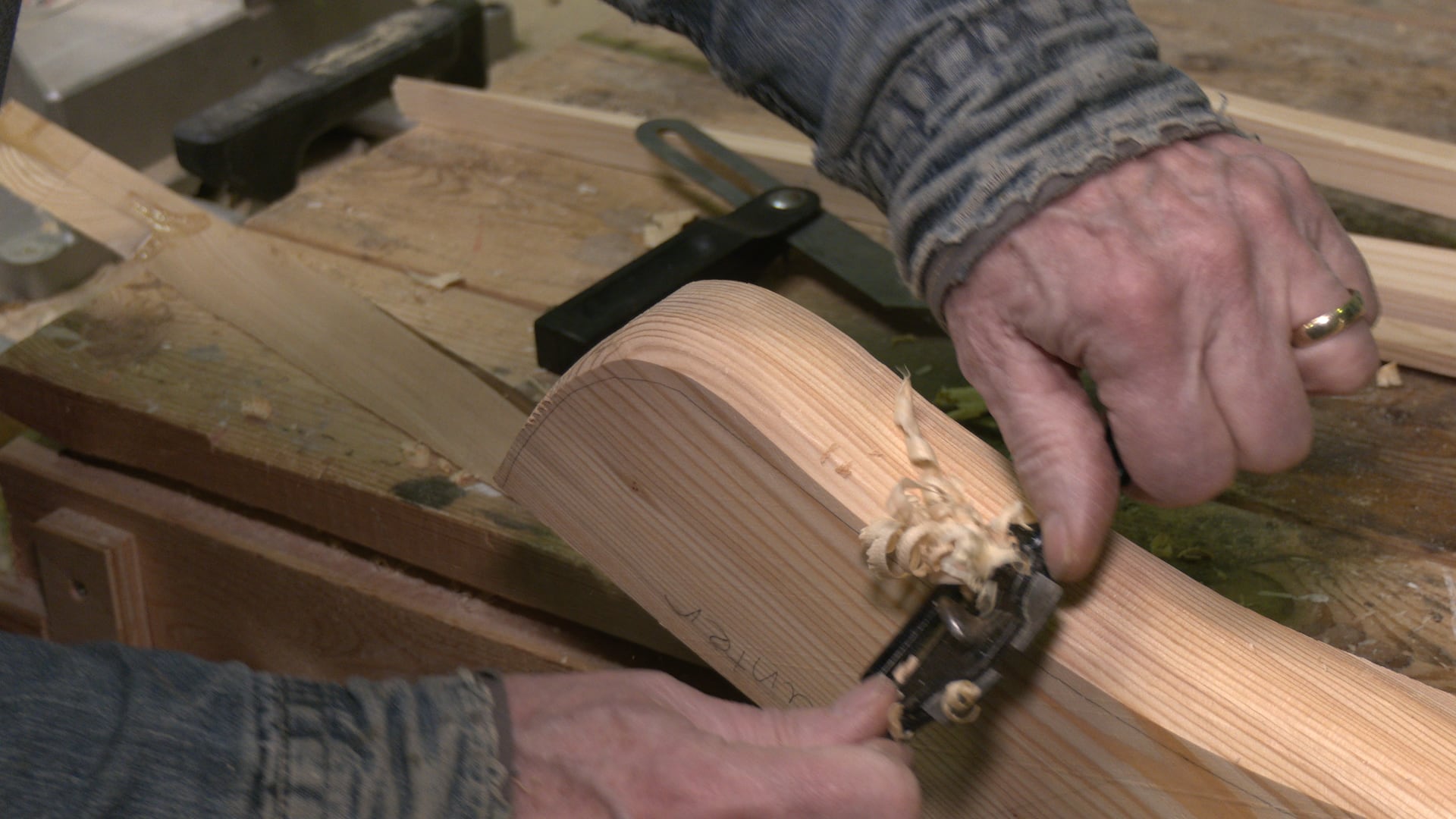
ST. JOHN’S, N.L. -- With every scrape, drill and nail, a 15-foot Rodney is coming to life inside the rigging room of the Marine Institute in St. John’s. There are only a few sessions left to finish the round-bottom rowboat, designed by instructor Jerome Canning — but inspired by the designs of John Reid, a boat builder from Winterton, N.L., who was one of the last keepers of the boat-building tradition. The 12 men studying in this class have just three more sessions to finish the construction of the boat, which has already been sold to recover some of the costs borne by class organizers. It’s one of just a handful that will be built this year. “It’s probably about five or six,” Canning said, “That’s the rowboats. But there’s always a couple of new motorboats being built.” Canning would know — over the past 20 years, he’s become Newfoundland and Labrador’s expert on wooden boat construction and tradition. “Most people who are building these small rowboats…have actually taken this course,” he said. “It’s a really good feeling.” Canning, and his bosses at the Wooden Boat Museum of Newfoundland and Labrador, started from practically zero. In 1997, when the museum founders first started to organize in Winterton, the wooden boat was practically extinct. After three decades of work, there has been, Canning says, a small resurgence. “We hope so,” he said. “I mean, it’s a resurgence for just keen people who want our row boats and want something of our own heritage and our own culture.” Marine Institute student Pacey Griffin is part of that resurgence. At 24, he’s the youngest student in the boat-building class, and trying to spread the word and build interest among his classmates. “It’s a dying trade for young people. There’s a lot of people my age that have never even set foot in a boat,” he said. “I try and preach it to people all the time: It’s our tradition, it’s what we grew up in as our trade. As Newfoundlanders, we grew up on boats.” The course is being held at the Marine Institute in St. John’s for the first time. Kristopher Drodge, the head of the School of Maritime Studies, said it’s a natural marriage for the school. “A lot of our students are involved with ship design and contribute to the national shipbuilding strategy in their careers,” he said. “And while we don’t build ships this way anymore, the basics are still there. The fundamentals are still there.” A Rodney is a round-bottomed boat, sometimes called a punt depending on the community. A dory — another Newfoundland staple — has a flat bottom. Different communities across the province would have slightly different design preferences, depending on what worked best for their bays. Canning himself learned from boat builders in Placentia, during a period of government-initiated resettlement that moved hundreds of people from their rural homes into slightly bigger centres. “A lot of people were there from the resettled islands of Placentia Bay,” explained David Taylor, another student in the 12-week class. “Guys had discovered that maybe a slightly higher bow in one area worked better.” But in almost every case, the arrival of fibreglass boats and outboard motors proved simply too alluring for most fishermen in the province. Taylor says little, if any, cod is being caught with wooden boats during the province’s recreational fishery over the summers. “Fibreglass came along, and people just chose that,” Canning said. “Any of the wooden boats that are out there are really boats that have been put in their sheds and kept.” But as the small resurgence grows, there is some optimism that these punts and dories might make it back out of the sheds, and into bays across the province. “We actually have a little group of punt builders who have been willing to share their experiences,” said Jim Dempsey, the chair of the Wooden Boat Museum of Newfoundland and Labrador. “It’s quite gratifying to see that we’ve been responsible for building half a dozen other boats at this time.”