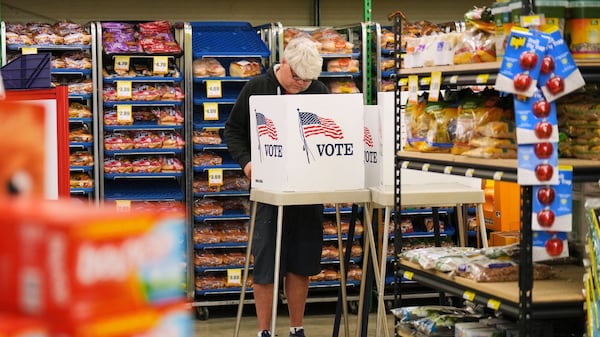
After sweeping wins by the Democrats south of the border Tuesday, Albertans spent Wednesday examining what the U.S. midterm elections mean here at home. Beyond the impact on national trade and tariff negotiations — experts largely now believe Ottawa’s position has been bolstered — the far-reaching implications could stretch into energy, technology and development policy. Re-energized Claims from United States President Donald Trump on Sunday that Canada would pay for all of a revived Keystone XL pipeline now seem even more unlikely. In fact, the entirety of the on-again-off-again line is now likely facing an uphill battle. Keystone XL would have seen crude oil sent from Western Canada to American refineries. But TC Energy cancelled the project in 2021, after then-U.S. president Joe Biden revoked its cross-border permit. Many more environmentally-friendly Democrats came into power during Tuesday’s blue wave. “We are looking at the move from an administration that was ‘drill baby drill’ to the rise of a new force on the Democratic side that is Green New Deal,” University of Calgary International Policy Professor Carlo Dade said. And that might not be the only major infrastructure project up in the air. Data centre rejection Dozens of data centre moratoriums were passed Tuesday night, and many candidates who have vocally opposed the facilities were victorious. The resounding call from across the political spectrum was that voters are not in favour of more development. Alberta Opponent Bek MacIntosh said it should be a signal to Canadian politicians who are looking to curry favour. “This really was an opportunity for people to speak up and use their voices as to what they do and don’t want from this process, and uniformly, they don’t want them being recklessly built at the speed and rate across the country,” she told CTV News Wednesday. That sentiment flies directly against a recent UCP government push to make Alberta a data centre hub. MacIntosh says she hopes that position is rethought. “I think it’s unfortunate that most political parties are unaware of the extreme human impact of data centre facilities,” she said. “What we’re seeing is this is going to be a massive push factor on any election at any scale — municipal, provincial or federal — in the near future.” Gerrymandered out American voters also rebelled against what they perceived as gerrymandering. The Democrats won recently redistricted ridings that originally appeared to be runaways for the Republicans. Mount Royal University Political Scientist Lori Williams believes it’s an interesting note. “The idea that the government chooses its voters instead of the voters choosing the government seemed to really hit a wall,” she said. “I think it’s an important lesson to look at, because there could very well be reaction in those Alberta areas where the electoral boundaries have been redrawn with an intention to give an advantage to the UCP.” Opposition NDP Leader Naheed Nenshi also drew comparisons to the recent redistricting at home. “Gerrymandering doesn’t always work,” he told reporters in Edmonton. “The Republicans tried really hard to increase their control of Congress, but they lost clearly gerrymandered seats in places like Florida, North Carolina, Alabama and Ohio. “That doesn’t mean we shouldn’t fight it here — it’s still anti-democratic — but the UCP might want to think harder on the fact that their legacy may be that they tried to cheat to rig the maps and lost anyway.” Smith called those accusations from Nenshi a “conspiracy theory.” The premier’s two cents Alberta Premier Danielle Smith says sweeping Democrat wins in the U.S. midterm elections prove her province was on the right path in the cross-border trade war. “It is a vindication of our approach when it comes to tariffs,” Smith told the house during question period Wednesday. “We always have objected to tariffs. We know it hurts us. It hurts the Americans.” Smith said she hopes the midterm results are an opportunity to improve the relationship between Canada and the U.S. She pointed to her government’s efforts to build relationships across the aisle, including with Adam Schiff, a Democrat senator from California. Smith’s government has stood apart from other provinces in the trade dispute. Alberta has for the most part resisted retaliatory tariffs or trade action while encouraging continued diplomacy. -with files from The Canadian Press