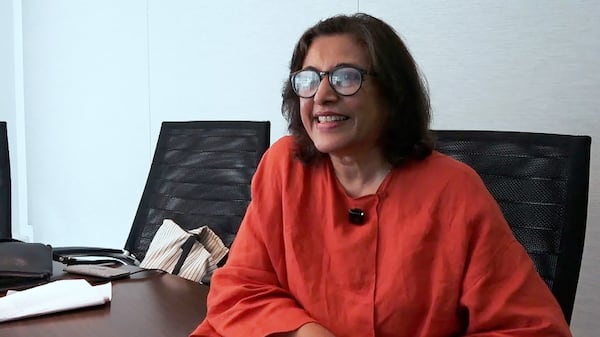
A clinical study about to get underway in Moncton will investigate the potential of breath analysis as a non-invasive tool for the early detection of breast cancer in women with dense breast tissue. Vitalité Health Network is partnering with Breathe BioMedical Inc. on the study, which is being led by Dr. Jocelyne Hébert. The health network says it is the first Canadian site to participate and women from across New Brunswick will be part of the program. Harder to detect Cancer can be harder to detect in women with dense breast tissue, an issue half of all women eligible for breast cancer screening face. “The current standard of care among mammogramy screening is less than 50 per cent accurate for these women,” Bill Dawes, president and CEO of Breathe BioMedical, told CTV News. “Mammograms for these 50 per cent of women with dense breast tissue, mammogram sees the underlying tissue as grey. It also sees the cancerous lesions as grey and so what clinicians say is trying to find cancer on a woman with dense breast tissue is like trying to pick a particular cloud out of a cloud filled sky.” Researchers are investigating whether breath analysis could help address this challenge by serving as a complementary tool to traditional screening methods. “By simply blowing into our device we capture your breath. We analyze it on our very sophisticated spectral device, which creates a data set from the breath and then we use machine learning to synthesize that data and identify patterns in the breath that are associated with the disease. In this case, breast cancer,” said Dawes. In a recent preliminary study conducted in Saint John, N.B., Breathe BioMedical says its technology distinguished women with early-stage breast cancer from those without the disease with an accuracy rate of 88.2 per cent. The results were consistent regardless of breast density. Hébert called the accuracy rate “amazing,” but the new study will be done a bit differently than the one in Saint John because the patients there had already been diagnosed with breast cancer and had already had biopsies. “Eighty-eight per cent accuracy is great. And also what is great about this what they found in the study in Saint John is that the breath test is not impacted by the breast density and breast density is very important because about 50 per cent of patients do have dense breasts,” said Hébert. Hébert said having dense breasts means having more breast tissue than fatty tissue. “And you have a higher risk of breast cancer and you have a higher risk that you can miss it. And your mammogram would be a false negative,” said Hébert. Technology has improved over the years, but Hébert said it’s been a challenge for a long time with mammograms to reduce the amount of false negatives to as low as possible. The study started this week at the Dr. Georges-L.-Dumont University Hospital Centre in Moncton and there will be around 800 subjects, many from New Brunswick. Hébert said when logistics are sorted out the plan is to invite other hospitals in New Brunswick and Canada to participate in the study. Early detection The health network says women with dense breast tissue are four to five times more likely to develop breast cancer, adding survival rates exceed 98 per cent when the disease is detected early. That number decreases to 30 per cent when it is discovered at an advanced stage. “This partnership illustrates our commitment to research and innovation to better serve our population,” said Hébert in a news release. “This technology offers a new perspective in breast cancer detection by strengthening our ability to detect the disease earlier and more accurately. We are proud to contribute to this scientific advancement here in New Brunswick.” American institutions such as the Mayo Clinic and Duke University are also participating in the study. Vitalité Health Network says its participation helps to diversify the study population, which in turn strengthens “the robustness of the machine‑learning algorithms.” For more New Brunswick news, visit our dedicated provincial page.